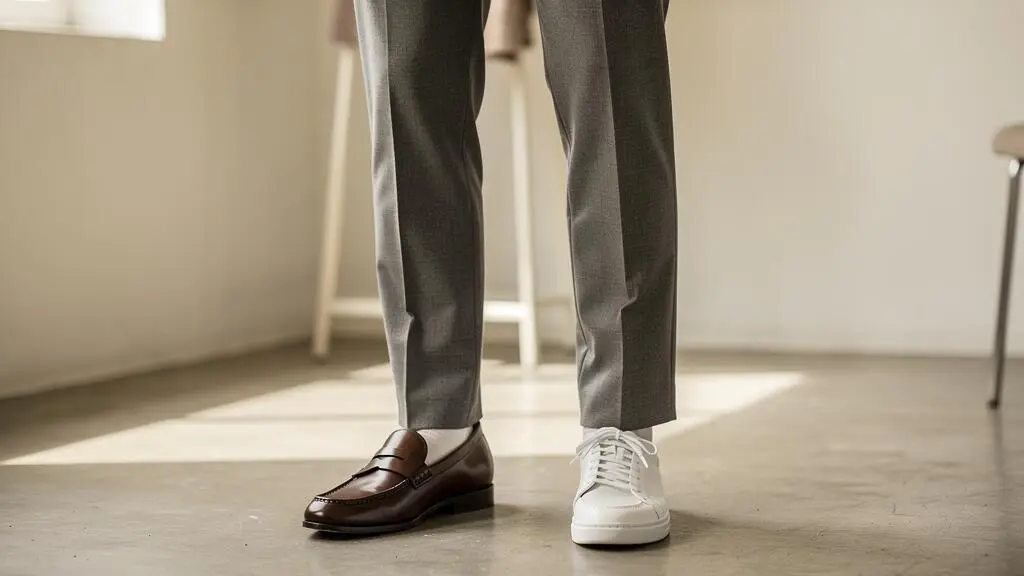
Smart casual trousers should look sufficiently structured for loafers yet relaxed enough for clean trainers. For most UK professionals, the most adaptable choice is a straight or gently tapered pair in a matte, mid-weight fabric, with a comfortable rise and a hem that meets the top of the shoe without excessive pooling. Dark navy, charcoal and mid-grey are useful starting colours because they work with a broad range of shirts, knitwear and jackets.
The challenge is that smart casual covers several different situations: a flexible office, a commute on a damp morning, lunch with colleagues and an evening at a pub. Each setting permits a slightly different balance of formality. Trousers that look excellent with polished leather loafers may feel too tailored with bulky running trainers, while relaxed drawstring trousers can make loafers look out of place.
The practical solution is to choose the trousers first, then assess them against both pairs of shoes. Fabric, fit, waistband construction, rise and hem length matter more than following a rigid dress-code formula. One versatile pair can cover many occasions, but a second pair may be necessary when the working week includes formal meetings, frequent travel or unpredictable weather.
The smart casual trouser formula
- Choose straight or gently tapered trousers in a structured, matte fabric that holds its shape without feeling stiff.
- Test the fit with minimalist trainers and loafers; the hem should sit cleanly over each shoe, with no excessive stacking.
- Match the fabric to your week: chinos for versatility, wool for a more tailored appearance, or technical trousers when mobility and easy care matter.
- Why Do Smart Casual Trousers Decide Whether You Look Polished or Too Relaxed ?
- How to Choose Trousers That Work With Trainers Without Looking Like You Forgot to Change ?
- Chinos, Wool, or Tech Trousers: Which Is Best for a 3-Day Office Week ?
- The Trouser Fit Mistake That Makes Smart Casual Look Untidy From Behind
- When Should You Replace Smart Casual Trousers Before They Start Looking Shiny ?
- How to Choose Rise and Hem Length So Wide-Leg Trousers Work With Trainers and Boots ?
- How to Spot Mobility Features in Clothes Without Doing a Full Changing-Room Workout ?
- How Do You Wear Wide-Leg Trousers Without Looking Shorter or Messier ?
Why Do Smart Casual Trousers Decide Whether You Look Polished or Too Relaxed ?
Smart casual trousers determine whether an outfit feels polished or overly relaxed because they establish the visual balance between formal and casual clothing. A crisp shirt and leather loafers cannot completely compensate for soft jersey joggers, while tailored trousers can make a simple knitted top and clean trainers look considered. The deciding factors are fabric, shape, waistband and drape, rather than the shoes alone.
Think of the trousers as the outfit’s formal anchor. A pressed crease, a clean waistband, a controlled hem and a matte fabric resembling lightweight suiting all introduce tailored cues. An elasticated waist, prominent drawstring, distressed finish or heavy jersey construction introduces casual cues. Neither category is automatically wrong, but combining too many casual features can push an outfit beyond what a flexible office or smart-casual dinner calls for.
The distinction is particularly useful in the UK, where workplace expectations vary considerably between industries, employers and teams. A pair of chinos may be suitable for an ordinary office day but less convincing for a client presentation. Wool-blend trousers can bridge that gap without requiring a complete change of outfit.
A useful self-check is to photograph the outfit from the waist down, then consider whether the trousers would still look appropriate beside an unstructured blazer. If they only make sense with a hoodie and bulky sports shoes, they may be too casual for a genuinely versatile wardrobe.
The aim is not to eliminate comfort. It is to choose comfort that does not compromise the intended appearance. Structured cotton, softly draping wool and carefully designed stretch fabrics can all work when their finish and cut match the setting.
Once the trousers provide the right foundation, the next step is to test their proportions against trainers and loafers rather than assuming that one versatile colour automatically guarantees a successful combination.
How to Choose Trousers That Work With Trainers Without Looking Like You Forgot to Change ?
The most reliable trousers for both trainers and loafers have a straight or gently tapered leg, a comfortable mid or higher rise, and a clean hem that does not bunch around the shoe. Choose a matte, mid-weight woven fabric in navy, charcoal, grey, olive or another restrained neutral. The crucial test is whether the trousers look intentional with smart trainers without losing their tailored appearance with loafers.
British GQ‘s advice on styling chinos with trainers supports the use of straight or gently tapered cuts and hems that meet the top of the trainer without accumulating excess fabric. Its styling recommendations also distinguish minimalist trainers from sportier footwear. These are editorial recommendations rather than universal dress-code rules, but they provide a practical starting point.
### Use a simple selection grid
| Feature | Best starting point | What to avoid |
|---|---|---|
| Silhouette | Straight or gently tapered | A cut that clings to the calf or overwhelms a slim shoe |
| Hem | A clean break or slight brush against the shoe | Heavy stacking or a hem that hides most of the footwear |
| Fabric | Mid-weight woven cotton, wool or a structured blend | Very soft jersey that resembles loungewear |
| Colour | Navy, charcoal, grey or muted earth tones | A colour that clashes with most of your existing tops and shoes |
| Finish | Matte, clean and relatively minimal | Heavy distressing, conspicuous cargo detailing or excessive shine |
**Smart trainers** are generally low-profile leather or suede styles with a clean sole and minimal branding. Running shoes with technical mesh, prominent cushioning and contrasting performance details create a more athletic impression. They can work in relaxed settings, but they place greater demands on the rest of the outfit.
The cohesion test is straightforward: the shoes and trousers should occupy compatible levels of formality. Tailored wool with highly technical running shoes can look disjointed, just as dress loafers with conspicuous cargo pockets can pull an outfit in conflicting directions. Neither pairing is universally forbidden; the question is whether the combination looks deliberate in the setting.
Socks influence the result too. No-show socks can create an uninterrupted ankle line with low-profile trainers or loafers, provided the trousers are short enough to reveal the intended amount of ankle when standing or walking. Visible ribbed socks add a deliberate styling detail and are often the more practical choice in cooler British weather. Match their colour to the trousers for a continuous line, or use a restrained contrast when the rest of the outfit supports it.
A useful shortcut is to assess the trousers with loafers first. If the cut, fabric and hem look balanced with a relatively refined shoe, the same trousers are often easier to adapt to minimalist trainers. The reverse is less reliable because very casual trousers may not provide enough structure for loafers.
After the fit and shoe pairing are established, fabric becomes the next decision: the best option depends on whether the working week prioritises easy maintenance, a tailored appearance or unrestricted movement.
Chinos, Wool, or Tech Trousers: Which Is Best for a 3-Day Office Week ?
For a three-day office week, chinos are a practical default when the dress code is relaxed, wool trousers suit more tailored workplaces and meetings, and technical trousers work best when commuting comfort and movement are priorities. No single fabric wins in every situation. The right choice depends on crease recovery, breathability, weather exposure, care requirements and how well the trousers retain their appearance throughout a full day.
| Factor | Chinos | Wool trousers | Technical trousers |
|---|---|---|---|
| Overall appearance | Casual to smart casual | Usually the most tailored | Ranges from understated to sporty |
| Trainer pairing | Very adaptable with a clean cut | Works best with minimalist trainers | Often easy, depending on the finish |
| Loafer pairing | Works with a clean, structured finish | Naturally suited to a tailored outfit | Works when technical details are discreet |
| Crease management | Can crease and fade with regular wear | Recovery depends on construction and care | Varies with fibre, weave and finish |
| Wet-weather practicality | Ordinary cotton may take time to dry | Depends on weight, weave and exposure | Some designs prioritise quick drying or weather resistance |
| Maintenance | Often straightforward, subject to the label | May need careful pressing and specialist care | Varies by material and construction |
Chinos are the versatile, accessible option. Mid-weight cotton gives them enough structure for a shirt or lightweight knit while remaining relaxed with trainers. Navy, charcoal and olive are especially useful when a small wardrobe needs to cover multiple settings. The trade-off is that frequent sitting, washing and friction can contribute to creasing, fading and loss of shape.
Wool trousers provide a more tailored appearance and can be particularly effective with loafers, an Oxford shirt or a fine-gauge jumper. Their performance depends on the weave and construction rather than the fibre name alone. Lightweight wool may suit indoor office conditions, while heavier cloth can feel less comfortable on a warm commute. Wool also needs appropriate care: Woolmark‘s wool garment care recommendations include resting wool garments for 24 hours between wears, brushing woven wool and using suitable steam pressing. Always follow the garment’s care label.
Technical trousers offer a useful middle ground when their appearance remains understated. Stretch fabrics and functional construction can make a long desk day, train journey and walk between meetings more comfortable. However, prominent drawstrings, shiny finishes and overtly athletic cuts can look too sporty in traditional offices. Check the actual fabric and finish rather than assuming that all technical trousers are interchangeable.
The hidden cost is rotation. Wearing the same pair on three consecutive office days places repeated demands on the fabric and leaves little time for airing or recovery. Two pairs that alternate can be more practical than one expensive pair worn constantly.
A useful strategy is to choose one anchor fabric for ordinary days and a second pair for the most demanding occasion. A relaxed office may favour two pairs of chinos or a chino and a technical pair; a client-facing workplace may be better served by wool trousers alongside dark, structured chinos. This is a wardrobe-planning recommendation, not a universal requirement.
Whichever fabric you choose, its appearance depends on fit as well as fibre. A premium cloth can still look untidy if excess material gathers under the seat or the rise fails to sit comfortably.
The Trouser Fit Mistake That Makes Smart Casual Look Untidy From Behind
The most easily overlooked fit mistake is excess fabric or tension around the seat and upper thighs. Trousers that sag below the seat, pull horizontally across the rear or gather heavily behind the knees can undermine an otherwise polished outfit. Checking the back view matters because a front-facing mirror may hide these problems. The goal is a smooth, comfortable fit that follows the body without restricting movement or eliminating the intended drape.
Proper Cloth‘s trouser hip-width fitting reference explains that horizontal pulling can indicate insufficient room around the hips, while excess vertical folds may indicate too much fabric. These signs are useful diagnostics rather than definitive proof of a single sizing problem: rise, posture, fabric and intended silhouette can all influence the result.
Three visual signs deserve attention:
– **Horizontal pull lines across the seat:** these may indicate that the hips or seat do not have enough room. Pockets that flare outward can be another warning sign. Try a different hip measurement or cut rather than assuming that a larger waist will solve the problem.
– **Vertical folds hanging under the seat:** these can indicate excess fabric or an unsuitable rise. Compare another size or cut and assess whether the folds remain when standing naturally.
– **Fabric stacking at the back of the knee or hem:** this can indicate excessive length, although deliberate wide-leg designs may have a different break. Check the trousers with the shoes you intend to wear.
The rise deserves a separate check because it affects both comfort and the way the seat hangs. A rise that is too low may cause the trousers to ride down or pull uncomfortably when sitting. A rise that is too long can leave excess material around the seat. Waist and hip dimensions interact, so changing one measurement without considering the other may simply move the problem.
To check the fit, stand naturally and photograph the rear view with your phone, then sit briefly and stand again. Look for persistent pulling, a drooping seat, uncomfortable pressure or folds that do not match the intended cut. Repeat the check in the actual shoes, because hem stacking can make an otherwise acceptable fit appear untidy.
Once the fit is right, assess the surface condition of the cloth as well. Trousers that fit perfectly can still look tired if abrasion has made the seat or thighs conspicuously shiny.
When Should You Replace Smart Casual Trousers Before They Start Looking Shiny ?
Replace smart casual trousers when wear becomes conspicuous and cannot be improved through appropriate cleaning, pressing or rotation. There is no reliable universal replacement timeline because fabric composition, colour, construction, friction and care habits differ. A practical inspection focuses on persistent shine at the seat and thighs, fading at the hem, knee bagging and loss of shape. These signs are more useful than counting how many months or office days the trousers have been worn.
Shine can develop when repeated friction and abrasion flatten surface fibres, changing how they reflect light. The seat, upper thighs and creased areas are common places to inspect because they experience repeated contact and pressure. Dark cloth may make a change in surface reflection particularly noticeable, but the precise rate of wear cannot be predicted from colour or fibre composition alone.
### Inspect before replacing
Check the trousers under angled light near a window or lamp. Turn slightly so the light travels across the seat and thighs, and compare these areas with less-worn fabric near the side seam or lower leg. This helps distinguish a change in surface texture from an ordinary crease or a difference in lighting.
Use the following decision framework:
– **Continue wearing:** the fabric remains matte enough for the setting, the colour is reasonably even and the knees recover their shape after rest.
– **Try maintenance first:** creases or surface dirt are the main problem, and the care label permits suitable brushing, washing or pressing.
– **Consider replacement:** the sheen remains prominent after appropriate care, the hem is visibly worn, the colour has faded unevenly or the trousers no longer hold their intended shape.
Rotation reduces the frequency with which one pair experiences friction and gives garments time to air between wears. For wool, allowing the garment to rest between wears and using appropriate brushing or steam can help maintain its appearance. Cotton chinos and technical trousers need care appropriate to their own fibre composition and labels; wool-specific instructions should not automatically be applied to them.
Pressing can improve ordinary creases, but it will not necessarily reverse fibre damage or restore a permanently bagged knee. Excessive heat or unsuitable ironing can also damage some fabrics, so use the manufacturer’s instructions rather than a universal temperature.
The cost decision is about more than durability. If trousers have become noticeably shiny in a client-facing setting, replacing them may be more sensible than continuing to pair them with increasingly formal shoes in the hope of disguising the wear.
After assessing condition, return to proportion: even clean, well-maintained trousers can look wrong with both trainers and loafers when the rise and hem are poorly matched to a wider leg.
How to Choose Rise and Hem Length So Wide-Leg Trousers Work With Trainers and Boots ?
Wide-leg trousers work with trainers and boots when the rise balances the leg volume and the hem is proportioned to the shoe. With loafers or low-profile trainers, a hem that just meets or lightly brushes the top of the shoe usually creates a cleaner line. Boots can accommodate a different break, including deliberate stacking when the cut and fabric support it. The aim is controlled volume rather than eliminating it.
Rise and leg opening need to be considered together. A higher rise can create a more continuous visual line from the waist through a wider leg, especially when the waistband is visible or the top is tucked in. A low rise combined with a very wide opening can make the upper body and lower body appear disconnected, particularly when the trousers sit low and the fabric gathers around the hips.
Footwear changes the balance too. A wide hem can overwhelm a slim, low-profile trainer, creating the impression that the shoe has disappeared beneath the trousers. A slightly more substantial sole can provide a better visual counterweight, provided the overall outfit still looks intentional. Boots often provide more visual weight, but extra fabric should not accumulate so heavily that the shoe becomes difficult to see.
The best test is a full-length mirror viewed from the front and side. Check where the waistband sits, whether the leg falls smoothly, and whether the hem reaches the shoe without dragging. Walk several steps and sit down to see whether the trousers shift noticeably or catch around the footwear.
### Buy the right length or alter the hem?
Hemming is useful when the waist, seat, thigh and leg opening already fit correctly. It adjusts length without changing the silhouette that makes wide-leg trousers work. Buying the right length is preferable when the original cut already provides the desired break.
Avoid tapering wide-leg trousers simply to make them easier to wear with trainers. Narrowing the leg changes the intended shape and may remove the balance between the rise, fabric volume and footwear. If the hem is too long, adjust the length rather than redesigning the leg.
Good proportions establish the silhouette, but they should not come at the expense of comfort. For a full office day, the next check is whether the fabric and construction allow natural movement while preserving a tailored appearance.
How to Spot Mobility Features in Clothes Without Doing a Full Changing-Room Workout ?
The quickest way to assess trouser mobility is to check the fabric’s recovery, waistband comfort and room around the seat and thighs, then sit down briefly to see whether the rise remains comfortable. Construction features such as a crotch gusset, articulated knees or discreet stretch panels can help, but none guarantees a good fit. The best office trousers move naturally without looking like sportswear.
Stretch and construction solve different problems. Two-way stretch generally allows the fabric to extend along one axis, while four-way stretch allows movement in two directions. The actual comfort depends on the fabric, fit, recovery and how much stretch the garment needs for its intended use. More stretch is not automatically better: a soft jersey finish or an overly elasticated waist can make trousers appear closer to loungewear than workwear.
Construction offers further clues. REI‘s technical advice on trouser construction and mobility explains that crotch gussets can redistribute stress across seams, while knee darts allow additional room for bending. Although this guidance concerns outdoor trousers, the construction principles are relevant when assessing movement in everyday clothing. These features should be treated as useful design clues, not proof that a pair will be suitable for every office.
For a desk-based working day, pay particular attention to the seat and waistband. The trousers should remain comfortable while seated, without digging into the abdomen, pulling across the hips or slipping down when standing. During a commute, the knees and crotch should allow ordinary walking and climbing stairs without excessive fabric tension.
### A five-step mobility checklist
Five checks before committing to a pair
- Check stretch recovery. Gently pinch and release the seat or thigh fabric; record whether it returns to its original shape or remains visibly distorted.
- Inspect the construction. Look for a gusset, articulated knee shaping or discreet waistband stretch panels, and note which features are actually present.
- Test the seated rise. Sit briefly on a fitting-room bench; confirm that the waistband and crotch remain comfortable without persistent pulling.
- Walk and bend. Walk naturally and bend your knees; note any restriction, excessive fabric tension or noticeable waistband movement.
- Repeat the checks at home before removing the tags. Sit, squat and climb stairs in the trousers; record any waistband rolling, seat pulling or hem ride-up and check the return conditions before deciding to keep them.
For online purchases, check the return policy before wearing the trousers outside. If the fit fails the movement tests, keeping them because they look good when standing is unlikely to make them a better everyday choice. Follow any seller-specific conditions for trying on and returning clothing.
Once movement and fit are settled, the final styling challenge is wide-leg volume. The solution is not necessarily a narrower cut, but a deliberate balance between waistband, top length, fabric drape and footwear.
Key takeaways
- Choose a rise that anchors the waistband comfortably and allows the wide leg to fall without dragging or excessive folds.
- Match the hem to the shoe’s visual weight, and adjust length before considering any change to the leg shape.
- Use fabric drape, a defined waist and comfortable movement to make a wider silhouette look deliberate rather than accidental.
How Do You Wear Wide-Leg Trousers Without Looking Shorter or Messier ?
Wide-leg trousers look intentional when the waist is clearly defined, the fabric falls cleanly and the hem meets the shoe without uncontrolled pooling. A tucked-in shirt, visible waistband or simple belt can establish the upper edge of the silhouette. Pair the volume of the trousers with a relatively controlled top, or deliberately balance a fuller top with a more structured fabric and carefully chosen footwear. Width itself is not the problem; poor proportion is.
Start with the rise and hem. A comfortable, well-positioned waistband gives the trousers a clear starting point, while a suitable hem allows the leg to flow towards the shoe. With loafers and low-profile trainers, a hem that just grazes the top of the footwear often keeps the line clean. If fabric stacks heavily over the shoe, the silhouette can look messy regardless of the trousers’ quality.
The upper body provides the second point of balance. A front tuck, a shorter knit or a belt can make the waistband visible without requiring a fitted top. If the trousers already provide considerable volume, a relatively simple top often prevents the outfit from appearing overloaded. Conversely, a fuller top can work when the fabric, proportions and footwear are deliberately coordinated.
Body proportions are best handled through visual adjustment rather than rigid rules. If you want a longer-looking leg line, try a higher rise, a hem that does not conceal the shoe, and a top length that does not visually divide the torso and legs at an awkward point. A continuous colour relationship between trousers, socks and shoes may also help the outfit read as one line. These are styling options, not requirements based on height or body type.
Fabric determines whether the width looks purposeful. Softly draping wool or a fluid woven fabric can follow the movement of the leg, creating a relaxed but controlled shape. Stiffer fabrics hold more volume away from the body; depending on their cut and finish, this can look architectural or unnecessarily bulky. Choose the effect that fits the outfit rather than assuming that all wide-leg trousers need the same material.
For a smart-casual wardrobe, wide-leg chinos or tailored trousers can work with both trainers and loafers when the hem and fabric suit each shoe. Chunkier trainers can balance a wider opening, while refined loafers can make a fluid, well-cut pair feel more dressed up. The final decision should be based on the whole outfit in motion, not only the way it looks in a static mirror.
Before buying another pair, photograph the complete outfit in both shoe options and assess the waist, drape, hem and overall formality. That simple comparison helps establish whether the trousers genuinely cover your working week or whether a second, more tailored option would fill a practical gap.
Can you wear the same trousers with trainers and loafers?
Yes. Straight or gently tapered trousers in a matte, structured fabric are a reliable starting point. Check the hem with both shoes, and choose trainers with a clean, relatively low-profile finish. The combination should suit the occasion as well as the footwear.
Are chinos or wool trousers better for smart casual?
Chinos are usually a practical choice for relaxed offices and everyday versatility. Wool trousers generally create a more tailored appearance, particularly with loafers or a blazer. The best option depends on the workplace, fabric weight, maintenance requirements and how often the trousers will be worn.
Should smart casual trousers sit above or on the shoe?
For most straight or gently tapered styles, a clean break or slight brush against the shoe works well. Cropped trousers can also be intentional with low-profile footwear. Wide-leg trousers need particular attention to avoid excessive pooling, while boots can accommodate a different hem break depending on the cut.
Can technical stretch trousers look professional?
Yes, provided the finish is understated and the cut resembles conventional trousers. Matte fabric, a clean waistband and discreet functional details help maintain a smart-casual appearance. Prominent drawstrings, shiny finishes and strongly athletic styling may be less suitable for traditional offices.
How many pairs of smart casual trousers do you need for a three-day office week?
Two alternating pairs are a practical starting point because they allow time for airing and reduce repeated wear on a single garment. A third pair may be useful if the week includes more formal meetings, travel or significant changes in weather. The right number depends on the dress code, laundry routine and how frequently you wear each pair outside work.