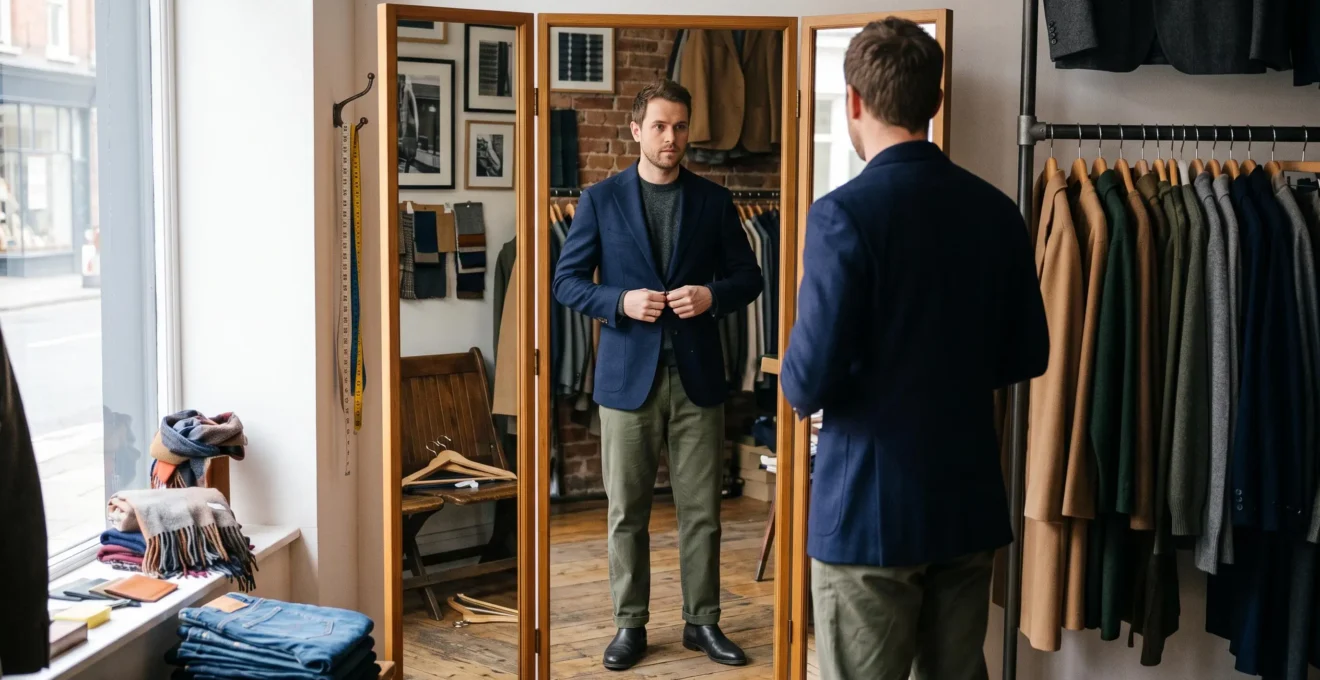
A tailored blazer can make an ordinary outfit look considered, but the same jacket can also suggest a corporate dress code that no longer matches how you live or work. The difference is rarely as simple as wearing trainers instead of formal shoes. It comes from how the shoulders sit, where the jacket closes, how its length relates to your trousers and whether the surrounding clothes create a natural contrast.
For a modern UK wardrobe, a blazer should work beyond a meeting room: over fine knitwear on the commute, with denim at the weekend or alongside smart trousers when an occasion calls for polish. That versatility starts with choosing the right silhouette, not buying the most expensive cloth.
The practical approach is to check fit first, adjust proportions second and dress the blazer according to the occasion. A structured jacket can still feel relaxed. Equally, an oversized one can look deliberate rather than shapeless, provided the whole outfit has balance.
How to make a tailored blazer look modern
- Prioritise shoulder fit, collar contact and a clean closure before changing accessories or footwear.
- Break up the suit effect with knitwear, denim or a deliberate contrast between jacket and trouser proportions.
- Alter manageable fit problems, but avoid expensive structural work on a jacket whose shoulders or overall balance are wrong.
- Why Do Some Tailored Blazers Look Instantly Dated Even If the Fabric Is Great?
- How to Check Blazer Fit in 7 Points Without Needing a Tailor on the Spot?
- Single-Breasted or Double-Breasted: Which Is More Flattering for Daily Commuting?
- The Blazer Styling Mistake That Makes Your Outfit Look Boxy in Mirrors
- When Should You Alter a Blazer Instead of Replacing It If the Shoulders Are Close?
- How to Check Stitch Density, Lining, and Seam Allowances in 90 Seconds at the Rail?
- How to Choose One Suit That Works for Interviews and Weddings Without Looking the Same?
- When Does Traditional Suiting Still Make Sense in Modern UK Life?
Why Do Some Tailored Blazers Look Instantly Dated Even If the Fabric Is Great?
A tailored blazer can look dated despite excellent fabric because its silhouette reflects an earlier fashion period. Exaggerated shoulders, an unusually low fastening point or a jacket length that clashes with contemporary trousers can create this effect. Fabric quality determines much of how a garment feels and wears, but proportions determine its immediate visual character.
Three features deserve attention before considering colour or cloth:
- Shoulder width: pronounced padded shoulders can evoke the power-dressing silhouettes associated with the 1980s, while a softer shoulder generally feels less institutional. Neither is automatically wrong; the question is whether the shape looks intentional on the wearer.
- Button stance: a low fastening point creates a longer opening through the chest and a different waist position. A higher stance can shorten that opening and change the visual balance, although excessively high buttons can look awkward or restrict comfort.
- Jacket length: very long jackets can recall older, more formal silhouettes, while excessively short jackets may resemble trend-specific tailoring rather than a versatile modern blazer.
Lapel width provides another clue. Extremely narrow lapels can suggest a particular slim-tailoring era, while unusually broad lapels may give a jacket a consciously retro appearance. A moderate lapel often offers more styling flexibility, but it must still relate to the wearer’s chest, shoulders and preferred silhouette.
To identify the problem, photograph two jackets on the same body, with the same trousers and footwear. Compare the images at the same distance and angle. First isolate the shoulder line, then the closure point, lapel width and sleeve length. If one jacket looks like a costume, identify the feature responsible rather than assuming its entire design is unsuitable.
Dated is not the same as formal. A blazer with balanced proportions can look too corporate simply because it is paired with a crisp business shirt, matching trousers and polished black shoes. In that case, styling is the problem. If the jacket’s proportions themselves feel wrong, changing the shirt will have limited effect.
Once you separate old-fashioned proportions from office-coded styling, the next question becomes more practical: does the jacket actually fit?
How to Check Blazer Fit in 7 Points Without Needing a Tailor on the Spot?
You can assess blazer fit using seven observable checks: shoulder alignment, neck contact, button tension, sleeve length, jacket length, back vents and overall collar behaviour. Test the jacket both standing and moving. A label size is only a starting point; visible pulling, persistent gaps and restricted movement reveal whether the cut suits your body.
Use a full-length mirror and, ideally, a phone photograph from the front and back. The following seven-point sequence is a practical shopping checklist informed by traditional tailoring principles, not a formally validated fitting standard.
- Shoulder seam: check whether the jacket’s shoulder line ends near your natural shoulder, allowing for the intended cut. Pass: a clean line without an unintended overhang or tight ridge. Fail: obvious protrusion or tension. Major changes are difficult.
- Collar gap: stand naturally and look at the back of the neck. Pass: the collar rests close to the shirt or neck. Fail: a persistent gap. Correction depends on the underlying construction.
- Button closure: fasten the jacket while standing. Pass: the front closes comfortably with controlled drape. Fail: strong horizontal pulling or wrinkles radiating from the button. Moderate waist adjustments may help.
- Sleeve length: let your arms hang naturally. With a shirt, a conventional reference is roughly 0.6–1.3 cm of visible cuff, although preferences vary. Pass: balanced sleeves on both arms. Fail: sleeves cover too much hand or expose more cuff than intended. Often adjustable, subject to cuff construction.
- Jacket length: compare the hem with your seat, hands and overall body proportions. Traditional tailoring often covers the seat, while modern cuts may be shorter. Pass: intentional balance. Fail: a length that disrupts the outfit. The thumb is a reference, not a universal rule.
- Back vents: check the jacket from behind while standing. Pass: vents lie closed without strain. Fail: they spread noticeably. The cause may be insufficient room around the hips or seat.
- Collar sit in movement: walk, turn and move your arms naturally. Pass: the collar remains reasonably settled and the jacket moves comfortably. Fail: repeated lifting, neck pressure or substantial displacement. These may signal a more complex balance problem.
The Permanent Style‘s jacket-fitting demonstration provides a useful specialist reference for judging shoulders, collar contact, button tension, sleeves and vents together. Its traditional conventions are valuable starting points rather than mandatory rules for every contemporary silhouette.
Distinguish between an adjustment and a structural mismatch. Sleeve length and moderate waist shaping are commonly manageable. Shoulder width, armhole position and persistent collar-balance problems deserve much greater caution. A jacket that requires several structural corrections is rarely a sensible speculative purchase.
Finally, do not confuse perfect adherence to traditional tailoring conventions with modern style. A softer shoulder and a comfortable amount of ease can make a blazer more wearable. A slightly higher button stance may suit some outfits, but it is not a universal modernising fix.
Your five-action blazer fitting checklist
- Photograph the blazer from the front with its main button fastened; save an image showing the shoulder line and button tension.
- Take a rear photograph with your arms relaxed; record whether the collar gaps or the vents spread.
- Check both wrists against your shirt cuffs; note which sleeve, if either, needs adjustment.
- Walk, sit and raise your arms comfortably; write down any persistent pulling or restricted movement.
- Classify each issue as acceptable, potentially alterable or a reason to reject the jacket; keep a short decision note before purchasing.
With the essential fit established, the next decision concerns structure: should your everyday blazer fasten in a single column or overlap across the chest?
Single-Breasted or Double-Breasted: Which Is More Flattering for Daily Commuting?
A single-breasted blazer is generally the more flexible commuting choice because it sits naturally open, is easy to layer and requires little adjustment when sitting. A double-breasted blazer offers a stronger visual statement and can make casual clothing feel more intentional, but its overlapping fronts and preferred fastening position require closer attention to movement and proportions.
Neither design is inherently more flattering for every body type. The better choice depends on the jacket’s cut, your torso proportions, how much structure you enjoy and whether you normally wear your jacket fastened.
The comparison becomes clearer when considering both silhouette and daily use.
| Consideration | Single-breasted | Double-breasted |
|---|---|---|
| Slim frame | Can create a long, open visual line. | Overlap and lapel shape can add perceived torso volume. |
| Broad frame | Offers a relatively straightforward front. | Can emphasise the chest or balance it, depending on button placement and lapel width. |
| Worn open | Usually drapes naturally and remains visually simple. | Overlapping fronts may spread or swing outward. |
| Sitting on public transport | Easy to unfasten and reposition. | Usually more comfortable unfastened; the fronts may need arranging. |
| Over knitwear | Works with fine knits and more relaxed layers if there is sufficient ease. | Works well with thin knitwear, but thick layers require enough room across the chest. |
| Casual styling | Understated and versatile, but may read corporate in conventional navy. | More distinctive, especially alongside denim or casual trousers. |
For a slim wearer wanting a stronger chest line, a moderately structured double-breasted design may be appealing. For someone who prefers minimal visual bulk, a single-breasted cut with a clean front may be easier to manage. These are styling tendencies, not fixed rules about body shape.
Commuting introduces practical requirements that a fitting-room mirror cannot capture. On trains and buses, you may repeatedly sit, stand and carry a bag. An open single-breasted jacket tends to accommodate those movements easily. A double-breasted jacket may look particularly balanced when fastened, but leaving it open can create a wider, less controlled front.
On a bicycle, freedom of movement, visibility and appropriate weather protection matter more than the formal distinction. Neither tailored style should be assumed suitable for all cycling conditions. Check that the hem, sleeves and fastenings do not interfere with movement or equipment.
There is also a useful style paradox. A navy single-breasted blazer with grey trousers and an Oxford shirt can resemble an office uniform. A double-breasted jacket over denim and a fine roll-neck may appear more deliberately casual precisely because the surrounding pieces break with conventional suiting.
The practical winner is the jacket that looks balanced both open and closed in the conditions where you actually wear it. That leads to a broader issue: how the rest of the outfit affects its shape.
The Blazer Styling Mistake That Makes Your Outfit Look Boxy in Mirrors
The most common cause of an unintentionally boxy blazer outfit is repeating similar volume everywhere. A wide jacket, straight-cut trousers and visually flat footwear can create one continuous rectangular outline. The solution is not necessarily a slimmer blazer: introduce contrast at the shoulder, waist, trouser leg or ankle so the outfit develops a recognisable shape.
Consider a relaxed blazer with a straight hem worn over an untucked shirt and wide trousers. Each garment may fit well individually, yet the combined silhouette can conceal the waist and create a heavy vertical block.
Instead of changing everything, adjust one relationship:
- Shoulder to trouser: retain a broad blazer but choose trousers with a more defined taper.
- Jacket to waist: combine a relaxed jacket with trousers whose waistband remains visually identifiable.
- Hem to footwear: refine trouser length or shoe profile so fabric does not accumulate unnecessarily around the ankle.
These contrasts need not be dramatic. A moderate taper can be sufficient to make a relaxed jacket appear intentionally oversized rather than badly fitted. Conversely, wide trousers can work with a generous blazer when the waist position is clear and the fabric hangs cleanly.
The trouser rise is particularly important. A higher waistband can create a continuous, deliberate line beneath a shorter blazer. A lower rise combined with a long jacket may shift the perceived waist downward, making the torso look elongated and the legs comparatively shorter.
Look at where the blazer’s main button sits relative to the trouser waistband. If the jacket closes noticeably below the visual waist, the outfit may feel heavy through the middle. If the button sits in a balanced position and the trousers begin at a complementary height, the silhouette is often more coherent.
A static front-facing mirror does not always reveal these relationships. It presents one angle, often at a relatively close distance. A full-length photograph can show overall proportions more clearly, while a short walking video reveals whether the front panels swing, the trousers bunch or the jacket rides up.
Use a simple three-angle test: front view while standing, side view with natural posture and a short walking sequence. This is a practical visual comparison rather than a scientifically standardised assessment. Keep camera height and distance consistent so perspective changes do not mislead you.
Once the problem is isolated, a small styling change may be enough. If the jacket itself still pulls or hangs incorrectly, alterations become the more relevant consideration.
When Should You Alter a Blazer Instead of Replacing It If the Shoulders Are Close?
Alter a blazer when the shoulders already sit close to their intended position and the remaining problems involve manageable sleeve or waist adjustments. Consider replacing it when the shoulder structure, armholes or overall balance require substantial reconstruction. A minor visual difference may be acceptable; a pronounced shoulder mismatch can make even otherwise successful alterations ineffective.
Shoulder fit is the principal buying decision. A shoulder seam that extends slightly beyond the natural shoulder may be appropriate for a relaxed design. There is no universally valid numerical tolerance: padding, construction and intended silhouette all affect what looks correct.
If the shoulder visibly collapses, protrudes unintentionally or restricts movement, take that seriously. Narrowing or reshaping it can involve reconstructing the sleeve head and associated internal structure. Such work is more complex than shortening an ordinary sleeve cuff.
Before committing to alterations, distinguish common adjustments from more demanding work.
| Alteration | Typical feasibility | What to check |
|---|---|---|
| Shortening sleeves at the cuff | Often routine | Working buttonholes, cuff details and available fabric |
| Moderate waist shaping | Often feasible | Existing seams, pockets, vent position and overall balance |
| Letting out the waist | Depends on construction | Internal seam allowances |
| Shortening jacket length | Potentially complex | Pocket position, front quarters, vents and hem proportions |
| Changing shoulder width | Structural and potentially costly | Sleeve setting, padding, armholes and overall construction |
The distinction matters financially. Ask a tailor to quote each alteration separately, including any reconstruction required. Then compare the combined bill with the cost of a blazer that fits more closely from the outset. There is no reliable universal price threshold because labour, construction and location differ.
The specialist guidance in Permanent Style’s five tips on suit alterations highlights practical constraints including working sleeve buttonholes, seam allowances and the difficulty of making substantial changes without disturbing the intended cut.
A secondary risk is altered balance. Aggressively narrowing the waist beneath shoulders that are already too wide may exaggerate the upper-body shape. Similarly, adjusting the sleeves without addressing their angle can leave the jacket uncomfortable even if the cuff ends at the correct point.
As a hypothetical buying decision, imagine a blazer with clean shoulders, sleeves that are slightly long and a waist that needs modest shaping. Obtaining an alteration quote is sensible. Now imagine a second jacket with noticeably oversized shoulders, restricted arm movement and a low button stance you dislike. Its extensive correction requirements make replacement the more prudent option.
Alterations can improve an already suitable jacket. They cannot reliably transform every unsuitable cut into a different design, which makes construction quality worth checking before purchase.
How to Check Stitch Density, Lining, and Seam Allowances in 90 Seconds at the Rail?
A quick blazer construction inspection should cover the outer fabric, lapel structure, buttonhole finishing, lining and internal seam allowances. In around 90 seconds, you can identify obvious quality concerns and potential alteration restrictions. However, touch and visual inspection cannot establish every construction method or predict durability with certainty, especially in partially canvassed jackets.
The most useful approach is a timed sequence, prioritising observable details over assumptions based on brand or price.
- First 15 seconds — fabric: handle the jacket gently to assess weight, texture and how the cloth recovers after light movement. Look for visible weave irregularities, damage or unusual distortion. A heavier fabric is not automatically better quality.
- Next 20 seconds — lapel and front: examine the lapel roll and gently pinch the jacket front near the waist button to feel whether a distinct internal layer can be separated from the outer cloth. Treat the result as a clue rather than proof of full canvassing.
- Next 15 seconds — stitching: inspect buttonholes, visible seams and loose threads. Look for consistent stitching and tidy finishing rather than assuming that the greatest possible stitch density means the highest quality.
- Next 20 seconds — lining: inspect accessible areas around the sleeve opening, vents and internal seams. Check that the lining is not excessively taut, twisted, torn or pulling against the outer fabric.
- Final 20 seconds — allowances: check visible internal seams, where accessible, for spare fabric and signs of construction that might permit future adjustments. Never force open a seam or damage a garment on the rail.
These timings form a practical shopping routine, not a verified inspection protocol. Some features will remain inaccessible without opening the garment or asking the retailer about its construction.
The distinction between floating canvas and fused interlining is particularly relevant. Floating canvas is sewn into the garment and can allow the front to move differently from a fused construction, where layers are bonded. Half-canvassed jackets combine construction approaches in different regions of the front.
Permanent Style’s suit construction and buying advice describes the lapel and front-panel pinch technique as a way of investigating internal construction. It should not be treated as a definitive diagnostic test for every modern jacket.
Look also for visible bubbling or puckering across the jacket front. This may warrant closer inspection, particularly if it appears unrelated to ordinary fabric texture. Its presence alone does not conclusively identify the construction, and the absence of bubbling does not prove a jacket is canvassed.
Seam allowances connect construction directly to long-term usefulness. Spare fabric may make it possible to let out a seam later, although the relevant tailoring work also depends on lining, seam placement and the garment’s existing shape.
A beautifully finished jacket with minimal spare fabric may still be an excellent purchase if it fits now. Conversely, generous allowances offer little practical benefit if its shoulders and basic proportions are fundamentally unsuitable.
Quality is most valuable when it supports repeated wear. For occasions that genuinely require coordinated tailoring, the same principle helps identify a suit that can serve more than one role.
How to Choose One Suit That Works for Interviews and Weddings Without Looking the Same?
Choose a versatile suit with balanced proportions, a restrained colour, mid-weight cloth and a conventional lapel. Then change the surrounding garments according to the occasion. A shirt, tie and formal shoes can make it suitable for an interview, while a different shirt, considered accessories and more expressive footwear can create a wedding outfit without altering the suit.
The strongest compromise is usually a suit that avoids extremes: neither conspicuously fashionable nor so conservative that every outfit resembles formal office wear.
Consider the following specifications:
- Colour: navy, blue-grey, charcoal or an appropriate medium grey can provide versatility. A blue-grey or muted navy may offer a particularly useful balance between professional restraint and social wear. Avoid very dark near-black shades if they make the outfit seem too severe for the weddings you attend.
- Fabric: a mid-weight wool or suitable blend offers a useful starting point for several seasons. Consider the venues, temperatures and how often the suit will be worn.
- Lapel: a moderately proportioned notch lapel generally crosses formal and professional settings without drawing excessive attention.
- Button stance: the main fastening should balance the torso and trouser rise in both contexts. Avoid choosing an extreme position merely because it is fashionable.
- Fit: enough ease for sitting, walking and dancing, with clean shoulders and controlled drape. A slightly relaxed fit may be more versatile than a restrictive interview-focused silhouette.
The goal is not to find a colour literally between navy and grey on every fabric chart. It is to choose a restrained shade and texture that work with both conservative accessories and more celebratory combinations.
Here is a hypothetical example using the same muted navy suit:
| Element | Job interview | Wedding guest |
|---|---|---|
| Shirt | White or pale blue, neatly pressed | White, soft blue or a subtle dress-appropriate pattern |
| Tie | Restrained, where appropriate to the employer | More colour or texture, depending on the dress code |
| Pocket square | Optional and understated | A considered accent without excessive matching |
| Shoes | Clean, conventional leather shoes | Polished formal shoes or suitably refined alternatives |
| Watch | Discreet and practical | Simple or slightly more expressive |
For the interview, investigate the employer’s actual dress expectations rather than assuming every profession requires a tie. For the wedding, follow the invitation and venue requirements. A versatile lounge suit is not a substitute for specified morning dress or black tie.
There is an unavoidable trade-off. A suit selected exclusively for conservative interviews might have a sharper, more restrained character. A suit chosen mainly for relaxed weddings may have softer construction or a more distinctive texture. The versatile option sits between these purposes, even if it is not the ideal specialist outfit for either.
Do not attempt to create two completely different looks through accessories alone if the underlying suit is visually extreme. A narrow, cropped or heavily fashion-led cut will retain that identity regardless of the shirt.
Before investing in any traditional suit, however, consider how often your own calendar actually requires one. The answer may change how you allocate your wardrobe budget.
What to remember before investing in formal tailoring
- Separate occasions with explicit dress codes from those where smart separates are acceptable.
- Prioritise frequency of wear and reliable fit over collecting suits for hypothetical future events.
- Choose coordinated suiting for genuine formality; use a tailored blazer when everyday flexibility matters more.
When Does Traditional Suiting Still Make Sense in Modern UK Life?
Traditional suiting remains useful in the UK for certain weddings, funerals, formal professional situations and occasions with explicit dress expectations. However, a matching suit is no longer the default requirement across every office or social event. For people with relatively few formal commitments, one adaptable suit alongside a well-fitting blazer can be more practical than several specialised suits.
The important distinction is between an event that requires formal clothing and an environment where a suit is simply one acceptable choice.
For UK wardrobes, consider these situations:
- Weddings: invitation wording, venue and time of day determine expectations. Some ceremonies call for lounge suits, while others specify morning dress or black tie.
- Funerals: dark, respectful clothing is often a conventional choice, but family requests and cultural or religious expectations take priority.
- Legal settings: professional advocates and some other legal roles may have specific dress requirements. Ordinary visitors should not assume that a suit is universally mandatory.
- Professional occasions: certain legal, financial and client-facing environments may still favour traditional tailoring, especially for formal meetings or particular institutions.
- Special events: ceremonies, formal hospitality and some membership venues may specify a dress code that makes coordinated suiting appropriate.
There is an important distinction concerning court attendance. According to HM Courts & Tribunals Service guidance on court attendance, ordinary visitors are not subject to a general formal dress code, but they are expected to dress appropriately for the court setting. That advice should not be confused with the separate clothing requirements that can apply to legal professionals.
Changes in working practices have also altered how many people use tailoring. Business-casual conventions and hybrid working mean that a traditional suit may be worn less frequently in some occupations. This is a practical wardrobe consideration, not a claim that every UK sector has abandoned formal dress.
Assess your likely needs rather than following an inherited rule that every professional must own several suits.
If you expect only a handful of formal occasions in a year, consider whether a versatile suit could cover them while a tailored blazer handles ordinary meetings, dinners and smart-casual days. If your work involves frequent formal client contact, a broader rotation may still be worthwhile.
The purchasing decision also depends on maintenance and climate. A suit worn regularly benefits from appropriate rest and care. A rarely worn garment should still fit well, remain suitable for your expected occasions and be stored properly.
Smart separates can be more adaptable for everyday use. A blazer with tailored trousers, knitwear or dark denim can communicate polish without making every outfit resemble a complete business suit. Yet separates should not automatically replace a matching suit when a specific dress code calls for one.
Start with the occasions already on your calendar, try on the blazer with trousers and shoes you actually own, and commission alterations only when the underlying fit is sound. The aim is not to eliminate formal tailoring, but to make every tailored garment useful rather than obligatory.
Can you wear a tailored blazer with trainers without looking too casual?
Yes, provided the combination suits the occasion and the trainers are clean and visually compatible with the outfit. A softly structured blazer, fine knitwear and well-proportioned trousers can work with restrained trainers. Avoid assuming that trainers automatically make an otherwise corporate outfit modern; the jacket’s shape and overall proportions still matter.
Should a modern blazer always be worn unbuttoned?
No. Wearing a blazer open can create a relaxed impression, but the jacket should still look balanced when fastened according to its intended design. Single-breasted jackets often work especially well open, while double-breasted jackets may lose some of their intended structure when left unfastened. Unbuttoning a jacket when sitting is also a practical comfort choice.
Is an oversized blazer the same as a badly fitting blazer?
No. An intentionally oversized blazer may use wider shoulders, extra chest room or a longer body as part of its design. Poor fit is more likely to show through unintended pulling, awkward collar gaps, restricted movement or uncontrolled drape. Judge whether the volume looks deliberate and works with your trousers rather than relying on labelled size alone.
Can a tailor make a structured blazer feel less corporate?
Sometimes. Moderate waist or sleeve alterations can improve balance, and changes to surrounding garments can soften the overall impression. However, shoulder padding, lapel shape and internal construction may limit what a tailor can reasonably change. Ask for a professional assessment before attempting to transform a heavily structured jacket into a soft, relaxed style.
What is the most versatile blazer colour for a modern wardrobe?
Navy, charcoal, mid-grey and muted brown are useful starting points, but versatility depends on what you already wear. Navy may suit many professional wardrobes, whereas grey or brown can provide more obvious contrast with blue denim. Choose a shade that works with at least several existing trousers and layers rather than treating one colour as universally best.