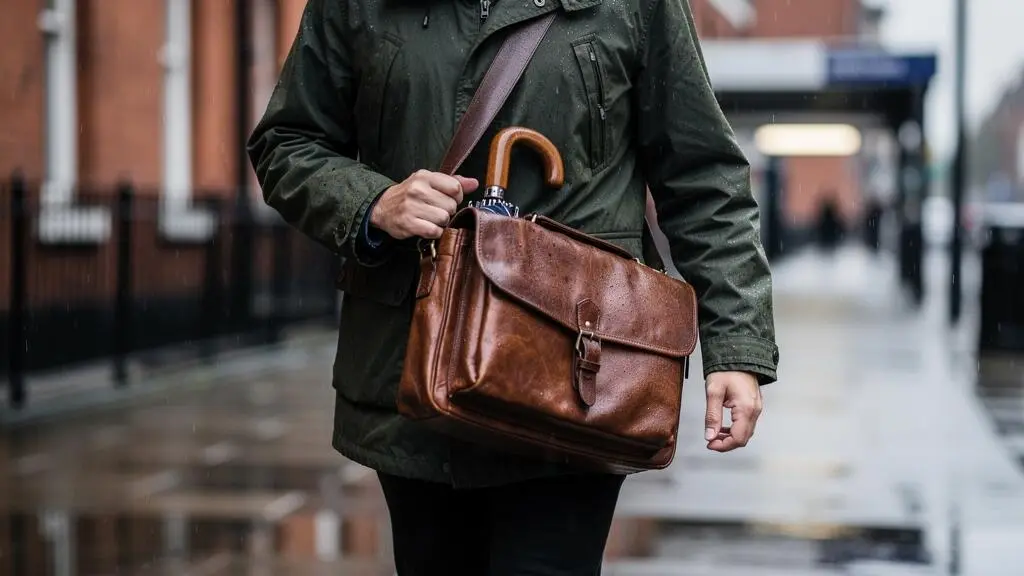
A leather satchel can look perfectly suited to office life and still become uncomfortable halfway to the station. The difference usually comes down to how its weight sits against the body, how much it carries and whether its strap and construction were designed for regular walking rather than occasional use.
For a UK commuter carrying a laptop, lunch, water bottle and umbrella, the best satchel is not necessarily the largest or most expensive. It is one that fits those essentials without excessive bulk, distributes the load comfortably, withstands frequent handling and tolerates the realities of damp pavements and crowded public transport.
Start with your actual daily load and the distance you walk. Then examine the strap, internal dimensions, leather finish and load-bearing hardware. A well-made bag should also remain practical to maintain and repair. These considerations reveal considerably more about long-term value than leather-grade labels or heritage-inspired styling alone.
Choosing a leather satchel for everyday commuting
- Prioritise a wide, adjustable, preferably padded strap and keep the loaded bag as light as practical. A backpack is generally preferable for heavier loads.
- Measure your laptop and everyday essentials against the bag’s internal dimensions rather than relying on advertised capacity.
- Judge leather by its finish and construction, inspect stressed hardware connections and establish whether rain care and repairs are manageable.
- Why Do Leather Satchels Feel Great in the Shop but Painful After a 30-Minute Walk?
- How to Measure What You Actually Carry So You Don’t Buy the Wrong Satchel Size?
- Full-Grain or Top-Grain Leather: Which Ages Better With Daily Commuting?
- The Satchel Hardware Detail That Fails First and Ruins the Bag
- When Should You Condition a Leather Satchel So UK Rain Doesn’t Leave Permanent Marks?
- How to Evaluate a “Premium” Label in 3 Checks When You Can’t Touch It Online?
- Full-Grain or Top-Grain Leather: Which Ages Better With Daily Commuting?
- How Do You Judge Premium Textiles Without Falling for Price-Tag Theatre?
Why Do Leather Satchels Feel Great in the Shop but Painful After a 30-Minute Walk?
A leather satchel can feel comfortable in a shop because it is usually empty and carried for only a few moments. During a real commute, its weight presses continuously against the shoulder, while walking creates repeated movement. A narrow, rigid strap can concentrate that pressure until a bag that initially felt excellent becomes difficult to carry.
Leather and metal fittings contribute weight before anything goes inside. Add a laptop, charger, water bottle and lunch, and the loaded bag may feel substantially different. Its centre of gravity shifts, its strap angle changes and the bag can begin swinging against the hip.
Strap design matters because pressure depends partly on the area over which a load is distributed. A broader strap generally spreads contact over more of the shoulder, while a padded section can improve comfort where the strap rests against clothing.
The Chartered Institute of Ergonomics and Human Factors guidance on carrying work equipment recommends wide straps, adjustable cushioning and crossbody carrying for single-strap bags. It advises considering a rucksack when the load exceeds 5% of body weight, while acknowledging that a rucksack can also be preferable for lighter loads.
That threshold is ergonomic guidance, not a guarantee that a particular satchel will feel comfortable below it. Walking duration, existing discomfort, load distribution and individual physical characteristics still matter.
Look closely at four design features before buying:
- Strap width: choose a strap broad enough to avoid concentrated pressure. There is no universally established minimum width for commuter leather satchels.
- Padding: prefer a secure, moveable pad that stays over the shoulder rather than sliding down the strap.
- Empty weight: compare bags before loading them; substantial leather and decorative hardware add to the burden.
- Rear-panel structure: check whether the loaded bag keeps its shape instead of folding or sagging uncomfortably against the hip.
Crossbody carrying generally reduces the asymmetrical loading associated with hanging a strap from one shoulder. It also keeps the bag close to the body, although a long strap can allow excessive swinging.
Single-shoulder carrying may provide quicker access to tickets, keys and other essentials, but leaves one shoulder supporting the load. Crossbody carrying is usually the stronger starting point for walking, while a backpack deserves serious consideration for heavier equipment.
Before purchasing, load the bag with the items you normally carry and walk around a shop or home for several minutes, including stairs if possible. Observe strap movement, pressure points and whether your posture changes. This is a practical comparison exercise, not a clinically validated test.
A satchel that passes this test should still be evaluated for capacity: a comfortable strap cannot compensate indefinitely for carrying more than the bag or your shoulder can reasonably manage.
How to Measure What You Actually Carry So You Don’t Buy the Wrong Satchel Size?
Measure the items you carry most often, especially your laptop, lunchbox and umbrella, then compare their combined dimensions with the satchel’s usable internal space. Allow modest room for occasional additions, but avoid sizing the bag around your heaviest imaginable day. Correct dimensions and manageable loaded weight matter more than advertised litres.
A satchel described as suitable for a 15-inch laptop does not necessarily accommodate every 15-inch machine. Screen size is measured diagonally, whereas the bag must fit the laptop’s actual width, height and thickness, ideally with appropriate protective padding.
Begin by placing all your usual commuting essentials on a table. Include the charger, headphones, notebook, water bottle, keys, lunch and folded umbrella. A surprisingly large proportion of sizing mistakes comes from focusing on the laptop while overlooking these smaller but bulky additions.
Measure the largest objects and assess how they can be arranged without forcing the satchel’s shape. A practical planning allowance of approximately 10–15% can help accommodate occasional extras, although it is not a standardised sizing requirement.
Pay attention to internal width, height and depth separately. A tall, narrow satchel may technically provide sufficient volume while making it difficult to insert a laptop horizontally or retrieve objects at a busy station barrier. A shallow bag may fit a computer but offer inadequate space for lunch and water.
A4 paperwork also deserves consideration. If you carry reports or folders, check that they lie flat without bending at the corners. Internal dividers, padding and narrow openings can reduce usable capacity even when the outside dimensions appear generous.
Five checks before choosing your satchel size
- Lay out everything carried on a normal workday and produce a complete daily-carry inventory.
- Measure the width, height and thickness of the largest items and record their dimensions in centimetres.
- Check the seller’s internal compartment measurements and note which items fit without forcing the opening or seams.
- Weigh the complete daily load, including the empty satchel, and record the total in kilograms.
- Test or simulate the loaded arrangement and write down any access, balance or shoulder-comfort problems before deciding.
Distinguish between what the bag can hold and what you can carry comfortably. Additional capacity can encourage unnecessary packing, and every extra object adds to the load supported by the strap.
The occupational ergonomic guidance discussed earlier makes an important distinction between general carried-bag weight and the suitability of single-strap bags. Do not interpret a general allowance of 10–15% of body weight as an appropriate target for a shoulder satchel.
Once the size is right, material selection becomes more meaningful: the leather must provide the appearance and weather performance you expect without making the bag unnecessarily heavy or demanding to maintain.
Full-Grain or Top-Grain Leather: Which Ages Better With Daily Commuting?
Neither full-grain nor top-grain leather automatically ages better in every commuter satchel. The terms are not consistently distinguished in retail marketing, and the finished bag’s durability depends on tanning, surface treatment, construction and use. For daily commuting, choose the appearance and maintenance characteristics of the actual leather finish rather than assuming one grade always wins.
Full-grain leather retains the original grain surface. That is a useful material description, but it does not guarantee scratch resistance, attractive ageing or superior performance in the rain.
Importantly, Leather Industries of America‘s full-grain and top-grain definitions treat top-grain and full-grain as equivalent terms. This conflicts with the simplified retail explanation that top-grain always means sanded or corrected leather.
Some retailers use top-grain to describe leather with a modified or corrected surface. Because that usage varies, buyers should ask whether the original grain remains intact, whether the surface has been buffed and what protective finishing has been applied.
For commuting, the meaningful comparison is often between a relatively exposed natural finish and a more heavily protected finish, not between two marketing labels.
| Criterion | Natural or lightly finished leather | More protected, finished leather |
|---|---|---|
| Appearance over time | May develop visible marks, tonal changes and patina | Often retains a more uniform appearance initially |
| Rain exposure | May show water spotting more readily | May provide greater resistance, depending on the actual finish |
| Scratches | Marks can remain visible or contribute to character | Surface treatment may help conceal minor marks, but coatings can also wear |
| Maintenance | May require more careful protection and cleaning | Care depends on the coating and manufacturer’s instructions |
| Best suited to | Buyers comfortable with visible ageing | Buyers seeking a more consistent appearance |
A commuter frequently walking in drizzle may prioritise a protective finish. Someone travelling mostly between indoor offices and covered stations may have greater freedom to choose a leather that visibly develops character. Cyclists should additionally consider exposure, movement and whether a satchel is practical and safe for their riding conditions.
Examine the flexibility of the leather, consistency of the finish, stitching, edge treatment and the strength of the bag’s internal structure. A pleasant leather smell is not proof of a particular grade or tanning quality.
Construction can make a substantial difference. An appealing hide attached to weak strap anchors will not produce a durable everyday bag, regardless of its material description.
The useful question is not which label sounds more luxurious, but which finished leather is compatible with the appearance, weather exposure and care routine you will actually accept.
The Satchel Hardware Detail That Fails First and Ruins the Bag
Strap anchors, buckles, rivets and the stitching around load-bearing connections deserve close inspection because failure at any of these points can make a satchel unusable. There is no reliable basis for naming one universal first failure across all leather satchels. The priority is identifying poorly reinforced connections before they face months of repeated carrying.
A satchel’s leather panels may remain in excellent condition while a strap connection stretches, a rivet loosens or a buckle stops holding its adjustment. This matters especially when the bag carries a laptop or other valuable equipment.
Inspect where the shoulder strap joins the bag body. Look for reinforcement around holes, stitching that remains consistent near the edges and sufficient material supporting the fastening. A neat exterior can conceal an attachment relying on a thin or poorly supported layer.
Material names alone are not decisive. Brass, steel, aluminium and plated alloys differ in strength, corrosion behaviour and manufacturing quality. A plated component is not necessarily weak, and an apparently solid metal fitting is not automatically durable.
For a useful technical perspective, SATRA‘s technical article on luggage testing identifies strap assemblies, stitching, reinforcements and fasteners as construction features requiring assessment.
Its TM244 method evaluates the strength of load-bearing attachments, while TM247 examines repeated loading of handles. These procedures demonstrate the importance of testing construction rather than judging it only by appearance; they do not rank particular satchel brands or identify universal failure frequencies.
In a shop, examine the connections without applying excessive force. Check whether buckles move smoothly, whether the strap adjustment holds under ordinary loading and whether exposed rivets or stitches show signs of loosening.
For an online purchase, request close-up photographs of both sides of the strap attachments. Images of a polished front panel reveal little about how the bag carries weight.
Hardware also affects comfort. If a buckle repeatedly slips, the bag gradually hangs lower, increasing movement and changing the pressure on the shoulder. A loose attachment can make an otherwise well-designed strap uncomfortable.
Repairability should be part of the buying decision. Ask whether replacement buckles, strap fittings and stitching repairs are available. A conventional attachment that a competent leather repairer can access may offer better long-term prospects than an unusual proprietary fitting.
Neither rivets nor stitching should be dismissed categorically. Strength depends on the materials, reinforcement, design and quality of assembly. A combined connection can be well made or poorly made.
With the attachment points assessed, the next challenge is preserving the leather itself through repeated handling and wet UK weather.
When Should You Condition a Leather Satchel So UK Rain Doesn’t Leave Permanent Marks?
Condition a compatible leather satchel when its surface shows signs of dryness or stiffness, rather than following an automatic monthly schedule. After rain, correct drying is the immediate priority: remove surface moisture gently, maintain the bag’s shape and let it dry naturally away from direct heat. Conditioning cannot guarantee that water marks will disappear or never form.
Rain can change the appearance of absorbent leather because water interacts with the surface, finish and substances already present in the material. Depending on the leather, uneven drying may leave darker areas, tide marks or changes in texture.
Not every mark has the same cause. Water composition, oils, dyes, existing treatments and finishing quality can all influence the result. It is therefore misleading to assume that mineral deposits are responsible for every visible rain spot.
The first step is to check the maker’s care instructions. Finished leather, waxed leather, suede and nubuck can require substantially different products and treatments.
For a conventional smooth-leather satchel exposed to rain, a cautious routine is to:
- Gently remove excess moisture with a clean, soft cloth without aggressive rubbing.
- Empty the bag and place suitable clean packing material inside to support its shape.
- Allow it to air-dry in a ventilated area, away from radiators, hairdryers and direct intense sunlight.
- Check the leather once dry for stiffness, colour changes or damage.
- Use only a compatible care product if the manufacturer recommends it, testing first on a discreet area.
Frequent light drizzle and occasional heavy soaking pose different challenges. During everyday wet walks, prevention may involve an appropriate protective treatment and promptly wiping away moisture. After substantial soaking, gradual drying and inspection take precedence over immediately applying oils or conditioner.
At high-flex points, such as the flap crease and strap base, dryness may become more apparent through a rough feel, reduced flexibility or changes in colour. These observations can help determine whether conditioning is needed, but they are not universal diagnostic signs for every finish.
More conditioner is not automatically better. Excessive application or incompatible products can alter colour, leave residue or affect the finish. Some coated leathers may need only gentle surface cleaning rather than penetrating conditioners.
For untreated or lightly protected leather, visible marks may simply become part of the bag’s patina. If a consistently pristine appearance matters, selecting a more weather-tolerant finish is often more realistic than trying to eliminate every mark through maintenance.
A practical care routine protects the investment, but the easiest time to avoid a maintenance mismatch is before buying, when the material description and seller’s instructions are still available for comparison.
How to Evaluate a “Premium” Label in 3 Checks When You Can’t Touch It Online?
Evaluate a premium leather satchel online by checking three things: the material description, detailed construction photographs and the practical return conditions. A high price, attractive product photography or vague craftsmanship language cannot establish durability. The strongest product listing supplies specific information that can be compared against how the bag will actually be used.
Buying online removes the chance to feel the strap, test the buckle and inspect the leather finish directly. The aim is therefore to replace those observations with verifiable evidence rather than relying on persuasive adjectives.
Check 1: Identify the leather and finish. Look for a clear description of the material, surface treatment and relevant care requirements. Details about the tannage, tannery or origin may provide useful traceability, but should not be mistaken for proof of performance.
Terms such as genuine leather are too broad to establish a particular quality level. However, genuine leather should not automatically be treated as synonymous with bonded leather. Ask the seller to clarify the actual composition if the description is ambiguous.
PU leather ordinarily describes a synthetic or polyurethane-based material, or may be used ambiguously for coated products. It should not be assumed to have the same composition, ageing behaviour or care requirements as conventional leather.
Check 2: Inspect the details, not just the silhouette. Look for close-up images of stitching, edge finishing, strap anchors, buckles, lining and the main compartment opening.
Product photographs can hide construction details through lighting, angles and retouching. Customer photographs taken after regular use can offer additional context, particularly where reviewers describe recurring problems with strap adjustment, stitching or surface wear.
Reviews should still be treated cautiously: an individual complaint does not establish a general defect, and positive unboxing impressions do not demonstrate long-term durability.
Check 3: Understand the returns policy before paying. For qualifying UK online purchases, buyers generally have 14 days after receiving an item to notify a retailer that they wish to cancel, followed by another 14 days to return it.
The official GOV.UK guidance on returns and refunds also explains that consumers may handle goods as they would in a physical shop. Handling beyond that level can result in deductions from a refund.
Consequently, the statutory cancellation period is not an unconditional two-week real-world commuting trial. Carrying the bag outdoors for multiple journeys may go beyond permitted inspection. Custom-made or personalised goods can also fall under exceptions.
Before ordering, confirm who pays return postage, whether the seller offers additional voluntary trial rights and whether indoor fitting with your normal belongings is permitted.
A convincing listing should make the purchase easier to evaluate, not ask buyers to substitute trust in the brand for evidence about materials, construction and suitability.
Full-Grain or Top-Grain Leather: Which Ages Better With Daily Commuting?
For a first leather satchel used on a daily UK commute, the lower-regret choice is generally the finish whose appearance and care demands match your routine. A natural finish may reward owners who enjoy visible ageing, while a more protective finish can suit those who prefer consistency. Neither outcome follows reliably from the labels full-grain and top-grain alone.
Imagine a commuter buying their first leather satchel for a laptop-based office job. Their journey includes a walk to the station, occasional rain, crowded train carriages and frequent contact with seats, desks and ticket barriers.
During the first year, the bag will face repeated abrasion, bending, handling and changes in moisture exposure. These events may affect each leather differently.
On a lightly finished material, scuffs and colour variation may become increasingly apparent. Some owners value this developing character; others see the same changes as unwanted wear.
A more heavily finished leather may retain a more uniform appearance, but surface coatings have their own vulnerabilities. Scratches, abrasion and deterioration of a finish are still possible. Without product-specific testing, neither type can be assigned a predictable appearance after twelve months.
This distinction matters because buyers frequently imagine an ideal patina without considering how their actual commute produces marks. Everyday wear is not automatically even or attractive.
Consider three typical ownership priorities:
- Visible character: choose a leather and finish whose marks and tonal variations you genuinely appreciate.
- Consistent office appearance: prioritise a finish that tolerates the expected handling and moisture exposure, while understanding that no finish is damage-proof.
- Low-maintenance practicality: compare the manufacturer’s care requirements and select a product that fits your willingness to clean, dry and protect it.
Price should then be considered over the expected ownership period, rather than only at checkout. A higher initial price might be justified by dependable construction, repairable fittings and durable materials, but no grade label alone proves a longer lifespan.
A practical way to assess value is to compare purchase price, anticipated maintenance costs, repair options and the length of service you can reasonably expect. Without verified lifespan data, a cost-per-year figure is only a scenario, not a reliable forecast.
As a final tie-breaker, ask yourself whether you would still enjoy the bag if its leather developed visible scratches and uneven darkening. If the answer is no, a more protected finish may better suit your expectations.
Choosing the right finish reduces the risk of disappointment, but the final buying decision should also challenge whether the price reflects useful construction quality or merely convincing presentation.
Key takeaways before judging the price
- Compare the finished bag’s construction and intended use, not just its leather classification or brand history.
- Look for evidence of reinforced load-bearing connections, suitable internal support and repairable components.
- Balance the purchase price against realistic upkeep and useful lifespan without assuming that an expensive satchel must last longer.
How Do You Judge Premium Textiles Without Falling for Price-Tag Theatre?
Judge premium materials by what can be verified about their composition, finishing and construction, not by price or luxury-inspired language. For leather satchels, a convincing premium claim should be supported by material information, dependable load-bearing hardware, sound stitching and useful internal design. Brand heritage and styling can add appeal without proving everyday performance.
Price-tag theatre occurs when an expensive presentation creates an impression of quality that the available evidence does not establish. In leather goods, this may involve evocative descriptions of tradition, craftsmanship and timeless design without explaining the actual material or how the bag is constructed.
The distinction is not that branding or aesthetics have no value. They may matter greatly to the buyer. They simply answer a different question from whether the bag will carry a laptop comfortably through repeated commutes.
A useful quality hierarchy begins with the features that affect durability and daily usability:
- Material specification: identifiable leather type, surface finish, care requirements and appropriate quality for the intended use.
- Load-bearing construction: dependable strap attachments, secure fittings, consistent stitching and adequate reinforcement.
- Internal structure: suitable laptop protection, practical compartments, accessible openings and lining appropriate for everyday wear.
- Serviceability: potential for strap, buckle, stitching and other component repairs.
- Brand and presentation: styling, provenance claims and customer experience, evaluated separately from physical performance.
For example, consider two hypothetical satchels advertised at £90 and £350. The higher-priced bag may offer more consistent finishing, stronger construction or better after-sales support. It may also charge substantially more for its name or design.
Without detailed product information, neither price establishes superior durability. Applying the same inspection criteria to both bags is more meaningful than assuming either that the expensive option is better or that the cheaper one offers greater value.
Paying more can be justified when the additional cost corresponds to tangible benefits: reinforced attachments, reliable fittings, carefully executed seams, suitable lining and access to repairs. Decorative metalwork, elaborate packaging or a fashionable silhouette may contribute to personal enjoyment, but not necessarily commuting comfort.
Equally, extreme scepticism about premium pricing can be misleading. Low-cost bags may use synthetic coatings, bonded materials or lightweight components, but price alone does not establish their composition or useful lifespan. Some affordable products are honestly specified and competently constructed.
The same approach extends to textile components within a satchel. Inspect the lining’s weave and attachment, the backing of padded compartments and the material used on shoulder pads. A premium textile claim is meaningful only when the specification and suitability are clear.
Rather than searching for a universal best price, seek evidence proportionate to the amount being charged. A retailer asking a substantial premium should be able to explain what improves the product beyond appearance.
Make the final decision with your daily-carry measurements, loaded comfort assessment and construction checks beside the product listing. Buy the satchel that meets those needs with the least compromise, and treat unsupported premium claims as reasons to ask further questions rather than reasons to spend more.
Is a leather satchel suitable for carrying a laptop every day?
Yes, provided the internal dimensions fit the laptop, the compartment offers suitable protection and the total load remains comfortable. A wide, adjustable strap and secure attachments are important. For heavier loads, occupational ergonomic guidance favours considering a rucksack rather than relying on a single-strap bag.
Should a commuter satchel have a dedicated laptop sleeve?
A properly sized, padded laptop compartment can reduce movement and help protect the device from everyday contact with other belongings. Check its actual dimensions, closure and padding. A separate protective sleeve may be useful when the satchel lacks sufficient internal protection.
Can a leather satchel be used in heavy rain?
Some finished leathers tolerate moisture better than others, but a leather satchel should not be assumed waterproof. Check the manufacturer’s weather-resistance information, protect electronic equipment and avoid prolonged soaking. If the bag becomes wet, dry it gradually and follow care instructions appropriate to its finish.
Does heavier leather mean a more durable satchel?
Not necessarily. Thickness and weight do not independently establish leather quality or the strength of stitching, hardware and structural connections. Extra weight can also reduce commuting comfort. Evaluate material specifications and construction together rather than treating heaviness as proof of quality.
Is it worth repairing a leather satchel instead of replacing it?
Repair may be worthwhile when the leather panels and overall structure remain sound and the problem is limited to accessible stitching, a strap or replaceable hardware. Ask a qualified leather repairer to assess the damage and provide a quote. The decision depends on repairability, cost, remaining condition and the bag’s usefulness.