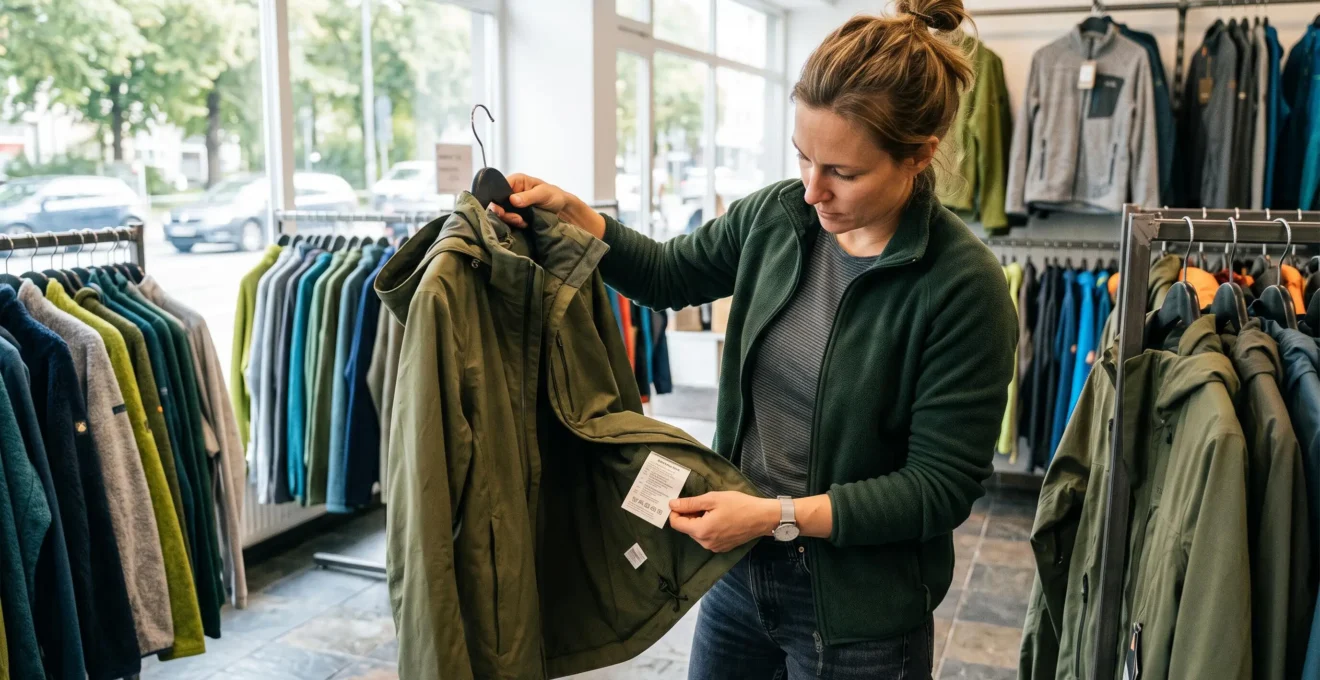
A jacket made from certified recycled polyester can be comfortable, durable and suitable for years of regular wear. But its certification does not establish any of those qualities. It verifies specific claims about recycled material and its supply chain, not whether the garment will survive repeated washing or keep you dry during a wet British winter.
That distinction matters when two seemingly similar jackets carry different prices and sustainability messages. One might contain independently verified recycled material but have poorly constructed seams. Another might use virgin polyester yet offer better documented resistance to abrasion, rain and laundering. The recycled label alone cannot settle the comparison.
Understanding the difference between material origin, fabric performance and garment lifespan makes purchasing decisions considerably easier. It also helps distinguish meaningful certification from vague environmental marketing.
The practical question is not whether recycled fibres are inherently better or worse. It is whether a particular garment provides the performance you need, has a credible recycled-content claim and is likely to remain useful long enough to justify its purchase.
What matters when buying certified recycled clothing
- GRS and RCS verify recycled content and supply-chain traceability. Neither guarantees durability, comfort or waterproofness.
- Assess fabric construction, washing requirements, seams and performance information before paying a premium for recycled materials.
- Keeping, repairing or buying a suitable second-hand garment can avoid purchasing something new. Certified recycled clothing is a useful option when a new item is genuinely needed.
- Why Do Recycled Fibres Need Certification If “Recycled Is Recycled”?
- How to Check a Recycled Fibre Claim in 3 Details Before You Pay More?
- Recycled Polyester or Virgin: Which Is the Better Choice for Outerwear You Wear Weekly?
- The Certified-Recycled Assumption That Leads to Disappointment After 10 Washes
- When Should You Choose Second-Hand Over Certified Recycled Because It Cuts Impact More?
- Polyester or Nylon: Which Performs Better for Outerwear in UK Rain and Wind?
- How to Build Your Personal Impact Ladder So You Focus on the 20% That Matters Most?
- Are Synthetic Fibres Always Bad, or Are Some Actually the Best Choice for Daily Wear?
Why Do Recycled Fibres Need Certification If “Recycled Is Recycled”?
Recycled fibres need certification because a manufacturer’s claim and independently verified material origin are not the same thing. Certification establishes rules for checking recycled content and tracing materials through a supply chain. It does not establish whether the resulting jacket is comfortable, waterproof or resistant to wear. Traceability and performance are separate questions.
Recycled material can pass through several businesses before becoming a finished garment: collection or recovery operations, recycling facilities, yarn producers, fabric manufacturers and clothing factories. A credible certification system defines how participating organisations document and account for certified material as it moves through those stages.
Without independent verification, a statement such as “made from recycled fibres” remains a claim made by the seller. That does not automatically make it false, but the shopper has less evidence available to assess it.
Two widely encountered standards are the Recycled Claim Standard (RCS) and Global Recycled Standard (GRS), both developed by Textile Exchange.
- RCS: focuses on verifying recycled material content and chain of custody.
- GRS: also verifies recycled content and chain of custody, while adding requirements concerning social, environmental and chemical practices in processing.
- Neither: guarantees that a finished jacket will retain its colour, resist pilling, maintain waterproofness or withstand a particular number of washes.
According to Textile Exchange’s RCS and GRS standards overview, GRS has different recycled-content thresholds depending on the certification context. At least 20% recycled content is required for applicable business-to-business certification, while consumer-facing GRS product labelling requires at least 50%.
Those thresholds should not be confused with the recycled percentage in any particular garment. A shopper still needs to examine the specific product claim.
Certification can also impose administrative and verification costs. However, there is no basis for assuming that brands necessarily offset those costs by using cheaper dyes or weaker construction. The relevant concern is simpler: certification spending does not replace investment in garment quality.
Once that distinction is clear, the next challenge is assessing whether the label attached to a particular garment provides enough evidence to justify its price.
How to Check a Recycled Fibre Claim in 3 Details Before You Pay More?
Check three things before paying extra for recycled clothing: the certification standard named, the stated percentage of recycled content and the component covered by the claim. A credible product description should make those details understandable. If the wording is vague or certification evidence cannot be identified, ask the retailer for clarification rather than assuming the whole garment is independently certified.
The first check is the standard itself. A product page naming GRS or RCS provides a more specific basis for verification than phrases such as “eco-conscious fabric” or “recycled-inspired design”. The name of an actual standard matters more than a leaf icon or an environmental-sounding collection name.
Next, find the percentage. A jacket containing some recycled polyester is not necessarily made entirely from recycled polyester. A percentage without a clear material or component reference can also be misleading.
Finally, identify exactly which part of the garment contains recycled material. The outer shell, lining, insulation, zip components and trims may have different compositions.
The following comparison illustrates how the wording changes the information available to a buyer.
| Detail | Weak claim | More informative claim |
|---|---|---|
| Certification | “Eco-conscious recycled fabric” | “Recycled polyester certified under GRS”, with supporting certification details |
| Percentage | “Made with recycled materials” | “Outer fabric contains 70% recycled polyester” |
| Coverage | “Recycled jacket” | “Recycled-content claim applies to the outer shell; lining and trims are excluded” |
The stronger examples are illustrative wording, not verified statements about real products. More specific language makes a claim easier to investigate, but does not independently prove it.
There is another useful verification step: check any available certificate reference. Textile Exchange’s certified-company directory provides information about certified organisations using scope certificate records supplied by certification bodies.
A scope certificate helps establish what an organisation is certified to handle or produce. It does not automatically prove that every product made by that organisation is certified. Transaction-specific documentation serves a different purpose, and shoppers may not have access to it.
Your five-step recycled-fibre claim check
- Record the stated standard, such as GRS or RCS. Your result should be an identifiable standard name rather than a general marketing phrase.
- Write down the recycled-content percentage. Your result should be a precise figure, or a note that the percentage is missing.
- Identify the garment component covered. Your result should distinguish the shell, lining, filling or other specified parts.
- Look up any supplied certification body or certificate details. Save the directory finding, or record what could not be verified.
- Ask the retailer to clarify any unresolved claim before paying a premium. Keep the written response alongside the product details.
This process cannot turn an inaccessible supply chain into a fully transparent one. It does, however, establish which statements have supporting information and which depend on the retailer’s assurances.
After verifying the material’s origin, assess a different issue: whether its construction and technical characteristics make it suitable for frequent use.
Recycled Polyester or Virgin: Which Is the Better Choice for Outerwear You Wear Weekly?
For outerwear worn every week, certified recycled polyester is a sensible choice when it provides the same necessary performance and expected durability as a comparable virgin-polyester garment. Fibre origin alone cannot establish that equivalence. Fabric construction, abrasion resistance, water protection and repairability deserve greater attention than the recycled label when choosing a jacket intended for repeated use.
Recycled polyester and virgin polyester belong to the same broad polymer family, but finished textile performance depends on much more than polymer origin.
Recycled feedstock may have different processing histories. Contamination, polymer degradation and manufacturing controls can influence the material ultimately produced. Yet these variables do not establish that recycled polyester is automatically weaker than virgin polyester.
Manufacturers can adjust production and fabric specifications to achieve particular performance targets. What matters to the buyer is the resulting product, not a general assumption about recycled inputs.
For two jackets intended for regular commuting, compare the following properties.
| Criterion | What to examine | Why it matters |
|---|---|---|
| Abrasion resistance | Available abrasion-test information and reinforcement at wear points | Repeated contact with bags, seats and surfaces can damage fabric |
| Pilling resistance | Fabric test results, surface finish and relevant product reviews | Visible wear can affect appearance and perceived condition |
| Water protection | Membrane or coating specifications, seam construction and water-resistance claims | Rain protection depends on the complete fabric system |
| Colour fastness | Available wash and light-fastness information | Repeated care and exposure can change appearance |
| Construction | Stitching, zips, closures and repair options | Component failure may shorten useful life regardless of fibre origin |
Fabric weight, yarn characteristics, weave or knit structure and finishing can also provide useful context. Denier, for example, describes yarn linear density, but does not independently establish whole-garment durability.
Certification cannot resolve the environmental question either. Recycled polyester remains a synthetic material capable of releasing plastic microfibres during use and laundering.
The European Environment Agency analysis of textile microplastics identifies textile construction, manufacturing and washing conditions among the factors influencing microfibre emissions. It does not establish that recycled polyester necessarily sheds more or less than virgin polyester.
At end of life, recycled polyester also remains subject to textile collection, separation and recycling constraints. Recycled origin is not proof that a finished garment can be recycled again through available local systems.
Choose recycled polyester when its performance is demonstrably suitable and the recycled-content claim is credible. Where the alternative is substantially more durable, the decision requires a broader assessment of expected lifespan and replacement needs.
A garment replaced prematurely can create additional production impacts, but there is no universal evidence-based threshold at which durability always outweighs a particular recycled-feedstock benefit.
Those performance differences often become most noticeable during maintenance, especially when a buyer assumes the certification also guarantees resistance to repeated washing.
The Certified-Recycled Assumption That Leads to Disappointment After 10 Washes
The mistake is assuming that certified recycled material means a garment has been tested and approved for repeated laundering. Recycled-content certification does not guarantee colour stability, seam strength, coating durability or resistance to shrinkage and distortion. If a jacket performs poorly after several washes, the explanation may involve its fabric construction, finish or care conditions rather than recycled fibre origin.
Imagine a hypothetical commuter buying a certified recycled rain jacket and washing it ten times. Initially, rain beads on the surface. After repeated laundering, droplets begin soaking into the outer fabric rather than rolling off.
That observation does not, by itself, prove that the polyester has degraded. The jacket’s durable water-repellent treatment may have lost effectiveness, become contaminated or been affected by unsuitable care.
It is important to distinguish surface water repellency from the performance of an underlying waterproof membrane. Reduced beading does not necessarily mean the membrane has failed, although a saturated outer fabric can reduce comfort and breathability.
Other problems have different possible causes:
- Colour fading: may relate to dye selection, finishing, light exposure and laundering conditions.
- Pilling: can depend on yarn, surface construction and friction.
- Seam damage: may reflect stitching quality, construction or repeated mechanical stress.
- Peeling or delamination: may indicate deterioration of a coating, adhesive or laminate structure.
Before purchasing, inspect the care label for restrictions on washing temperature, tumble drying, ironing and fabric treatments. Technical garments may require specific detergents or maintenance procedures.
Also examine whether the brand provides any independent durability information. Relevant evidence might include wash-performance tests, coating information or seam-construction specifications. A warranty may help if a manufacturing defect appears, but its terms do not independently demonstrate durability.
For garments already showing reduced rain performance, start with the manufacturer’s maintenance instructions. Cleaning can remove residues that interfere with water repellency, while suitable reproofing treatments may improve the outer fabric’s ability to repel water.
Gentle washing and air drying may reduce unnecessary stress where permitted by the care label. However, some technical treatments require specific drying or heat-activation procedures, so air drying is not universally the best method.
Reproofing cannot repair every fault. A damaged waterproof membrane or delaminated fabric may require specialist repair or replacement, and some failures cannot be restored economically.
The strongest purchase is therefore not necessarily the garment with the most prominent label, but the one whose likely care requirements and performance limitations fit the buyer’s actual routine.
When Should You Choose Second-Hand Over Certified Recycled Because It Cuts Impact More?
Second-hand is often the preferable environmental choice when a suitable garment already exists, is in good condition and will genuinely replace a new purchase. Reusing existing clothing can avoid demand for additional manufacturing, while buying certified recycled clothing still requires producing a new garment. The advantage is conditional: remaining lifespan, transport, refurbishment and actual purchase substitution can influence the outcome.
A well-maintained second-hand coat may have years of useful service remaining. Buying it can make more sense than ordering a new coat simply because the new one contains recycled fibres.
However, the calculation becomes less straightforward for technical outerwear. A heavily worn waterproof jacket might require immediate reproofing, zip replacement or repair to its membrane. Some second-hand garments cannot be restored to the performance needed for demanding conditions.
There is a practical difference between extending the life of a reliable existing item and acquiring one that is close to failure.
Before buying used technical clothing, assess its condition rather than relying on appearance alone.
Test every zip and fastening, inspect high-friction areas such as cuffs and shoulders, and check for seam damage. On laminated waterproof garments, look for bubbling, peeling, detached seam tape or other signs of separation.
Persistent odour can be another practical consideration with previously worn synthetic clothing. Cleaning may improve it, but successful removal should not be assumed.
These observations help screen unsuitable purchases, although they cannot establish the remaining lifespan of a second-hand technical garment with certainty.
UK resource-efficiency organisation WRAP has examined garment longevity through testing frameworks and clothing-industry research.
Up to 20%
WRAP reports that extending clothing lifespan by nine months could reduce associated carbon, water and waste footprints by up to 20%. This is a potential benefit from the research context, not a guaranteed saving for every garment or purchase.
WRAP, clothing durability and product-lifetime research.
The underlying work, discussed in WRAP’s clothing durability case study, reinforces the importance of longevity and tests addressing properties such as wash endurance and colour fading.
A practical choice depends on the garment’s role.
| Buying situation | Option to consider first | Condition |
|---|---|---|
| Everyday coat in sound condition | Second-hand | Suitable fit, reliable construction and meaningful remaining life |
| Technical waterproof shell | Either | Verified condition and required weather performance |
| Specialist garment with demanding fit requirements | Certified recycled new, if necessary | Appropriate performance and no suitable existing option |
| Garment already owned and repairable | Keep and repair | Repair is practical and restores useful service |
Second-hand and certified recycled clothing are not opposing strategies. Reuse can be the starting point, with a well-specified new garment available when existing options cannot reliably meet the need.
When new technical outerwear is necessary, choosing the appropriate fibre and fabric system becomes the next priority.
Polyester or Nylon: Which Performs Better for Outerwear in UK Rain and Wind?
Neither polyester nor nylon is universally better for British rain and wind. Waterproofness and wind resistance depend primarily on the finished fabric system, including its construction, membrane or coating, seams and closures. Nylon can offer useful strength and abrasion-resistance characteristics, while polyester often has advantages in lower moisture absorption and colour stability. The best choice depends on the jacket’s intended use.
A polyester jacket with well-designed waterproof construction can perform better in persistent rain than a nylon jacket with an unsuitable coating. The reverse is also possible.
The fibre name alone therefore provides limited evidence about rain protection. For a technical shell, consider the complete system: fabric, membrane, seam sealing, hood design, cuffs and front closure.
Wind resistance follows similar principles. Tightly constructed fabrics, membranes and garment design can restrict airflow independently of whether the base fibre is polyester or nylon.
Still, fibre-level characteristics influence performance under particular conditions.
| Use case | Potential advantage | What to verify |
|---|---|---|
| Everyday commuting in drizzle | Polyester may offer lower moisture absorption and useful dimensional stability | Water-repellent finish, drying behaviour and seam protection |
| Hillwalking with rucksack friction | Nylon can provide favourable strength-to-weight and abrasion characteristics | Abrasion specifications and reinforcement at contact points |
| Lightweight jacket packed frequently | Either, depending on fabric design | Fabric weight, packed size, coating durability and construction |
| Regular sunlight exposure | Polyester often offers useful UV and colour-retention characteristics | Actual dye, finish and fabric specifications |
These are material tendencies, not guarantees. Different yarns, constructions, treatments and test conditions can produce different results.
For frequent outdoor use, identify the most likely reason a garment might fail. Someone carrying a heavy backpack regularly may prioritise abrasion resistance. A commuter repeatedly caught in damp weather may prioritise drying characteristics, dependable seams and straightforward maintenance.
Recycled polyester and recycled nylon introduce another independent decision: the origin of the material. Certification helps establish that origin under the relevant standard, but it does not select the best fibre or fabric system for the intended conditions.
Performance first, verified origin second is a useful evaluation sequence when comparing otherwise suitable products.
Once suitable options have been identified, their environmental claims can be considered alongside an often more consequential question: whether another purchase is necessary at all.
How to Build Your Personal Impact Ladder So You Focus on the 20% That Matters Most?
Build an impact ladder by prioritising decisions that can avoid unnecessary garment production before comparing material labels on new products. Keeping a functional jacket, repairing it and considering suitable second-hand alternatives generally deserve attention ahead of buying something new. The “20%” idea is a prioritisation prompt, not an established measurement of which clothing decisions account for a fixed share of environmental impact.
Environmental marketing frequently concentrates attention on one material characteristic because it is easy to display on a hangtag. Recycled-content certification can provide meaningful information, but it addresses only part of a garment’s lifecycle.
Garment manufacture, use, care and disposal also matter. The relative importance of each stage varies between products and circumstances, so there is no defensible universal percentage assigning the greatest impact to a single purchasing decision.
A practical ladder helps organise choices without claiming that every step has the same environmental advantage in every situation.
- Keep using what works. If an existing garment remains suitable, avoiding an unnecessary replacement is the first option.
- Maintain or repair. Clean, reproof or repair a useful item where doing so is practical and effective.
- Consider second-hand. Look for a garment in sufficiently good condition to provide meaningful additional service.
- Buy certified recycled new when needed. Choose verified recycled content where performance, fit and expected durability meet the requirement.
- Evaluate other new options carefully. If suitable certified recycled products are unavailable, assess quality, expected lifespan and other relevant impacts rather than automatically rejecting every alternative.
This ordering is a decision aid rather than a quantitative lifecycle ranking. A second-hand garment close to failure, for example, may not outperform a durable new alternative under every relevant impact measure.
The most useful personal exercise is to examine the three garments worn most frequently.
For each, record its approximate age, current condition, care requirements, repair needs and likely reason for eventual replacement. Then identify what could extend its useful life.
A jacket worn several times a week deserves particular attention because its performance and maintenance are repeatedly tested. An occasional-use garment may have a very different replacement pattern.
Purchasing an additional certified recycled jacket does not cancel the impacts associated with producing that item. The recycled-content claim becomes relevant only after the need for the purchase has been established.
Similarly, extending garment life is most useful when it genuinely displaces replacement or additional consumption.
The ladder leads to a more balanced final decision: sometimes the right product is a synthetic garment, sometimes another fibre makes more sense, and often the best option is already in the wardrobe.
Key takeaways before choosing a fibre
- Match the garment to a specific job: weather protection, abrasion resistance, comfort or everyday versatility.
- Judge environmental claims alongside likely service life, not as a substitute for performance information.
- A necessary, durable synthetic garment can be a reasonable choice without pretending that microfibre pollution and end-of-life limitations disappear.
Are Synthetic Fibres Always Bad, or Are Some Actually the Best Choice for Daily Wear?
Synthetic fibres are not automatically a poor choice for daily clothing. Polyester and nylon can be particularly useful where quick drying, low weight, abrasion resistance or technical weather protection matter. They also create environmental concerns, including microplastic emissions and persistent waste. The appropriate choice depends on what the garment must do, how it will be maintained and how long it will remain useful.
Synthetic materials can solve practical problems in demanding clothing categories. A lightweight outer shell that dries readily and provides dependable protection may be more suitable for a wet commute than a garment chosen solely because it contains a natural fibre.
Likewise, fabric strength, stretch and resistance to repeated handling can make synthetics useful in sportswear and regularly washed clothing. Those benefits depend on actual fabric construction and garment design rather than on the fibre category alone.
There are limitations. Synthetic textiles can release microfibres during manufacturing, wearing and washing. Their end-of-life management is also complicated by blends, coatings, components and the availability of suitable collection and recycling systems.
Using recycled synthetic material can reduce reliance on virgin feedstock, but a recycled label does not eliminate those downstream problems or independently establish a lower total environmental footprint for every garment.
Natural fibres offer different properties, but they are not automatically impact-free or universally preferable. Their performance and environmental consequences also depend on cultivation or production, processing, care and longevity.
Use the garment’s dominant requirement as a final filter:
- For technical rainwear and wind protection, assess the complete fabric system and required performance before selecting the fibre.
- For frequently washed active clothing, consider drying, comfort, durability and appropriate care.
- For low-intensity everyday garments, compare comfortable natural, recycled and other suitable materials without assuming synthetic performance advantages are always necessary.
- For any garment, prioritise useful lifespan, repairability and a credible reason to purchase.
Comfort also needs to be assessed at product level. Fibre composition does not alone determine breathability, softness, skin feel or thermal comfort. Fabric structure, finishing, fit and the conditions in which clothing is worn all contribute.
The complete purchasing sequence is therefore straightforward. First, establish whether another garment is needed. Next, define its expected use and performance requirements. Then compare construction, care and likely longevity. Finally, examine any recycled-content certification and the evidence supporting it.
Certification tells you something about material origin. Construction and maintenance tell you more about how a garment may perform. Actual use determines whether those qualities are valuable.
For your next clothing purchase, start with the garment you already own and the specific problem you need to solve. If a replacement is justified, compare two suitable alternatives using their technical specifications, expected durability and verifiable material claims. That is a more reliable way to buy intelligently than trusting any single label.
Does GRS certification mean a jacket is completely recycled?
No. Under the GRS framework described by Textile Exchange, consumer-facing product labelling requires at least 50% recycled content, not necessarily 100%. Check the actual stated percentage and which components are covered. A certified organisation’s scope and a particular finished product’s claim should also be distinguished.
Can a garment contain recycled polyester without GRS or RCS certification?
Yes. Material can originate from recycling without carrying either certification. However, an uncertified claim may be harder for shoppers to verify independently. Request clear information about the recycled content, its origin and the evidence supporting the retailer’s statement.
Does recycled polyester release fewer microplastics than virgin polyester?
Recycled polyester can release synthetic microfibres, just as virgin polyester can. The environmental evidence presented here does not establish that recycled polyester consistently releases fewer or more microfibres. Fabric construction, garment condition and laundering practices are important variables.
Can a certified recycled waterproof jacket be reproofed?
Often, yes, if the fabric and garment manufacturer permit suitable reproofing treatments. Restoring surface water repellency may help with wetting-out, but it does not necessarily repair a failed waterproof membrane, damaged coating or delaminated seams. Follow the manufacturer’s care and treatment instructions.
Is paying more for certified recycled fabric worthwhile?
It can be worthwhile when the certified claim is credible, the garment meets your performance requirements and the price difference fits your priorities. Certification adds evidence about material origin, but does not prove that the garment is more durable or environmentally preferable overall. Compare expected lifespan and construction quality before paying a premium.