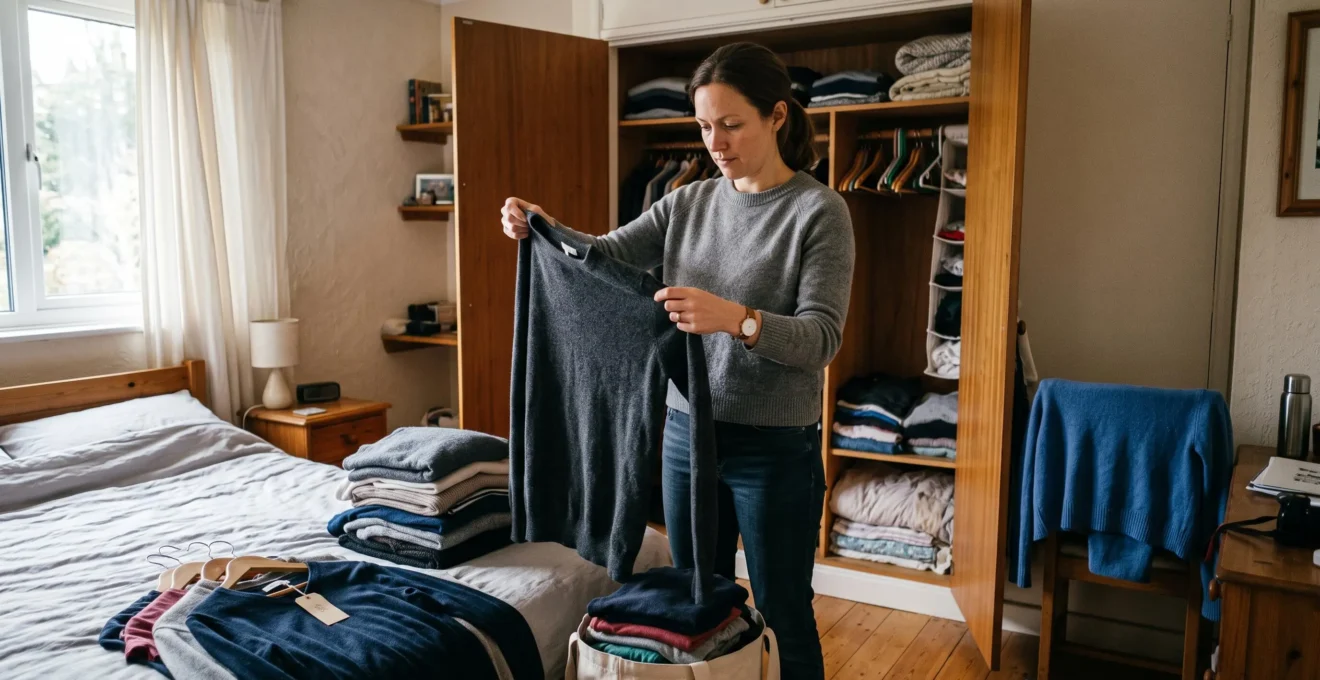
Reducing your wardrobe’s environmental impact does not require a capsule wardrobe, expensive ethical labels or a ban on buying clothes. The more useful approach is to examine what enters your wardrobe, how long it remains useful and whether each purchase solves a genuine clothing need.
Buying fewer unnecessary garments, maintaining clothes you already own and choosing replacements that will actually be worn can make a more meaningful difference than endlessly switching between supposedly greener materials. The difficult part is deciding which changes deserve your attention and which simply create more work.
A practical wardrobe strategy should also recognise ordinary constraints: unpredictable British weather, limited budgets, changing sizes, work requirements, laundry routines and the occasional need to replace something quickly. Environmental decisions become easier when they fit those realities rather than compete with them.
The starting point is therefore not perfection. It is a manageable system that reduces avoidable purchases, keeps suitable clothes in use and allows you to assess progress without relying on guilt or questionable carbon calculations.
The practical route to a lower-impact wardrobe
- Prioritise avoiding unnecessary new purchases and extending the useful life of clothes before spending time on minor adjustments.
- Evaluate second-hand, repair and sustainable-new options according to actual use, condition, cost and whether they replace another purchase.
- Use a seasonal audit and four manageable weekly habits to track purchasing, identify neglected clothes and prevent avoidable waste.
- Why Do Many “Eco-Friendly” Wardrobe Swaps Make Almost No Difference in the End?
- How to Build Your Personal Impact Ladder So You Focus on the 20% That Matters Most?
- Second-Hand or Sustainable New: Which Choice Cuts Impact More for Winter Coats?
- The Eco-Justification Trap That Makes You Buy More Clothes While Feeling Better
- When Should You Do a Wardrobe Audit So You Buy 30% Less Next Month Without Trying Harder?
- Repair or Resell: Which Choice Makes Sense When a £120 Item Needs a £25 Fix?
- How to Build a Circular Wardrobe System Using 4 Habits You Can Do Weekly?
- Which Circular Fashion Principles Actually Work in Real Wardrobes, Not Just Reports?
Why Do Many “Eco-Friendly” Wardrobe Swaps Make Almost No Difference in the End?
Many eco-friendly wardrobe swaps deliver limited overall benefits because they change how a garment is produced or maintained without reducing unnecessary consumption. Choosing a different fibre or washing at a lower temperature can help, but these improvements may be outweighed if you continue buying clothes that receive little use. The crucial distinction is between improving an individual action and changing your overall purchasing pattern.
Environmental impacts occur throughout a garment’s life cycle, from extracting raw materials and manufacturing fabric to transport, washing and disposal. According to the European Environment Agency briefing on textile design and environmental impacts, approximately the share of the climate-change impact of textiles that occurs during production 80 % in the studies cited of the climate-change impact of textiles occurs during production in the studies cited, compared with approximately 14% during use.
These are literature-based estimates, not percentages that apply to every individual wardrobe. The balance varies with garment type, manufacturing processes, laundering and accounting methods. Nevertheless, the distinction helps explain why preventing an unnecessary purchase can address impacts that a different washing routine cannot.
Consider switching to organic cotton or bamboo-derived fabric. Either choice may change specific environmental pressures, but neither automatically lowers the impact of a wardrobe if the number of garments purchased keeps increasing. Water consumption, land use, chemical inputs, energy and garment durability all need consideration.
A quick screening method is to assess each proposed change against three questions:
- Frequency: How often will this decision affect your wardrobe?
- Impact magnitude: Does it prevent production, extend garment life or merely adjust one stage of use?
- Compensation risk: Might feeling environmentally responsible encourage additional shopping?
Carbon-footprint estimates can also differ because studies include different transport, use and end-of-life assumptions. Treat them as approximate comparisons rather than precise personal scores, and remember that climate emissions are only one environmental indicator.
Small improvements still have value, particularly when they are easy and repeatable. They simply should not distract from the larger question of how many garments you genuinely need to purchase.
How to Build Your Personal Impact Ladder So You Focus on the 20% That Matters Most?
Build your personal wardrobe impact ladder by ranking actions according to how much they can change your future purchases and the lifespan of clothes you already own. Start with unnecessary buying, then garment longevity, replacement quality and everyday care. The reference to 20% is a prioritisation principle, not a scientifically established percentage of wardrobe actions responsible for a particular share of environmental impacts.
The order should reflect your behaviour rather than a universal clothing allowance. Someone regularly buying fashion items they rarely wear has different opportunities from someone who already shops infrequently but repeatedly replaces garments that fail prematurely.
Use four practical levels:
- Reduce avoidable purchases. Identify shopping that duplicates existing garments, responds to temporary promotions or fills no lasting need.
- Extend useful life. Repair, maintain, alter and wear suitable clothes already in your wardrobe.
- Improve necessary purchases. Compare durability, suitability, second-hand availability and anticipated wear before choosing replacements.
- Optimise garment care. Follow care labels, avoid unnecessary washing, use suitable temperatures and prevent avoidable damage.
This is a decision framework rather than a validated calculation of personal environmental savings. A person’s dominant opportunities may differ according to purchasing habits, textile types and how garments are used.
Before choosing your priority, answer three questions: How many garments did you buy during the past year? How often do you repair clothing instead of replacing it? What proportion of your wardrobe receives regular wear?
The responses create a useful preliminary diagnosis. Frequent purchases combined with low utilisation suggest that reducing shopping deserves attention first. Low purchase volume combined with premature wear points towards garment quality, care or repair.
One especially useful question is: Will this action change what I own or buy during the next 12 months? If it will not, it may still be worth doing, but it is usually less urgent than an avoidable replacement.
A practical estimate can be based on recording annual garment purchases, approximate wears and items repaired or retained. These indicators do not produce a reliable carbon footprint on their own, but they reveal whether the behaviours most relevant to your wardrobe are changing.
Choose just one higher-priority action initially, such as pausing duplicate purchases for the next month. Attempting every improvement simultaneously creates unnecessary complexity.
Once you have identified the decisions that matter most, the same reasoning can guide individual purchases, particularly expensive outerwear expected to last through several winters.
Second-Hand or Sustainable New: Which Choice Cuts Impact More for Winter Coats?
A second-hand winter coat can offer a lower-impact choice when it is in good condition, meets your actual warmth and weather-protection needs, and replaces a new purchase you would otherwise make. A responsibly produced new coat may be more practical when second-hand alternatives are unsuitable or unlikely to last. The decisive factors are useful lifespan, reliable performance and real wear, not simply whether the label says second-hand or sustainable.
Winter coats deserve careful evaluation because they may be worn frequently during colder months and retained for multiple seasons. An attractive coat that never gets worn is a poor purchase, even when its materials or production credentials appear favourable.
Begin by asking how the coat will be used. Someone regularly commuting outdoors may need dependable insulation and rain resistance. Someone mainly travelling by car could have different requirements. A coat that does not suit its intended use may lead to an additional purchase.
Before buying a used coat, inspect the structural details that affect whether it can remain useful:
- Check shoulder seams, pockets and cuffs for damage or weakening.
- Test the zip, buttons and other fastenings.
- Examine the lining for tears and whether these can be repaired.
- Check that insulation or padding remains reasonably even and effective.
- Assess weather resistance where relevant, including whether a coating or finish may need maintenance.
- Try the coat over the layers you would normally wear in winter.
The comparison should consider how long each option is likely to remain useful, rather than simply comparing purchase prices.
| Decision factor | Second-hand coat | Sustainable new coat |
|---|---|---|
| Existing condition | Requires careful inspection | Usually starts with unused components |
| Useful lifespan | Depends on remaining condition and repairability | Depends on construction, quality and actual use |
| Weather performance | May be reduced by wear or deterioration | Can be selected for particular functional requirements |
| Environmental benefit | Strongest when it substitutes for buying new | Depends on production impacts, durability and future replacements avoided |
| Buying risk | Hidden wear or unsuitable fit | Higher spending without necessarily greater utilisation |
The tipping point occurs when an inadequate used coat leads you to purchase another coat soon afterwards. Similarly, a new premium coat offers no automatic environmental advantage if it is uncomfortable, poorly suited to your routine or rarely worn.
There is no reliable universal carbon threshold at which every used coat becomes better than every new one. The comparison depends on the individual garments, their condition and the purchases they actually replace.
The best outcome is a coat that does its job through repeated winters without triggering additional unnecessary purchases. That principle also exposes a less obvious risk: feeling that a purchase is sustainable can sometimes make further shopping easier to justify.
The Eco-Justification Trap That Makes You Buy More Clothes While Feeling Better
The eco-justification trap occurs when buying a supposedly responsible garment makes additional spending feel acceptable, even though the original aim was to reduce consumption. An ethical or recycled-material purchase can become a psychological reason to relax normal buying limits. This is a possible behavioural risk, not evidence that everyone who shops sustainably will automatically buy more.
Imagine buying a carefully researched jumper from a sustainability-focused brand. Later, an impulse purchase feels less concerning because the earlier decision seems to balance it out. The two purchases remain separate additions to the wardrobe, regardless of how responsible the first one appeared.
Another version involves second-hand bargains. Because each item seems inexpensive and avoids buying the equivalent new product, purchasing several pieces may feel harmless. But if they fill no actual need, reuse has not necessarily displaced any new consumption.
The Ellen MacArthur Foundation research on circular fashion business models distinguishes circular commercial activity from genuine reductions in environmental impact. It highlights that resale and rental do not automatically create environmental benefits when they fail to replace demand for newly manufactured clothes. It also identifies the risk of take-back incentives encouraging new purchases.
This research supports concern about additional consumption, but it does not establish how frequently individual sustainable shoppers experience psychological moral licensing.
A practical defence is to change your pre-purchase question from “Is this sustainable?” to “What existing need does this purchase meet?”
Then ask whether the garment replaces something genuinely worn out, fills a documented gap or merely expands an already sufficient category. A replacement does not require throwing away a perfectly useful garment: the point is to avoid unnecessary additions, not manufacture a reason to dispose of clothes.
Track the number of items purchased during a 90-day period before adopting a more sustainability-focused shopping approach, then compare it with the following 90 days. Consider seasonal differences and actual needs before interpreting the result.
If purchases remain stable or increase, sustainable branding alone has not achieved a reduction in purchasing volume. That does not prove the environmental footprint is unchanged, because materials and production methods can also matter.
Premium ethical brands can introduce another complication. Spending more on sustainable clothing may make purchasing feel like an investment, while discounts or loyalty incentives encourage further transactions. Higher spending is not itself evidence of higher environmental impact, but it should not become a reason to buy more.
Once shopping becomes a deliberate response to actual wardrobe gaps, a simple inventory can make those gaps much easier to recognise.
When Should You Do a Wardrobe Audit So You Buy 30% Less Next Month Without Trying Harder?
The most useful time for a wardrobe audit is shortly before a period when you are likely to buy clothes, particularly seasonal changes, sales or planned shopping trips. Reviewing the season just finished helps reveal what you actually wore and what you already own. A 30% reduction in next month’s purchases is a personal target to test, not a proven outcome of wardrobe auditing.
In the UK, an audit after winter can reveal which knitwear, coats and layers remained unused, while an end-of-summer review can prevent unnecessary purchases when autumn collections appear. Doing the exercise before seasonal promotions gives you a recent inventory to consult when something looks tempting.
The audit does not require an elaborate spreadsheet. Put garments into categories based on their actual use during the relevant season: regularly worn, occasionally worn, not worn and needing attention.
Distinguish neglected garments from clothing kept for legitimate occasional needs. Formalwear, specialist outdoor clothing and garments for irregular events should not automatically count as waste merely because they are rarely used.
Complete a practical wardrobe audit in five steps
- Count recent purchases: Record the number of garments bought during the previous comparable month or season, creating a baseline.
- Sort by actual use: Group clothes into regularly worn, occasionally worn and unused categories, producing a clear usage inventory.
- Identify functional duplicates: Mark items serving the same purpose and compile a list of categories that need no more purchases.
- Record genuine gaps: Write a short shopping list covering only missing or unsuitable essentials, with repairable items identified separately.
- Set a review date: Compare next month’s purchases with the baseline and calculate the percentage change, noting any unusual needs or seasonal differences.
For a hypothetical example, someone who usually buys ten garments in a month could set a target of seven the following month. That represents a 30% numerical reduction, but it is an illustrative target rather than a forecast.
Such comparisons need context. Someone who rarely buys clothes cannot be expected to produce the same reduction as a frequent shopper. A necessary replacement can also increase purchases during one month without indicating that the approach has failed.
Available European textile-consumption data illustrate why purchasing volume deserves attention. The European Environment Agency statistics on textile consumption and circularity estimate apparent textile consumption at 19 kg per person in 2022 in the EU in 2022, including approximately 8 kg of clothing. These figures also cover footwear and household textiles and cannot be treated as UK-specific wardrobe measurements.
19 kg per person
Estimated EU apparent consumption of clothing, footwear and household textiles in 2022, including approximately 8 kg of clothing. This is a historical EU population estimate, not an individual UK buying benchmark.
European Environment Agency, circularity of the EU textiles value chain.
The audit’s practical benefit comes from reducing uncertainty. Once you can see that several suitable jumpers already exist, buying another becomes a more deliberate decision rather than a reaction to a promotion.
A good audit also reveals which garments need attention. Some are worth repairing, while others may be better passed to someone who will use them.
Repair or Resell: Which Choice Makes Sense When a £120 Item Needs a £25 Fix?
Repairing a £120 garment for £25 can be sensible if the repair makes it wearable for several more seasons and you still want to use it. Reselling may be preferable when the item no longer fits your needs and has genuine resale demand. The original price alone cannot determine the answer: expected future use, repair quality, resale proceeds and the time required to sell all matter.
In this hypothetical scenario, the £120 already spent is a sunk cost. The decision now concerns whether paying another £25 produces enough future wear to justify the expense, compared with selling or passing on the item.
Consider a jumper that fits well, is frequently worn and needs a straightforward seam repair. If a reliable fix returns it to regular use, repair may avoid the need for a replacement. Conversely, repairing a garment that has not been worn for years does not create environmental value merely because it prevents the item from leaving your cupboard.
The repair cost represents approximately 21% of the original £120 purchase price. That calculation is useful for budgeting but says little about the garment’s remaining life or the environmental benefit of the decision.
Three outcomes deserve consideration:
| Option | Best circumstances | Important limitation |
|---|---|---|
| Repair | You regularly wear it and the fix offers meaningful additional use | Other damage may limit its remaining lifespan |
| Resell or donate | You no longer use it and another person may realistically benefit | Condition, demand and transfer costs affect the outcome |
| Withdraw from use | Damage makes continued use impractical or unsafe | Recycling options depend on local facilities and material suitability |
For resale, estimate the amount you might actually receive after platform fees, postage, packaging and any repair required before selling. Also account for the time spent photographing, listing, answering messages and arranging delivery.
There is no universal price below which resale becomes pointless. An inexpensive item with a ready local buyer may be easy to sell, while a comparatively valuable item with little demand could remain listed for months.
Establishing your own minimum acceptable net proceeds can prevent repeated, time-consuming decisions. If the expected return does not justify the effort, direct donation may be more practical, provided the garment is suitable for reuse.
Setting these rules in advance makes repairs and clothing transfers less dependent on mood or motivation. They can then become part of a simple weekly wardrobe routine.
How to Build a Circular Wardrobe System Using 4 Habits You Can Do Weekly?
A workable circular wardrobe system can be built around four recurring habits: checking garments for minor damage, bringing neglected clothes back into use, reviewing intended purchases and moving genuinely unwanted items towards appropriate reuse. These habits encourage longer clothing use and more deliberate buying without requiring daily tracking. Their effectiveness depends on whether they change real behaviour, not simply how consistently you complete a checklist.
The easiest approach is to connect each habit to an activity already in your week. The purpose is to create a repeatable routine, not another demanding sustainability project.
- Maintain and mend. During laundry sorting, look for loose buttons, opening seams or small areas of wear. Address simple problems promptly, or place the garment in a clearly identified repair area. Early attention may prevent minor faults from becoming more difficult repairs.
- Rotate neglected garments. While putting clean clothes away, identify one suitable item that has received little use. Plan an outfit around it if it fits your routine. If you repeatedly avoid wearing it, consider whether its fit, comfort or function explains why.
- Review pending purchases. Before your usual shopping opportunity, check a written list of potential purchases. Remove items that duplicate something already suitable, and leave uncertain purchases pending until their usefulness is clearer.
- Complete one exit-related action. Review a garment you no longer need. Decide whether it should remain stored for a legitimate purpose, be offered for resale, donated or directed towards an appropriate textile collection route. The action may be preparing or arranging a transfer rather than discarding an item every week.
These activities reinforce one another. Maintenance keeps useful garments wearable, rotation reveals overlooked options, purchase reviews reduce avoidable additions and responsible transfers help prevent unused clothing from accumulating indefinitely.
For busy weeks, a five-minute version is sufficient: inspect one garment, reconsider one purchase or resolve one pending repair. Completing every activity in full every week is less important than keeping the system realistic.
Progress can be monitored using a few simple indicators: how many garments remain unused despite being suitable, how many purchases came from a considered list rather than an impulse, and how long identified repairs remain outstanding.
These are household management measures, not scientifically validated proxies for exact carbon savings. The four-habit programme is a practical method derived from circular-fashion principles rather than an intervention proven by the cited research.
A reduction in dormant garments does not automatically mean lower environmental impact, particularly if the clothes were simply discarded. What matters is whether suitable clothes are worn longer and whether new purchases are genuinely avoided.
As these habits become familiar, broader circular-fashion principles become easier to judge on their real usefulness rather than their theoretical environmental promise.
What matters before choosing a circular fashion solution
- Keeping a suitable garment in regular use is generally a more direct starting point than finding a complicated disposal solution.
- Resale, rental and recycling require practical conditions and do not automatically replace new clothing production.
- Choose methods that fit your available time, repair skills, local services and clothing needs rather than trying to adopt every circular practice.
Which Circular Fashion Principles Actually Work in Real Wardrobes, Not Just Reports?
The circular fashion principles most practical for individual wardrobes are buying only what is needed, choosing clothes that remain useful, maintaining existing garments and repairing them where worthwhile. Resale, rental, donation and recycling can also contribute, but their benefits depend on whether they prevent new production, preserve garment value and work within real household constraints. No single circular solution is suitable for every garment.
Circular fashion aims to keep materials and products useful rather than treating clothing as disposable. Yet a programme that looks effective at industry level may be inconvenient or environmentally disappointing in an individual household.
For instance, a rental service may make sense for occasional formalwear that would otherwise be bought for a single event. It is less obviously attractive for regularly worn basics requiring repeated deliveries, cleaning and handling. Similarly, reselling unwanted clothing may extend its life, but the benefit depends partly on whether the next owner actually uses it instead of buying an additional garment.
The Ellen MacArthur Foundation identifies resale, rental, repair and remaking as circular business models. Its research also highlights durability and cleaning, repair and logistics requirements as important conditions for these approaches to work environmentally. These considerations help explain why a circular label alone cannot establish a garment’s real impact.
Evaluate the main principles against practical household conditions:
| Principle | When it is useful | Practical constraint |
|---|---|---|
| Buy less, buy for lasting use | When purchases can be avoided or suitable replacements chosen carefully | Requires understanding actual clothing needs |
| Maintain and repair | When garments remain suitable and damage can be corrected | Time, skills, repair cost and garment condition |
| Reuse and resale | When another person can wear an unwanted garment | Demand, condition and transport requirements |
| Rental | When it substitutes for buying seldom-used clothing | Cleaning, delivery, durability and availability |
| Textile recycling | When items are no longer suitable for direct reuse and appropriate collection exists | Sorting infrastructure and limits on fibre recovery |
Recycling deserves particular care. Collection does not guarantee that a garment will be turned into equivalent new clothing. Outcomes depend on textile composition, contamination, sorting capacity and the recycling processes available. Some collected material may have lower-value uses, while some may not be recoverable.
In households without nearby repair shops or specialist textile services, the most accessible alternatives may be simple home sewing, maintaining garments carefully or offering usable items directly to people who need them. Retailer take-back schemes can be considered, but their accepted materials and actual handling routes should be checked rather than assumed.
The practical hierarchy is therefore to avoid unnecessary additions, keep suitable clothes wearable and choose realistic reuse routes before relying on end-of-life solutions. This is a household decision framework, not a universal ranking established for every textile and environmental indicator.
It also matters that clothing needs change. Weight changes, disability, employment requirements, pregnancy, caring responsibilities and climate conditions can make certain garments unsuitable. Keeping an item indefinitely should not become a moral obligation when it no longer serves its owner.
For your next practical step, choose one clothing category, review what you already own and identify one avoidable purchase or useful repair. Track the result over the following month, then adjust the system according to what genuinely works in your routine.
Do you need to own fewer clothes to have a sustainable wardrobe?
Not necessarily. The number of garments alone does not establish environmental impact. How often clothes are purchased, how long they remain useful and whether they meet genuine needs also matter. Someone with a larger, stable wardrobe used for many years may generate less demand for new clothing than someone who repeatedly replaces a smaller collection.
Is washing clothes at 30°C worth doing?
Lower-temperature washing can reduce energy used for water heating when compared with warmer cycles, depending on the machine and programme. Follow garment care instructions and hygiene requirements, however. Washing at 30°C is a useful maintenance choice for suitable clothes, but it does not remove the environmental impacts already associated with their manufacture.
Should you donate clothes that have not been worn for a year?
Not automatically. A year without use may indicate that an everyday item is unnecessary, but seasonal equipment, formalwear and clothing for specific activities can remain useful despite infrequent wear. Check fit, condition, expected future need and whether someone else is realistically likely to use the garment before deciding.
Can you calculate the exact carbon footprint of your wardrobe?
An estimate may be possible, but exact calculation is generally impractical without detailed information about garment manufacturing, materials, transport, care and disposal. Published life-cycle results also vary by methodological boundaries. For household decisions, tracking purchases, expected wear and avoided replacements may be more actionable than treating an uncertain footprint estimate as an exact score.
What if second-hand shopping is difficult where you live?
Second-hand shopping is only one option. Maintaining existing clothes, repairing suitable garments, limiting unnecessary purchases and choosing well-fitting replacements can all support a lower-impact wardrobe. If local resale options are limited, compare the practical costs and suitability of alternatives without assuming that distant deliveries or inconvenient purchases are automatically preferable.