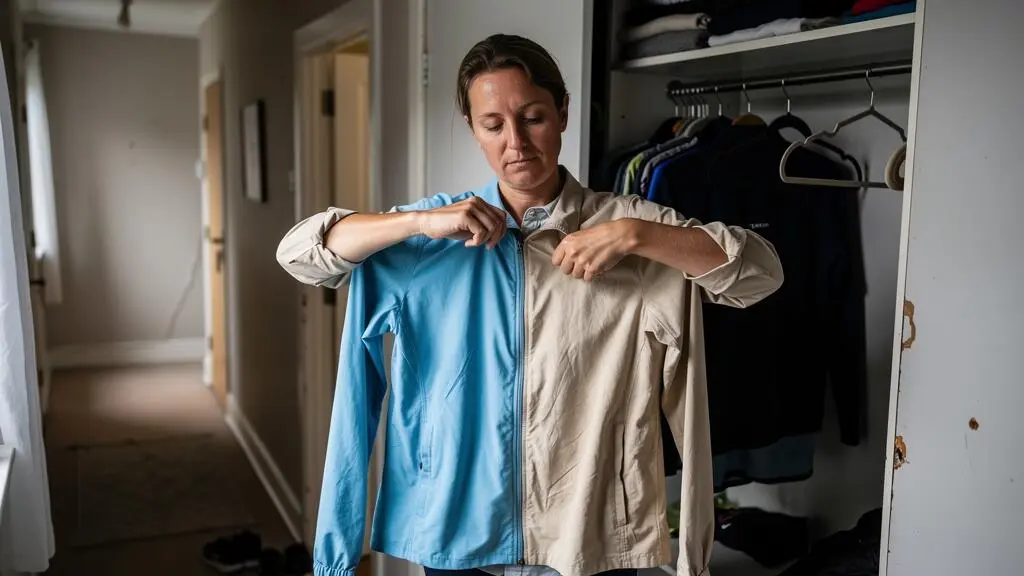
A polyester running top can feel more comfortable than cotton during exercise, yet the same fibre may be less pleasant in an office shirt worn all day. A lightweight synthetic jacket may also be a sensible choice for a wet British commute, even for someone trying to reduce their environmental impact.
Synthetic fibres are not inherently bad, and natural fibres are not automatically better. Polyester, nylon and elastane can offer useful combinations of strength, stretch, quick drying and shape retention. Their drawbacks include potential odour retention, discomfort in poorly ventilated fabrics and the release of plastic microfibres.
The distinction matters because a garment’s performance depends on more than its fibre label. Yarn structure, fabric density, finishes, construction and how the clothing is used can change the result substantially. Recycled content adds another consideration, but it does not settle questions about quality or environmental impact.
A responsible choice starts with the garment’s intended purpose, followed by a realistic assessment of comfort, durability, care and material sourcing.
Synthetic fibres: what matters most
- Choose by activity: synthetics can excel in quick-drying sportswear and weather-resistant outerwear, while cotton and wool may suit other everyday conditions better.
- Look beyond composition: breathability, odour, static and longevity depend on fabric construction, fit, finishing and care, not just polyester percentages.
- Question environmental claims: recycled certification verifies specified sourcing criteria, but does not eliminate microplastic shedding or guarantee garment durability.
- Why Do Synthetic Fibres Outsell Naturals Even When People Say They Prefer Cotton?
- How to Read Fibre Blends So You Don’t End Up Sweaty, Static, and Uncomfortable?
- Polyester or Nylon: Which Performs Better for Outerwear in UK Rain and Wind?
- The “Recycled” Assumption That Leads to Disappointing Quality After 10 Wears
- When Should You Avoid Synthetic Fibres Because They Lock in Odour Too Easily?
- How to Check a Recycled Fibre Claim in 3 Details Before You Pay More?
- Why Do Modern Fabrics Feel Lighter Yet Sometimes Less Breathable Than Older Clothes?
- Do Certified Recycled Fibres Actually Perform Well, or Is It Mostly a Label?
Why Do Synthetic Fibres Outsell Naturals Even When People Say They Prefer Cotton?
Synthetic fibres dominate global production because they can deliver useful properties at commercially competitive prices, including easy care, shape retention and fast drying. Cotton remains popular for its familiar feel and moisture absorption, but expressed preference is not the same as purchasing behaviour. Global production figures demonstrate synthetic dominance without proving why individual shoppers choose particular garments.
According to Textile Exchange’s Materials Market Report 2026, polyester represented 59% of global fibre production in 2025, compared with approximately 18% for cotton. Worldwide fibre production reached an estimated 139 million tonnes.
59%
Polyester’s estimated share of global fibre production in 2025. This measures production across textile and related applications, not UK clothing purchases or consumer preferences.
Textile Exchange, Materials Market Report 2026.
These figures reveal the scale of polyester production, but do not establish a direct contradiction between what British consumers say they prefer and what they buy. That would require consumer-preference research linked to actual purchasing data.
The practical attractions are nevertheless identifiable. Polyester absorbs comparatively little water into the fibre itself, helping suitable fabrics dry quickly after exercise or laundering. Nylon can offer toughness in lightweight constructions, while elastane adds stretch and recovery when incorporated into a fabric.
For a hypothetical shopper comparing two similarly priced everyday tops, a polyester-rich option might retain its shape and dry sooner, while a cotton-rich option could feel more comfortable during sedentary indoor wear. Neither outcome is guaranteed by the label alone.
Modern synthetic clothing also deserves to be judged separately from the reputation of older polyester garments. Fibre fineness, yarn engineering, knitting technology and finishing treatments allow manufacturers to create fabrics with very different textures and moisture-management behaviour.
However, describing modern synthetics as uniformly breathable or comfortable would repeat the same oversimplification in the opposite direction. An advanced yarn can still become uncomfortable in a tightly constructed, poorly ventilated garment.
The next question is how to identify those properties on a clothing label before a comfortable-looking garment becomes unpleasant to wear.
How to Read Fibre Blends So You Don’t End Up Sweaty, Static, and Uncomfortable?
Read a fibre blend by identifying the largest component, understanding what the smaller fibres contribute, and then examining the fabric’s structure and intended use. Polyester-rich blends may dry quickly but feel clammy in some conditions; cotton-rich blends can absorb sweat but remain damp longer. Static and breathability also depend on layering, humidity and construction.
Start with the composition label. In the UK, textile fibre composition is generally declared using percentages by weight, so the largest listed percentage indicates the dominant fibre. Remember that composition describes material content, not how a garment will actually behave against your skin.
For example, a hypothetical 65% polyester and 35% cotton T-shirt contains more polyester by weight, but that alone does not reveal whether it has an open, airy knit or a dense surface. Similarly, a garment containing 95% cotton and 5% elastane may feel noticeably stretchier than a pure cotton alternative.
These typical constructions illustrate how to interpret the information without treating blend ratios as universal comfort guarantees.
| Composition example | Potential advantage | What to check |
|---|---|---|
| 100% cotton | Absorbent, familiar skin feel | Drying time, shrinkage and dampness during exertion |
| 65% polyester / 35% cotton | Potential balance of easy care and absorbency | Airflow, sweat handling and odour after wear |
| 95% cotton / 5% elastane | Stretch in an otherwise cotton-rich fabric | Recovery, fit and care requirements |
| 100% polyester | Fast-drying potential and dimensional stability | Knit openness, finish and odour retention |
| Polyamide / elastane blend | Stretch, strength and close-fitting comfort | Compression, ventilation and heat build-up |
The two main moisture-related discomfort patterns are different. Cotton can absorb perspiration and hold considerable moisture within the fibre. In cold or wet conditions, the resulting damp fabric may be uncomfortable against the skin. Polyester absorbs much less moisture internally, but sweat can still accumulate between the fabric and the body if ventilation or moisture transport is inadequate.
Static electricity is another independent issue. Friction between fabrics can transfer electrical charge, particularly under dry indoor conditions. Synthetic layers may accumulate noticeable charge when rubbed together, although static is not exclusive to synthetics.
If static is a recurring problem, try changing the combination of garments, avoiding excessive tumble drying and checking whether one of the layers creates most of the friction. Indoor humidity can also affect charge accumulation.
Labels such as “performance blend” are not substitutes for a composition declaration. Where possible, inspect the garment against a light source, stretch the fabric gently, feel the surface and check independent comments about comfort after repeated wear.
No specific polyester-to-cotton ratio guarantees the absence of sweat, odour or static. The same blend can perform differently when knitted, woven, brushed or tightly finished.
For outerwear, however, a different set of properties matters: water resistance, wind protection, abrasion and the construction of the entire jacket.
Polyester or Nylon: Which Performs Better for Outerwear in UK Rain and Wind?
Polyester and nylon can both work well for British outerwear. Polyester generally absorbs less water into the fibre and retains dimensional stability in damp conditions, while nylon can offer excellent abrasion resistance in appropriate constructions. For staying dry in persistent rain, however, the waterproof membrane, seams and garment design matter more than whether the shell uses polyester or nylon.
Polyester is a sensible choice for many commuter shells because of its low moisture absorption, relatively quick drying and good resistance to sunlight in typical textile applications. Nylon, also labelled polyamide, can be particularly useful where a jacket experiences regular friction from rucksack straps or repeated contact with rough surfaces.
These are broad material tendencies, not guarantees. Yarn size, weave density, fabric coatings and weight can reverse the apparent advantage of a particular fibre in a finished jacket.
Most importantly, water repellency is not the same as waterproofness. A durable water-repellent treatment, often called DWR, helps droplets bead on the outer surface. A waterproof coating or membrane provides the main barrier against penetrating rain, while seam sealing prevents water from entering through stitched areas.
A jacket can shed droplets attractively during a brief shower and still leak during prolonged rain. Conversely, a waterproof membrane may continue to prevent penetration even when the outer DWR has deteriorated, although the saturated face fabric can reduce comfort and moisture-vapour transfer.
Before purchasing, check the stated hydrostatic-head rating where available, whether critical or all seams are taped, how well the hood adjusts and whether the closures are protected against rain. A water-beading demonstration offers information about surface repellency, not proof of waterproof construction.
| Consideration | Polyester | Nylon (polyamide) |
|---|---|---|
| Fibre moisture absorption | Generally lower | Generally higher |
| Dimensional stability when damp | Generally favourable | Can change more with moisture uptake |
| Abrasion resistance | Depends on construction | Often strong in suitable constructions |
| UV resistance | Generally favourable | More dependent on formulation and protection |
| Actual waterproofness | Depends on coating, membrane and seams | Depends on coating, membrane and seams |
For a short walk to a railway station, a light water-resistant jacket may be adequate. For prolonged outdoor exposure, the construction and waterproof specification deserve greater attention than fibre branding. For frequent cycling or carrying a heavy bag, abrasion resistance and freedom of movement become additional priorities.
A jacket that protects against rain but loses its coating or develops seam damage prematurely is not a successful long-term purchase, recycled material or otherwise.
The “Recycled” Assumption That Leads to Disappointing Quality After 10 Wears
Recycled polyester is not automatically weaker than virgin polyester, and a garment that deteriorates after ten wears cannot be blamed on recycled content alone. Recycling processes can affect polymer quality, but fibre production can compensate for some limitations. Fabric density, yarn quality, stitching, finishing and garment care are often more useful indicators of early failure.
Recycled polyester is commonly manufactured by collecting PET material, processing it and producing polyester feedstock suitable for spinning into fibres. In mechanical recycling, heating and reprocessing can reduce polymer chain length under some conditions. That may affect material properties unless the process includes appropriate control, restoration or blending.
It would nevertheless be misleading to conclude that every mechanically recycled polyester fibre is inferior. Recycled yarns can meet demanding performance specifications, while poorly engineered virgin-polyester fabrics can pill, distort or tear early.
There is another distinction that sustainability labels rarely make obvious: recycled inputs do not necessarily come from discarded clothing.
Textile Exchange estimates that approximately 97% of recycled polyester production in 2025 used plastic bottles as its feedstock. Textile-to-textile recycled fibres represented approximately 0.76% of worldwide fibre production that year, across fibre types.
Turning bottles into garments can replace some virgin polyester inputs, but it is not the same as recovering polyester from discarded clothing and producing new textile fibre. The resulting garment also does not automatically enter an effective recycling system when it reaches the end of its useful life.
For a shopper disappointed after ten wears, the immediate question should be what actually failed.
- Surface pilling: inspect yarn quality, fibre behaviour and fabric friction rather than assuming recycled content caused it.
- Seams coming apart: examine stitch integrity, seam allowance and construction quality.
- Loss of shape: consider fabric recovery, heat exposure and whether the garment has been cared for as instructed.
- Thinning or holes: assess abrasion points, fabric weight and repeated mechanical stress.
These checks do not establish laboratory-grade durability, but they distinguish visible manufacturing or use-related failures from an unsupported assumption about recycling.
There is also a behavioural trap. A garment marketed as sustainable may appear to justify another purchase, even when the buyer already owns suitable clothing. If the new item is worn rarely or replaced quickly, the sourcing claim alone cannot demonstrate an environmental benefit.
Buying fewer useful garments and keeping them in service for longer can be a more meaningful decision than choosing between two products solely on the word “recycled”.
Longevity also depends on whether a garment remains pleasant enough to wear, which makes odour retention an important consideration for close-fitting everyday clothing.
When Should You Avoid Synthetic Fibres Because They Lock in Odour Too Easily?
Consider avoiding odour-prone synthetic fabrics for close-fitting garments that must stay fresh through long days or repeated wears without washing. Polyester can retain and release some odour-related compounds differently from cotton or wool, but there is no universal rule that all synthetic clothing smells worse. Fibre chemistry, fabric construction, finishing and washing all influence the outcome.
Body odour on clothing involves a combination of sweat, skin oils, microorganisms and volatile compounds. Some substances interact more readily with hydrophobic fibre surfaces or oily residues, while others are absorbed and released differently by cellulosic and protein fibres.
A 2024 Textile Research Journal study on odour retention in textile fibres investigated selected odorous volatile compounds applied through a synthetic sweat solution. The researchers examined cotton, mercerised cotton, viscose, wool, nylon and polyester, with measurements after 30 minutes, three hours and 24 hours.
The behaviour depended on the fibre, compound and observation period. Nylon generally released higher quantities of certain ketones and aldehydes at 30 minutes, while polyester showed higher release intensities for those compounds after 24 hours.
Laboratory evidence: odour behaviour changes over time
Researchers compared six textile fibre types exposed to selected volatile compounds in synthetic sweat, measuring their subsequent release under controlled conditions.
Differences between nylon, polyester and cellulosic fibres changed across the measurement intervals. The experiment demonstrates material-dependent sorption and release, but does not rank finished garments by everyday odour complaints.
In practical terms, a polyester sports top may perform well during a single workout because it handles moisture efficiently, yet retain unpleasant smells after repeated use. A tightly fitted synthetic office base layer could present a similar issue, especially where body oils accumulate near the underarms.
By contrast, a synthetic rain shell worn over other clothing has less direct skin contact and may be a lower odour concern. The same applies to many accessories or garments that rarely absorb significant perspiration.
Blends can offer a compromise. Merino wool or cotton combined with synthetic fibres may provide a different balance of moisture behaviour, care and durability. The percentage alone, however, cannot guarantee odour resistance.
Antimicrobial treatments can be another option. Some use silver-based compounds or other active chemistries intended to inhibit microbial growth. Their effectiveness varies, and concerns about substance release during washing and potential environmental exposure should not be ignored. Reducing bacterial growth is also not identical to preventing every form of odour retention.
For a practical personal test, wear a clean garment through an ordinary day, air it overnight and check the underarm area before considering another wear. Repeat the assessment after normal laundering. This is a useful consumer comparison, not a scientifically validated test or a substitute for washing when hygiene requires it.
If a recycled synthetic top performs well in those conditions, its environmental claims still need separate scrutiny before a higher purchase price is justified.
How to Check a Recycled Fibre Claim in 3 Details Before You Pay More?
Check the recycled percentage, the certification behind the claim and which parts of the garment it covers. A recycled label can describe genuine material sourcing without proving that the whole garment is recycled or unusually durable. Before paying a premium, establish exactly what is being claimed and whether credible product-level evidence supports it.
The first detail is the actual percentage. A description such as “made with recycled materials” is less informative than a specific declaration such as “outer fabric: 100% recycled polyester”. It does not automatically tell you how much recycled material is present across the finished garment.
The second is the standard or certification. The Recycled Claim Standard (RCS) and Global Recycled Standard (GRS) provide third-party verification of recycled content and chain of custody. GRS also includes additional social, environmental and chemical-processing requirements.
As explained in Textile Exchange’s explanation of the RCS and GRS standards, the schemes are not interchangeable. In particular, the GRS threshold for business-to-business certification should not be confused with the higher threshold required for consumer-facing GRS product labelling.
The third detail is claim coverage. A jacket might contain recycled polyester in its outer shell but virgin material in its lining, zips, elastic components or trims. The prominence of a recycled claim does not indicate how much of the garment’s total mass it covers.
For example, imagine a hypothetical jacket advertised as containing 100% recycled polyester. The statement may be accurate for the shell material while leaving the composition of the lining and trims unspecified. Asking which component the percentage describes prevents an exaggerated interpretation without automatically dismissing the claim.
Certification documents, product identification and retailer information should be consistent. An unqualified claim based only on a manufacturer’s general certification is less persuasive than a clearly identified product claim supported by the relevant documentation.
The following checklist brings sourcing and construction together into a practical buying decision.
Five checks before buying a recycled-fibre garment
- Record the fibre breakdown: find the composition label and write down each declared percentage, including separate shell and lining compositions where supplied.
- Identify recycled content: note the exact recycled percentage and which material or garment component it describes.
- Verify the certification claim: record the named standard and check whether available evidence relates to the finished product rather than only the supplier.
- Inspect construction quality: examine fabric density, stitching, seams and high-friction areas, noting any visible weaknesses.
- Make a documented comparison: compare the price, intended use, available quality evidence and expected frequency of wear with a suitable alternative.
Meeting all three recycled-claim checks makes the sourcing statement more credible; it does not prove that a price premium is justified. Higher prices can reflect many factors unrelated to recycled content, and environmental superiority requires evidence beyond certification alone.
If the manufacturer cannot explain a prominent recycled claim, treat the missing information as a reason to investigate further rather than making an unsupported accusation of greenwashing.
Once sourcing is clear, comfort remains a separate question, particularly with the lightweight fabrics now common in everyday clothing.
Why Do Modern Fabrics Feel Lighter Yet Sometimes Less Breathable Than Older Clothes?
Modern garments can feel lighter yet less breathable because fabric weight and ventilation measure different properties. Fine yarns, compact constructions and thin coatings can reduce mass while restricting airflow. Some fabrics transfer moisture vapour effectively without allowing much air circulation, so a lightweight jacket or top may still feel hot or clammy during ordinary wear.
Manufacturers can reduce garment weight through finer fibres, lighter yarns, thinner fabric constructions and more efficient material engineering. But reducing weight does not automatically increase the size or continuity of pores through which air can pass.
Breathability is particularly confusing because the term is used for two distinct mechanisms.
- Air permeability describes how readily air flows through a textile under specified conditions. Open knits and loose constructions can allow more airflow than tightly woven or coated materials.
- Moisture-vapour transfer concerns how water vapour moves through a fabric or clothing system. It depends on material structure, environmental conditions and the resistance of the garment’s layers.
A waterproof jacket may permit some moisture-vapour movement through its membrane while allowing almost no direct airflow through the main fabric. Without effective ventilation, moisture can still accumulate inside during exertion.
Conversely, an open-knit top can feel cool because it allows air movement, even when its constituent fibres absorb little moisture. The experience depends on temperature, humidity, activity, fit and the layers worn underneath.
Older cotton-rich garments sometimes feel more forgiving during casual indoor use because cotton absorbs moisture and can temporarily buffer changes in humidity near the skin. That does not mean older clothing was universally more breathable or better engineered. A thick cotton sweatshirt, for example, may be much less suitable for vigorous exercise in cold conditions than a carefully designed technical base layer.
For warm-weather walking or indoor daily wear, evaluate airflow and loose fit alongside fibre composition. For exercise, consider how rapidly the fabric moves and releases moisture under the expected conditions. For exposed, windy environments, accepting lower air permeability may be necessary to preserve weather protection.
Try a garment in realistic movement, not simply while standing still. Raise your arms, walk briskly and assess whether the fabric clings when slightly damp. Where technical measurements are available, distinguish air permeability from moisture-vapour resistance rather than assuming one figure represents all aspects of comfort.
The environmental implications also matter. Lightweight synthetic fabrics can shed microfibres, although the amount released varies with fabric and use.
The European Environment Agency assessment of microplastics from synthetic textiles identifies washing as an important release pathway, alongside other stages including manufacturing, wearing and waste treatment. Its estimates of EU releases in 2019 cover a very broad range, reflecting substantial measurement uncertainty.
The assessment does not establish the microplastic emissions of any particular jacket or T-shirt, nor does it demonstrate that recycled polyester necessarily sheds more or fewer particles than virgin polyester.
For a practical reduction in unnecessary fibre release, follow care instructions, avoid needless abrasive washing and keep garments in good condition. These are sensible maintenance measures, not a guarantee that microfibre pollution is eliminated.
These performance distinctions are essential when deciding whether recycled-fibre certification describes a genuinely useful product or simply a verified material input.
Key takeaways before choosing certified recycled fibres
- Separate sourcing from performance: certification can establish recycled-content and traceability requirements without measuring comfort or longevity.
- Judge the finished fabric: construction, quality control and suitability for the activity determine whether a garment is worth keeping.
- Consider the full trade-off: reduced virgin feedstock demand does not automatically eliminate microplastic pollution or establish a superior whole-life environmental outcome.
Do Certified Recycled Fibres Actually Perform Well, or Is It Mostly a Label?
Certified recycled synthetic fibres can perform well, but certification and garment quality answer different questions. RCS and GRS can substantiate recycled sourcing and traceability, with GRS imposing additional processing requirements. Neither standard guarantees a garment will resist pilling, retain its colour or last for years. Performance must be assessed through the fabric, construction and intended use.
Recycled polyester made through well-controlled processes can achieve properties suitable for demanding clothing applications. Whether it matches a particular virgin-polyester alternative depends on polymer quality, production conditions, yarn specifications and the design of the finished textile.
For example, a high-quality recycled-polyester running top may be comfortable, lightweight and durable for its intended purpose. A loosely constructed recycled-polyester jumper may pill quickly. A virgin-polyester garment could exhibit either outcome. The recycled percentage does not establish a reliable performance ranking between them.
Certification has an important but limited function. RCS focuses on verifying recycled content and chain of custody. GRS adds relevant social, environmental and chemical-processing criteria. These requirements provide sourcing-related assurance, rather than the equivalent of independent testing for abrasion resistance, colour fastness or repeated laundering.
Specific quality questions therefore require different evidence.
| Question | Relevant evidence | Important limitation |
|---|---|---|
| Is recycled material genuinely used? | Applicable recycled-content certification and traceability documents | Check product-level claim and component coverage |
| Will the fabric resist pilling? | Relevant fabric testing and observed wear performance | Certification does not establish a pilling grade |
| Will the colour remain stable? | Colour-fastness testing under relevant conditions | Recycled content does not guarantee dye performance |
| Will the garment retain its shape? | Dimensional-stability testing, fabric recovery and care performance | Construction and laundering conditions affect results |
| Will it be comfortable? | Airflow, moisture management, fit and actual wear conditions | Comfort is not certified by a recycled-content label |
| Does it have a lower overall environmental impact? | A suitably scoped environmental assessment | Certification alone does not prove whole-life superiority |
Consumers rarely have access to full laboratory test results. More accessible indicators include fabric weight in grams per square metre (gsm), if provided, yarn and knit compactness, stitch consistency, seam finishing and retailer information about repeated-wash testing. Higher fabric weight alone is not a universal indicator of better quality, and a tightly constructed textile is not necessarily comfortable or durable in every application.
Also consider whether a recycled product genuinely replaces the purchase of a virgin-fibre alternative. Buying a suitable garment that remains useful over many wears is a more defensible choice than buying additional low-quality clothing because its label sounds environmentally reassuring.
Microplastic release remains an unresolved trade-off rather than a problem removed by certification. Synthetic garments can shed plastic microfibres, and evidence does not justify a blanket claim that recycled polyester always sheds less than virgin polyester. Likewise, recycled sourcing should not be treated as proof that manufacturing, washing and disposal have no significant environmental consequences.
A balanced daily wardrobe may therefore contain synthetic rainwear, technical exercise clothing, cotton-rich basics and wool garments, chosen for their different functions. The aim is not to maximise or eliminate one fibre category, but to avoid garments that are poorly suited to the way they will actually be worn.
Before your next clothing purchase, identify its main purpose, read the composition and any recycled claim, examine the construction and consider how often you are likely to wear it. Choose the garment that meets those needs with credible quality and sourcing information, whether it is natural, synthetic or blended.
Are synthetic clothes safe to wear against your skin every day?
Most conventional synthetic clothing is intended for regular skin contact, and the presence of polyester or nylon alone does not establish a health hazard. Individual reactions may depend on dyes, finishing substances, friction, heat and skin sensitivity. Microplastic shedding is a documented environmental concern, but the evidence presented here does not establish that wearing every synthetic garment creates a specific personal health risk.
Does washing synthetic clothing in cold water prevent microplastic pollution?
No. Water temperature can influence textile care and some shedding processes, but washing synthetic clothing in cold water does not prevent all microfibre release. Mechanical action, fabric construction, garment condition and washing procedures also matter. Follow garment-care instructions and avoid unnecessary washing or abrasive treatment, while recognising that these measures do not eliminate emissions.
Is 100% polyester always worse than a cotton-polyester blend?
No. Pure polyester may be useful for quick-drying sportswear or lightweight outdoor clothing. Cotton-polyester blends can provide a different balance of absorbency, feel and care requirements. Neither composition guarantees comfort, odour resistance or durability. The best choice depends on the textile’s structure and the conditions in which it will be worn.
Can a garment be made from recycled polyester and still contain virgin plastic?
Yes. A garment can use recycled polyester in one component while containing virgin polyester, elastane or other materials elsewhere. Even a statement that one fabric component is made entirely from recycled polyester does not establish that every component of the finished garment is recycled. Check which material and percentage the claim describes.
Is keeping an existing synthetic garment better than replacing it with a natural-fibre alternative?
Continuing to use a functional garment avoids the immediate need to manufacture a replacement. However, the full environmental comparison depends on factors such as laundering, garment lifespan, fibre releases and the impacts of any alternative. Replacing a perfectly serviceable polyester garment simply because it is synthetic is not automatically a more responsible decision. Its actual usefulness and remaining lifespan should be considered first.