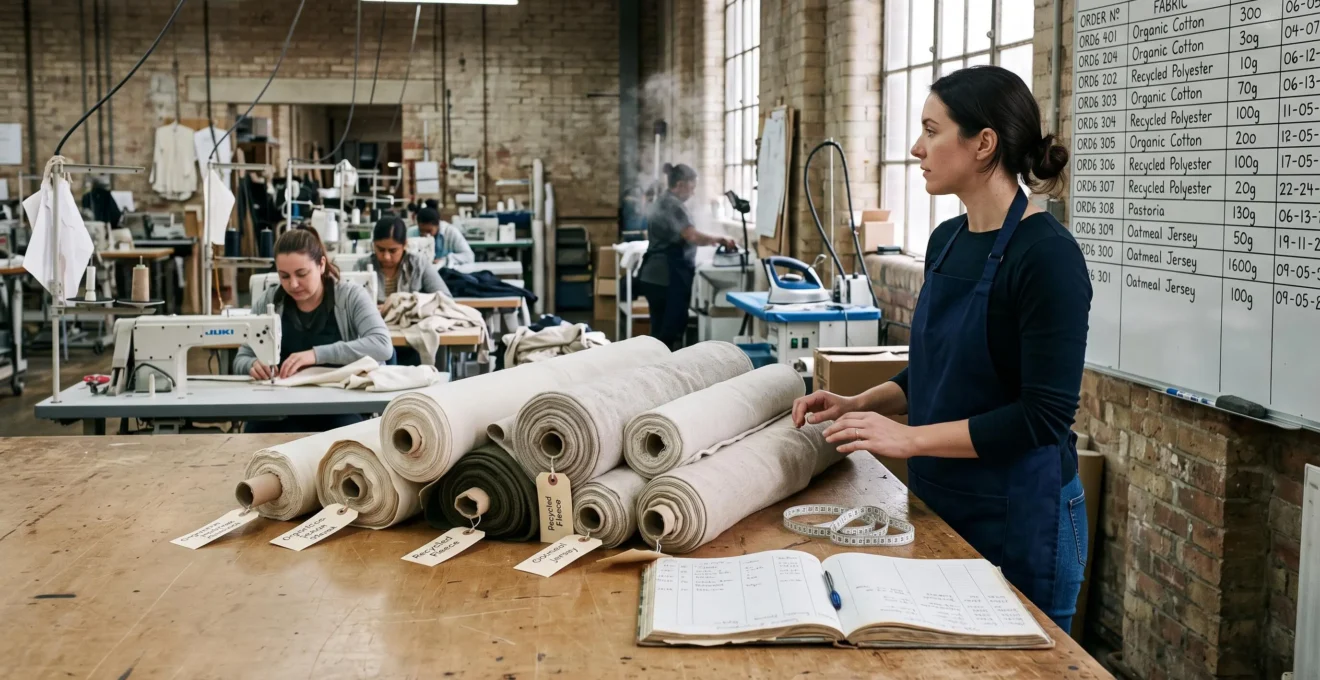
Eco-responsibility changes clothing production long before the first garment reaches a sewing machine. A decision to use certified recycled fibres, reduce unnecessary sampling or change a dyeing process can affect supplier selection, purchasing quantities, technical specifications, production schedules and quality control.
For a small clothing brand, the central difficulty is not identifying an environmentally preferable option. It is determining whether that option can be manufactured reliably at the required volume, within the available budget and without creating avoidable waste.
A fabric substitution may require new laboratory tests. A supplier’s minimum order quantity may exceed the collection’s expected demand. A slower sourcing cycle may force a choice between extending the launch calendar and paying for faster transport. Even a promising digital development tool can create additional work if the factory cannot use its outputs.
The operational answer is to treat sustainability as a sequence of production decisions, not as a specification added after product development. Each improvement needs a measurable objective, a feasible supply route and a quality standard that remains intact.
What eco-responsible clothing production changes in practice
- Planning becomes supply-chain dependent: material availability, certification documents and subcontractor capacity can determine when production starts.
- Small volumes change the economics: minimum order quantities, development costs and unused fabric can undermine an apparently attractive material substitution.
- Quality and environmental improvements need controlled implementation: verified materials, staged technical tests and genuinely reduced physical sampling are more dependable than changing everything simultaneously.
- Why Does Eco-Responsible Production Often Take Longer Even With “Modern” Factories?
- How to Choose the First Eco-Responsibility Lever Without Doubling Your Production Costs?
- Materials or Logistics: Which Eco Choice Matters More for a Small Production Run?
- The Sustainability Promise That Backfires When Production Minimums Kick In
- In What Order Should You Upgrade Production Practices So Quality Doesn’t Dip?
- Why Are Brands Moving to 3D Sampling Even When It Still Looks “Unreal” on Screen?
- How to Check a Recycled Fibre Claim in 3 Details Before You Pay More?
- Why Are Brands Moving to 3D Sampling Even When It Still Looks “Unreal” on Screen?
Why Does Eco-Responsible Production Often Take Longer Even With “Modern” Factories?
Eco-responsible clothing production can take longer because certified inputs, traceability checks and specialist processing capacity must be available at the same time. Modern cutting and sewing equipment cannot compensate for fabric that has not arrived or a dyeing subcontractor that lacks capacity. The critical lead time therefore belongs to the entire supply chain, not simply the garment factory.
A conventional fabric may already be held in a supplier’s warehouse. An alternative containing certified fibres may instead depend on a particular spinning, weaving or knitting run. If the required construction, colour or quantity is unavailable, the brand must align its production calendar with the supplier’s next confirmed opportunity.
Three sources of delay need to be separated during planning:
- Documentation: checking supplier certification, chain-of-custody arrangements and transaction records can delay the release or acceptance of materials if the required documents are incomplete.
- Material validation: a replacement fabric may need testing for shrinkage, dimensional stability, colour performance and cutting behaviour before production can proceed.
- Capacity scheduling: specialised fibre, dyeing or finishing orders may depend on production slots that are not continuously available.
These are possible sources of latency, not evidence that every certified material takes longer to manufacture. A certified fabric already approved and stocked by the existing supplier may require little additional lead time.
The scheduling risk becomes greater when the main factory uses external dyeing, washing or finishing facilities. A factory may have immediate sewing capacity while an upstream processor remains the bottleneck. Asking only for the garment assembly lead time gives an incomplete picture.
A practical lead-time assessment should map each material and processing stage, identify where a certified alternative replaces an established input, and record whether the relevant supplier is already approved. For every new link, request the confirmed availability date, required validation and capacity reservation deadline.
Once those dependencies are visible, a brand can distinguish unavoidable sourcing constraints from delays caused by introducing too many unfamiliar production requirements at once.
How to Choose the First Eco-Responsibility Lever Without Doubling Your Production Costs?
The best first sustainability improvement is usually the one with a credible environmental benefit and the lowest implementation complexity for the existing production system. A material already handled by an established supplier may be preferable to an ambitious alternative requiring new factories, patterns and tests. The objective is to improve a measurable outcome without multiplying technical and commercial risks.
Begin by comparing each possible improvement against the production stages it changes. Replacing a main fabric, optimising cutting layouts, consolidating shipments and reducing physical samples have different cost structures. Their environmental value also depends on the original process and what the proposed change actually replaces.
The quoted fabric price is only one part of a substitution’s cost. A new textile may have a different usable width, shrinkage rate or drape. These differences can increase cutting consumption, require pattern redevelopment or create additional sample rounds.
Likewise, introducing a new supplier may involve commercial qualification, technical testing, document verification and extra coordination. These costs can outweigh a modest material saving.
For low-volume collections, fixed development and verification costs are spread across fewer garments. An improvement to cutting efficiency or shipment planning may therefore be easier to justify initially than commissioning a new fabric construction.
A useful prioritisation approach is to score candidate improvements on expected environmental benefit, direct expenditure, implementation effort, technical risk and ability to measure the outcome. A high-impact proposal that requires complete redevelopment should not automatically outrank a smaller, verifiable change.
Before approving a material substitution, ask the current supplier whether it has previously manufactured the same or a technically comparable material for another customer. Existing production experience can reduce uncertainty, although the brand must still validate its own garment.
The first successful improvement should also leave reliable technical data behind. That evidence makes the next change easier to assess and reduces the temptation to rely on untested assumptions.
Materials or Logistics: Which Eco Choice Matters More for a Small Production Run?
Neither materials nor logistics is automatically the better sustainability choice for a small production run. The priority depends on fabric impacts, cutting waste, transport mode, distance and the additional production required by the alternative material. An available lower-impact fabric may be valuable, while avoiding an urgent air shipment can be decisive in a transport-intensive supply chain.
Two different measurements matter: environmental impact per garment and total impact for the collection. A change that improves the first can worsen the second if it requires manufacturing substantially more material or garments than customers need.
Material selection affects the physical product and often its upstream manufacturing processes. Logistics choices affect the movement of fabrics, components, samples and finished goods. Their relative importance cannot be established from production volume alone.
For instance, consolidating consignments may improve transport efficiency without changing the garment specification. But if delivery deadlines force air freight instead of a slower mode, logistics deserves closer attention. Conversely, a fabric with high manufacturing impacts or poor cutting utilisation may present a more important opportunity than a minor delivery adjustment.
The following comparison helps determine which variable should receive attention first.
| Production condition | Material priority | Logistics priority |
|---|---|---|
| Approved alternative fabric already in stock | Compare performance, evidence and actual material impacts | Keep planned transport arrangements efficient |
| Certified fabric MOQ exceeds the requirement | Assess surplus, alternative stock and shared purchasing | Consider whether existing material offers a more feasible route |
| Urgent international delivery requires air transport | Avoid introducing changes that cause further delays | Evaluate schedule changes and slower transport options |
| New fabric requires extensive redevelopment | Include prototype waste, testing and yield changes | Consider improvements available without product redesign |
When a certified material has an unsuitable minimum order quantity, three purchasing alternatives deserve investigation: sourcing supplier-held stock, combining requirements with other buyers where available, or adjusting the design to use a greater share of the purchased fabric.
The final option needs particular scrutiny. Creating additional styles or colours solely to consume surplus material can shift the problem from unused fabric to unsold garments.
For small brands, a modest improvement that fits confirmed demand may be more defensible than an apparently superior input that forces an unwanted increase in purchasing volume.
The Sustainability Promise That Backfires When Production Minimums Kick In
A sustainability commitment can backfire when a brand must purchase or manufacture more than it can sell to meet supplier minimum order quantities. An environmentally preferable input does not automatically compensate for unnecessary production. If the purchasing decision creates excess fabric, unwanted garments or additional processing, the actual benefit must be reassessed rather than assumed.
Minimum order quantities, or MOQs, operate at different points in the supply chain. A spinning mill may specify a minimum yarn order, a fabric mill may impose its own production quantity, and a garment factory may require a minimum number of units per style or colour.
These requirements are not interchangeable. A brand might satisfy its garment factory’s minimum while still failing to meet the fabric supplier’s minimum. Restricted fabric widths, colours or finishes can introduce further design constraints.
Hypothetical example: a certified fabric commitment
Consider a small brand developing a limited collection using a particular certified recycled fabric. The fabric supplier can only produce more metres than the collection requires, while the garment factory accepts the planned number of units.
The brand faces a choice: hold unused certified fabric, manufacture additional garments without proven demand, redesign the collection or source an existing alternative. The correct decision depends on the inventory plan, environmental impact and commercial feasibility; the recycled label alone does not determine the answer.
Marketing commitments can make this conflict harder to resolve. Announcing a fully recycled collection before checking material availability may leave the brand choosing between changing a public claim and over-ordering to preserve it.
Before confirming a collection brief, request the supplier’s material availability history, expected replenishment schedule, minimum quantity by colour and any tolerance around the ordered amount. Also establish whether leftover material can be held against a later confirmed order and what happens if demand changes.
Negotiating flexibility early is generally more useful than attempting to solve surplus inventory after a production commitment has been signed.
The safest production promise is one supported by real purchasing conditions, verified material availability and a credible plan for using what is ordered.
In What Order Should You Upgrade Production Practices So Quality Doesn’t Dip?
Production improvements should be introduced in stages, beginning with changes that can be tested independently and progressing towards more disruptive process or supplier changes. A sensible sequence is to validate replacement materials, adjust finishing and dyeing processes, then consider structural changes to manufacturing or logistics. Every stage needs quality acceptance criteria before the next variable changes.
The purpose of this order is diagnostic control. If a brand changes its fabric, dyeing process and garment factory simultaneously, it becomes difficult to determine why a garment shrinks, loses colour or fits differently. Corrective action becomes slower and potentially more expensive.
A material substitution should begin with a technical baseline from the approved original product. Relevant measurements may include fabric weight, usable width, stretch and recovery, dimensional stability, garment drape and cutting consumption.
Changes to colouration or finishing require their own validation. The ISO 105-C06 colour-fastness testing standard provides methods for evaluating textile colour resistance to specified laundering conditions. It does not replace separate assessments of shrinkage, seam strength or other garment performance characteristics.
Factory-level changes belong later in the sequence because different equipment, operators and operating procedures can introduce additional variability. A trial that succeeds on a sample line must also be reproducible during the intended production run.
Five checks before approving a production upgrade
- Document the original product: produce an approved baseline specification with fabric properties, measurements and quality tolerances.
- Test the proposed material: obtain laboratory results and a comparison sheet covering the relevant fabric performance characteristics.
- Validate garment construction: approve a prototype inspection report covering fit, seams, drape and anticipated cutting consumption.
- Run a controlled production trial: record processing conditions, defects, operators’ observations and corrective actions in a trial report.
- Approve repeatability: issue a signed production specification containing process settings, quality checkpoints and acceptance criteria.
The last step matters because a successful small trial does not guarantee identical results at a larger scale. Production volume, machine settings, operator training and process control can all affect consistency.
With the manufacturing baseline secured, brands can also examine development-stage waste, particularly repeated physical samples that may never become saleable products.
Why Are Brands Moving to 3D Sampling Even When It Still Looks “Unreal” on Screen?
Brands adopt 3D garment sampling because its principal value is reducing physical development iterations, not producing perfectly realistic screen images. Digital prototypes can help teams review proportions, pattern geometry and simulated fabric behaviour before requesting a sewn sample. When this process genuinely replaces physical work, it can reduce sampling materials, shipments and development time.
The distinction between technical and marketing uses is important. A digital garment may be useful for pattern review while still looking unsuitable for an e-commerce campaign. Treating visual realism as the only measure of success overlooks the operational purpose of the software.
Digital sampling can support early comparisons between pattern variations, garment lengths and design proportions. It may also help teams assess material usage before cutting physical fabric, provided the underlying pattern and material data are sufficiently accurate.
Environmental benefits arise when a virtual iteration eliminates a real sample and its associated production activities. Merely adding a digital prototype before producing the same number of physical samples does not deliver the same saving.
Up to 73%
Reduction in sample preparation time reported in the investigated scenarios of a comparative life-cycle assessment using four garment models. This is a sampling-stage finding, not a universal reduction in total clothing production time.
2026 study on the environmental benefits of virtual garment sampling, published in Journal of Cleaner Production.
The same study reported reductions of approximately reductions in several assessed environmental impact indicators of 85–90 % when comparing virtual and conventional sampling in its investigated scenarios. Those findings cannot be applied directly to every clothing brand or entire production system.
The technical limitation is fabric characterisation. If an unfamiliar textile has not been represented adequately in the simulation system, its virtual drape or stretch may differ from its real behaviour. Recycled content or organic origin alone does not determine whether a material is difficult to simulate; the relevant mechanical properties matter.
Physical validation therefore remains necessary where simulation data are incomplete or where fit, hand feel and final quality cannot be approved confidently on screen.
The next question is whether the physical materials entering that development process carry the certified attributes the brand intends to purchase and communicate.
How to Check a Recycled Fibre Claim in 3 Details Before You Pay More?
Before paying a premium for recycled fibres, verify three things: the certification status of the relevant supplier, documentation connecting the claimed material to the actual shipment, and the precise meaning of the recycled-content claim. A certificate held by a company does not automatically prove that every fabric it sells contains the stated recycled material.
The distinction matters because supplier qualification, product traceability and material composition answer different questions. A procurement team needs all three to support a specific purchasing decision.
First, verify who holds the certification. Confirm that the legal entity selling the material is appropriately covered by the relevant certification arrangement. Check the certificate’s scope, validity and relationship to the actual supplier. A document belonging to an unrelated upstream entity should not be treated as sufficient evidence for the immediate transaction.
Second, establish shipment-level evidence. Under the applicable Textile Exchange chain-of-custody systems, a scope certificate establishes that an organisation is qualified to handle certified products within its scope, whereas a transaction certificate documents specific certified products and shipments.
As explained in Textile Exchange‘s certification FAQs, the distinction between organisational certification and transaction evidence is essential. The buyer should verify the relevant transaction records and their authenticity through the appropriate certification system.
A supplier’s general statement about using recycled material is not equivalent to evidence that a particular order contains it. Where blending, allocation or mass-balance methods are discussed, buyers must establish which accounting or chain-of-custody model the applicable standard actually permits. Such methods should not be assumed to prove physical recycled content in an individual product.
Third, verify the recycled-content terminology. Pre-consumer recycled material generally originates from waste diverted during manufacturing, while post-consumer recycled material comes from products discarded after consumer use. The distinction affects sourcing decisions and the interpretation of a recycled-content claim.
Ask for the declared recycled percentage, the stated source category and the supporting documentation applicable to the purchased material. Relevant invoice, delivery and transaction references should be consistent so the evidence can be retrieved during a customer enquiry or claim review.
Once material claims are supported, the same discipline should be applied to development technologies: a promising sustainability tool should be adopted only when its operational benefits can be demonstrated.
Key takeaways before investing in digital sampling
- Count physical prototypes that could realistically be eliminated, rather than treating every digital design as an avoided sample.
- Check whether the factory can use digital patterns and material data without creating a second, parallel development process.
- Keep physical approval steps for garment categories where fabric behaviour, construction or fit remains uncertain.
Why Are Brands Moving to 3D Sampling Even When It Still Looks “Unreal” on Screen?
Brands continue investing in 3D sampling despite imperfect visual realism because the commercial decision depends on avoided sample rounds, faster technical communication and better development control. The technology becomes worthwhile when those benefits exceed software, training and fabric-digitisation costs. For a small brand, adoption should be based on its actual sampling workload and supplier capabilities, not the attractiveness of a digital demonstration.
Introducing 3D sampling changes more than the designer’s workstation. Pattern makers need to understand the simulation workflow, fabric parameters must be dependable, and factory teams must agree how digital approvals translate into production instructions.
A design team may be comfortable approving proportions on screen while a manufacturing partner still depends entirely on conventional paper patterns and physical samples. In that situation, software investment can add a new stage instead of removing an existing one.
Before committing to a platform, estimate how many physical samples are produced per collection, which iterations involve repeated pattern or proportion changes, and how many of those could reasonably be handled digitally. Compare the potential avoided expenditure and time with licensing, implementation, training, material digitisation and continuing support.
The evaluation should also distinguish routine styles from technically difficult products. Established woven constructions may be suitable candidates for an initial trial, while complex knitwear, highly elastic materials or fabrics with unusual mechanical behaviour may demand additional calibration.
A systematic review of fabric mechanics in 3D apparel simulation identifies textile parameter measurement and differences between simulation systems as important influences on reliability. Bending, tensile and shear behaviour all matter when attempting to reproduce fabric movement digitally.
The practical implication is that digital approval should reflect the accuracy of the available material data. When those data are insufficient, a physical prototype remains a useful technical control rather than evidence that the software has failed.
For factory collaboration, the team should agree on the approved pattern version, measurement specifications, fabric assumptions and any permitted production tolerances. A 3D file can support this shared technical reference, but it does not automatically become a contractual specification. Its contractual role must be defined and accepted by the parties concerned.
A limited pilot provides the most useful adoption test. Select a repeatable garment category, track the physical samples and revision cycles required under the existing method, then compare the equivalent digital-assisted workflow. Record the new work introduced as well as the work removed.
Environmental savings should be assessed on the same basis. If fewer prototypes are cut, sewn, dyed and shipped, the change has a tangible mechanism for reducing impacts. If the digital process simply accompanies conventional sampling, the environmental case is weaker.
For the next collection, establish a baseline of physical samples, material waste, development costs and lead times. Choose one feasible improvement, test it against that baseline and approve broader implementation only when quality and operational evidence justify the change. That is how eco-responsibility becomes a dependable production practice rather than an additional layer of promises.
Can a small clothing brand become more sustainable without changing factories?
Yes. A brand can first examine material availability through its existing suppliers, cutting efficiency, unnecessary sampling and shipment planning. These improvements do not necessarily require a factory change, although their environmental value still needs assessment. Existing manufacturing relationships can make technical validation and implementation more manageable.
Should sustainable materials always cost more than conventional fabrics?
No universal price relationship applies. The cost depends on fibre specification, processing, order volume, available stock, certification arrangements and supplier conditions. Brands should compare the full cost of using the material, including testing, pattern changes, purchasing minimums and expected waste, rather than relying solely on the price per metre.
What should a clothing brand do when certified fabric minimums exceed its production needs?
Investigate supplier-held stock, alternative approved constructions, shared purchasing arrangements and possible order flexibility. If additional fabric must be purchased, determine whether it has a credible future use. Producing unwanted garments simply to consume the minimum quantity may undermine the intended environmental improvement.
Can a digital garment sample replace the final physical production sample?
Not automatically. Digital samples can support pattern development and early design decisions, but their reliability depends on fabric characterisation and software accuracy. Physical validation may still be necessary for fit, construction, drape, finishing and final quality, especially when a material or garment type has not previously been validated in the digital workflow.
How can a UK clothing brand make a defensible recycled-content claim?
The brand should identify the exact product and recycled-content percentage being claimed, verify the relevant supply-chain certification and transaction evidence, and retain documents connecting the claim to the purchased materials. The wording should distinguish pre-consumer and post-consumer content where relevant. Any consumer-facing claim should also be checked against applicable UK rules and guidance before publication; certification alone does not automatically establish that all marketing wording is compliant.