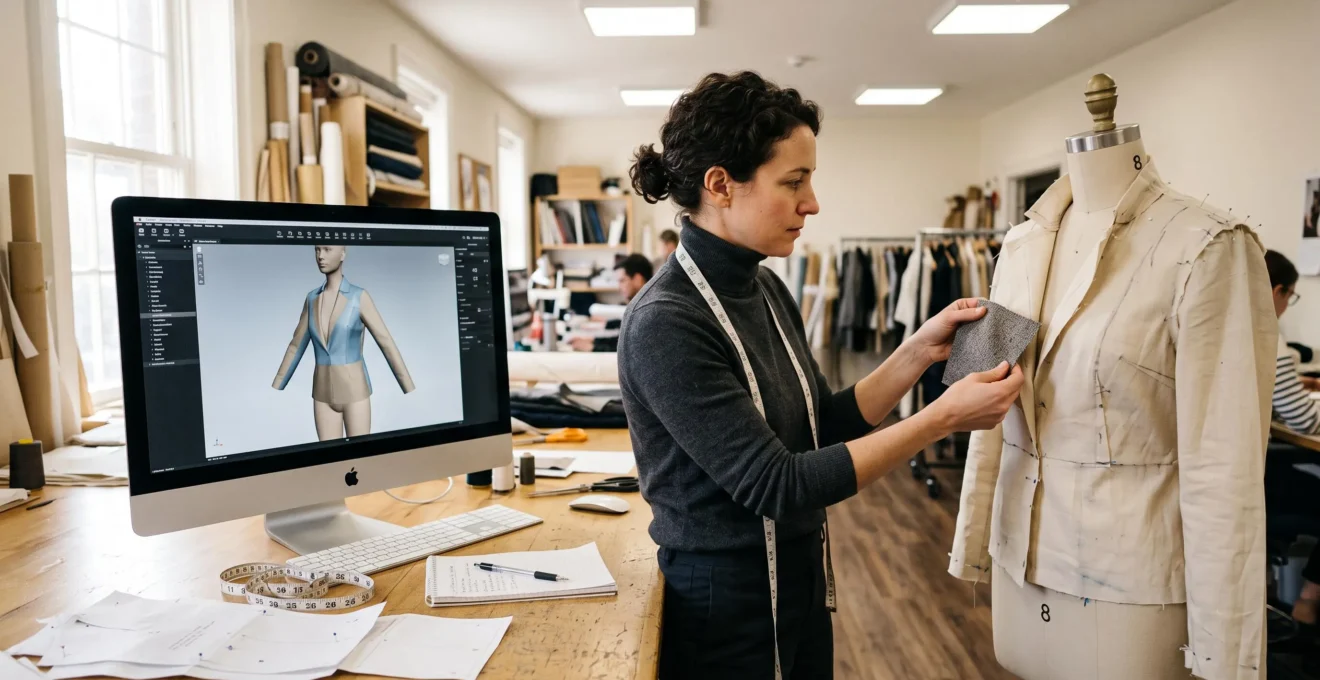
A jacket that looks slightly artificial on a computer screen may still be useful enough for a fashion brand to approve its next development stage. That apparent contradiction explains much of the shift towards 3D sampling: the technology is designed to answer production questions before it produces convincing marketing imagery.
Digital innovation is changing how clothing is developed, how shoppers choose sizes and how retailers manage returns. But these applications solve different problems. A virtual garment prototype helps a pattern technician identify construction issues. A size predictor estimates which option might fit a customer. A virtual try-on image helps someone visualise an outfit. None guarantees that the finished fabric will feel comfortable or move naturally.
For UK shoppers and fashion students, the useful distinction is between what a digital tool demonstrates and what remains untested. Understanding that boundary makes it easier to evaluate sustainability claims, avoid disappointing online purchases and recognise where physical sampling still matters.
Digital fashion sampling: the essentials
- Brands use 3D prototypes primarily to improve development decisions and reduce unnecessary physical sampling, not simply to generate realistic pictures.
- Size predictors and virtual try-on tools provide useful information, but neither guarantees fit or a particular reduction in returns.
- Garment measurements, fabric specifications and targeted physical testing remain essential checks before purchasing or approving production.
- Why Are Brands Moving to 3D Sampling Even When It Still Looks “Unreal” on Screen?
- How to Use Size Predictors and Review Data to Cut Returns by 30%?
- Digital-First Label or Heritage Brand With Tech: Which Is Safer for Fit on the First Order?
- The Online Shopping Mistake That Happens When You Trust Renders More Than Fabric Specs
- When Should You Rely on Virtual Try-On Instead of Ordering Two Sizes?
- How to Decode “Performance Fabric” Claims So You Don’t Overheat on the Commute?
- How to Measure What You Actually Carry So You Don’t Buy the Wrong Satchel Size?
- What Should the First Prototype Actually Prove Before You Approve a Design?
Why Are Brands Moving to 3D Sampling Even When It Still Looks “Unreal” on Screen?
Fashion brands are adopting 3D sampling because a useful digital prototype does not need to look photorealistic. Its immediate purpose is to test garment proportions, pattern relationships and potential construction problems before cutting physical fabric. Better decisions at this stage can reduce repeated sampling, development delays and material consumption, although physical fit and fabric testing remain necessary.
Traditional sampling involves cutting fabric, assembling a prototype, fitting it, communicating alterations and potentially shipping revised versions between suppliers and design teams. Every additional round consumes time and resources, even if the final garment changes only slightly.
A 3D workflow allows pattern adjustments to be visualised before requesting another sewn sample. A designer might alter a jacket’s shoulder width, move a seam or compare two sleeve shapes while keeping the underlying digital pattern consistent.
The economic benefit comes primarily from avoiding unnecessary physical iterations, rather than making each physical sample intrinsically cheaper. A digital revision may be completed within hours in a suitable workflow, but its speed depends on model preparation, team experience, material data and approval processes.
Up to 73%
Reduction in sample preparation time reported in a comparative study of four garment models. This is a study-specific maximum, not an expected improvement for every brand.
2026 Journal of Cleaner Production study on virtual garment sampling.
The same research reported reductions of approximately 85–90% in several assessed environmental impacts and 86–91% in water consumption, depending on the garment model. These comparisons concern sample preparation, not the complete environmental footprint of producing and selling clothing.
Simulation has limits. Digital fabric behaviour depends on input parameters and the quality of the garment model. A screen cannot establish whether a wool blend feels scratchy, whether a lining catches against clothing or whether a jacket remains comfortable after hours of movement.
That creates an important distinction between a digital twin as a development tool and a consumer-facing render as a promise of the finished product. The former may be useful while visibly imperfect; the latter can become misleading if presented without sufficient product evidence.
Once the design process becomes more digital, the next question is whether the information generated can help customers choose the correct size rather than simply helping factories make the garment.
How to Use Size Predictors and Review Data to Cut Returns by 30%?
Size predictors and customer reviews can help reduce avoidable fashion returns, but a 30% reduction is a target to test, not a proven universal result. Start by identifying which returns are caused by incorrect sizing or fit preferences. Then combine garment measurements, comparable customer reviews and any available prediction tool to improve decisions.
The first mistake is treating every return as a sizing failure. A customer may return a perfectly fitting coat because its fabric feels unpleasant, the colour differs from the listing or the construction seems poor.
A retailer evaluating a size predictor should separate returns into meaningful causes:
- Wrong size: the garment is objectively too small or too large for the intended fit.
- Fit preference: the size is technically plausible, but the customer dislikes the looseness, length or proportions.
- Quality or fabric mismatch: the received product does not meet material or construction expectations.
- Expectation gap: the appearance, styling or behaviour differs from what the customer anticipated.
Only some of these outcomes are directly addressable through size prediction. Even perfect size selection would not eliminate returns driven by other causes.
Consider an explicitly hypothetical retailer with 200 returns from 1,000 orders. If 80 returns are attributed to sizing and fit, eliminating three quarters of those 80 returns would prevent 60 returns. That would mean a 30% reduction in the original number of returns, from 200 to 140. It is a mathematical scenario, not an observed industry result, and assumes that purchasing behaviour and other causes remain unchanged.
Actual evidence is less straightforward. A 2025 study examining 496,365 items ordered through one fashion e-commerce platform reported that customers using a size finder were slightly more likely to return purchases. Its observational findings do not prove that size tools universally increase returns, but they challenge automatic claims that implementing a predictor will reduce them.
The Journal of Innovation & Knowledge research on size finders and fashion returns illustrates why tool performance must be tested against transaction outcomes rather than assumed from the feature’s existence.
For shoppers, customer reviews provide an additional source of fit information. Look beyond a simple average rating. Comments such as “tight at the shoulders” or “shorter than expected” identify particular garment dimensions worth checking.
Reviewer context matters. A complaint about sleeve length is more useful when the reviewer’s height, selected size and preferred fit resemble your own. Research published in Information Systems Research on fit reviews and online returns supports the value of contextual fit information, particularly when overall reviews disagree.
For an unfamiliar brand, a practical starting point is to measure a garment already owned that fits well. Compare its laid-flat chest, shoulder, waist and length measurements with the prospective purchase, using the same measurement conventions.
Brand-side recommendation systems may use body dimensions, previous purchases or other information. They can be helpful when trained and validated against relevant garments and customers. However, their recommendations should not override a clear contradiction between published garment dimensions and a known comfortable fit.
The same discipline applies when deciding which brands to trust: a sophisticated digital experience does not necessarily mean the underlying sizing system is more consistent.
Digital-First Label or Heritage Brand With Tech: Which Is Safer for Fit on the First Order?
Neither a digital-first label nor an established heritage brand is automatically safer for a first online order. A digitally developed collection may offer precise product measurements, while an established brand may benefit from well-tested patterns and longstanding fit knowledge. The stronger choice is the one that makes its garment dimensions, sizing assumptions and return conditions easiest to verify.
Digital-first development can give a brand a consistent starting point. Garments may share a virtual fit model, a defined base-size block and a connected pattern-development process. When this information is maintained carefully, comparing products can become easier.
However, a coherent digital design process does not guarantee accurate sizing across different fabrics, factories or styles. A fitted woven shirt and a relaxed knitted shirt may require very different ease allowances even when both originate from the same base size.
Heritage brands may have extensive pattern archives and experience refining particular silhouettes. Their challenge can be maintaining consistency across product lines, production periods or collections developed by separate teams.
Rather than judging fit by brand age, compare the evidence shoppers can inspect.
| Fit criterion | Digital-first label | Heritage brand using digital tools |
|---|---|---|
| Base pattern | May use unified digital blocks | May combine established blocks and digitised archives |
| Product measurements | Check for style-specific garment dimensions | Check for measurements specific to each collection |
| Size grading | Ask whether proportions were validated across sizes | Check whether older grading assumptions remain appropriate |
| Fit consistency | Compare styles and material types | Compare product lines rather than relying on reputation |
| First-order risk | Depends on data quality and return conditions | Depends on the same evidence |
Three signals deserve particular attention: actual garment measurements, a clearly explained fit reference or base size, and a return policy that makes a reasonable mistake manageable.
For someone between sizes or near the ends of a size range, proportional grading deserves additional scrutiny. Extending a pattern digitally does not itself prove that shoulder width, hip shaping or sleeve proportions work equally well on all bodies.
This is especially relevant when archived patterns have been digitised without sufficient physical validation across the available sizes. Reviews from customers wearing a similar size band can reveal issues that broader brand ratings conceal.
Even after selecting a promising brand and the right size, the garment may still disappoint if its fabric does not behave as the online imagery suggests.
The Online Shopping Mistake That Happens When You Trust Renders More Than Fabric Specs
The mistake is assuming that a convincing garment render proves how the real fabric will hang, stretch or feel. Digital simulations depend on the material properties entered into the software, and those inputs may not fully describe the production fabric. Fabric composition, weight, construction, stretch information and lining details provide essential checks that appearance alone cannot supply.
A digital jacket may appear structured because the simulation uses relatively stiff material settings. If the finished fabric is softer, lighter or differently constructed, the actual silhouette may collapse or move in an unexpected way.
The reverse is also possible: a simulated garment may look rigid because the digital material has not been calibrated accurately, while the manufactured fabric drapes comfortably.
Product specifications help narrow the uncertainty, but they require interpretation.
- Fabric weight in gsm: grams per square metre indicate material mass per unit area, not a universal measure of warmth, stiffness or quality.
- Fibre composition: cotton, wool, polyester, viscose and blended constructions can behave differently, but fibre percentages alone do not determine drape.
- Elastane content: an indication that stretch fibres are present, not a direct measurement of total extension or recovery.
- Fabric construction: woven, knitted, coated and laminated structures influence flexibility, airflow and movement.
- Lining and reinforcement: these affect comfort, structure and the way a garment moves over other clothing.
A higher gsm value means more material mass per square metre, but a lightweight densely woven fabric may feel less flexible than a heavier open knit. Similarly, two garments with identical elastane percentages can have very different stretch characteristics.
Be cautious when a listing provides polished renders but omits material composition, garment measurements or lining information. Missing details do not prove poor quality, although they increase uncertainty for the buyer.
When a specification sheet does not provide enough information, close-up fabric photographs, videos of the garment in movement or a physical swatch can offer useful additional evidence. None should be confused with a formal performance test.
Texture and drape mismatches also expose a limitation of size predictors: selecting the correct size cannot fix the wrong material expectation. Depending on return conditions and the nature of any product misdescription, the consumer may face additional inconvenience or cost.
This becomes more important when retailers add virtual try-on experiences that make a garment appear personally fitted before any real measurements have been checked.
When Should You Rely on Virtual Try-On Instead of Ordering Two Sizes?
Virtual try-on is most useful when deciding whether a garment’s general appearance, colour or silhouette is appealing. It is less dependable when the decision requires precise information about tightness, compression or movement. Ordering two sizes can provide physical evidence, but costs and return restrictions should be checked first; neither approach guarantees a satisfactory fit.
Image-based virtual try-on systems can create a persuasive visual impression without accurately representing the relationship between the customer’s body measurements and the garment’s dimensions.
A 2026 research preprint, FIT research paper on the limits of virtual garment try-on, identifies this problem. The researchers describe systems capable of displaying apparently well-fitting clothing even when the body and garment sizes differ substantially.
The work introduces measurement-aware training data intended to improve fit representation. As a preprint, it should not be interpreted as an independent validation of all commercial try-on tools.
A sensible decision rule separates three questions:
- Does this silhouette appeal to me? Virtual try-on can provide a useful visual reference, although the result may still be approximate.
- Which size matches my body and preferred ease? Consult garment measurements, fit reviews and appropriately validated recommendations.
- How does the actual garment feel and move? Physical testing remains the more direct method.
Ordering two sizes transfers some fit testing from the retailer to the customer. It can be reasonable when uncertainty remains and return conditions are favourable, but it should not be treated as a cost-free default.
Consider a hypothetical UK purchase with one garment costing £80 and a £4 return charge. Ordering two sizes at £80 each requires an initial £160 payment. If one is returned for an £80 refund minus £4, the final spending is £84, assuming no other fees. The initial cash commitment is twice the single-item price, and the refund is not immediate.
If a delivery charge also applies, or a promotional discount is affected by the return, the outcome can change. Statutory consumer rights should be distinguished from a retailer’s optional return policy; a discretionary return fee does not override applicable rights where goods are faulty or not as described.
Before ordering duplicates, check whether the retailer provides detailed measurements or can clarify the garment’s fit. This may eliminate the need to purchase a second size.
Visual fit is only part of everyday comfort. A technically styled jacket that looks ideal in an online fitting room can still perform poorly during a warm commute.
How to Decode “Performance Fabric” Claims So You Don’t Overheat on the Commute?
To assess performance-fabric claims, look for measurable material properties and evidence relevant to the way the garment will actually be worn. Words such as “technical” and “breathable” do not establish thermal comfort by themselves. Fabric construction, airflow, moisture management, lining and layering matter especially during seated or crowded journeys where ventilation is limited.
Marketing terminology can be broad. A garment described as performance-oriented might be designed to stretch during movement, manage perspiration, resist water or retain a crisp silhouette. Those functions are not interchangeable.
The terms themselves do not guarantee a particular laboratory result, although any specific marketing claim remains subject to applicable advertising and consumer-protection requirements.
When available, useful technical information includes:
- Fabric weight in gsm, which helps describe material mass but does not independently measure breathability.
- Air permeability, ideally with an identified test method and conditions.
- Water-vapour transmission or evaporative-resistance data, where the information is provided and interpretable.
- Fabric composition, weave or knit construction, and the presence of membranes, coatings or linings.
- The intended conditions of use, such as active exercise, outdoor protection or everyday urban wear.
A fabric designed for moisture management during exercise may depend on air movement, evaporation or particular layering conditions. Its perceived comfort can change when the wearer is seated on a crowded train or standing in a warm carriage.
For example, a tightly constructed synthetic blazer may offer useful crease resistance and flexibility yet feel warmer than expected if its design restricts airflow. That is a possible trade-off, not a conclusion that all synthetic tailoring is unsuitable for commuting.
For a garment marketed as breathable, check whether the brand explains the test behind the claim. A general assertion of comfort is weaker evidence than a relevant, clearly described measurement. Even a published test does not automatically predict comfort in every environment.
A practical purchase check is to examine the complete garment rather than only the outer fabric: lining, interlining, collar construction and the clothes worn underneath can substantially change the experience.
The principle extends beyond clothing: an item can look proportionally correct in a digital image yet fail a practical test because its actual dimensions or construction were overlooked.
How to Measure What You Actually Carry So You Don’t Buy the Wrong Satchel Size?
Measure the items you carry every day before choosing a satchel, then compare their combined dimensions with the bag’s usable interior. A laptop, sleeve, charger, water bottle and notebook occupy space differently, so external bag measurements can be misleading. Internal width, height, depth and the usable opening matter more than the appearance of the bag in a render.
Begin with your actual load rather than the products you might occasionally carry. Place the essential objects together on a table and measure them in their normal travelling configuration.
A laptop should be measured with its protective sleeve if that sleeve stays on during the journey. A charger should be measured in the shape it will occupy when packed, and a water bottle should be assessed according to whether it stands upright or lies on its side.
Satchel capacity is three-dimensional, but the dimensions serve different purposes. Width and height determine whether large flat objects fit. Depth determines how much bulk can be accommodated without distorting the bag. The opening may impose a further restriction even when the interior is nominally large enough.
Strap drop affects carrying position and accessibility rather than internal capacity. A bag may hold everything required while sitting awkwardly against the body or becoming difficult to open when worn over a coat.
A digital render may accurately communicate the intended silhouette but remain insufficient for checking these functional details. In particular, gusset depth and strap position can be difficult to judge from a single perspective.
Five checks before buying a satchel online
- List your essential items. Produce a short inventory of everything carried on a typical working day.
- Measure each item as packed. Record its width, height and depth in centimetres, including any protective case.
- Plan the arrangement. Sketch how the items will sit together and identify the required combined dimensions.
- Verify the bag specifications. Record the stated usable interior dimensions, opening width and strap drop; mark any missing measurements for clarification.
- Check compatibility. Make a final fit comparison that allows for closures, internal dividers and practical clearance before ordering.
Do not simply add every object’s width together unless the proposed arrangement places those objects side by side. The required dimensions depend on how the load is positioned and stacked. A drawing of the packed arrangement is often more useful than a single advertised capacity figure.
If the brand supplies only external dimensions, ask for the internal compartment and opening measurements. An attractive product image does not resolve those uncertainties.
This same distinction between appearance and demonstrable function should guide product developers: a prototype needs a defined purpose before anyone can meaningfully approve it.
Key takeaways before approving a design
- A visually convincing prototype is not proof that material behaviour and functional dimensions have been validated.
- Every approval decision should identify the question being tested and the evidence required to answer it.
- Digital development can reduce unnecessary iterations, but physical testing must remain part of the process wherever material or real-body behaviour is uncertain.
What Should the First Prototype Actually Prove Before You Approve a Design?
The first prototype should establish whether a design’s proportions, construction approach and base pattern are sufficiently credible to continue development. It should not automatically be treated as proof of final fit, comfort or fabric performance. Approval should depend on explicit criteria, with unresolved material and movement questions assigned to later physical testing rather than silently accepted.
The purpose of a first sample is often misunderstood. Designers may expect an initial prototype to resemble the final product closely, while technical teams are still investigating whether the construction is feasible.
When these different expectations are not separated, a team may approve an appealing silhouette and then discover that seams, materials or proportions require substantial redevelopment.
A more useful approach is to define what each prototype must prove.
| Criterion | Evidence required | Action if unsuccessful |
|---|---|---|
| Proportion and silhouette | Comparison against the design brief and intended dimensions | Revise the silhouette or pattern |
| Construction feasibility | Review of seam placement, assembly sequence and stress points | Redesign construction details |
| Base-size pattern | Pattern measurements and a suitable fit assessment | Correct the base block |
| Fabric assumptions | Comparison between expected and observed material behaviour | Recalibrate simulation or reconsider fabric selection |
| Physical comfort and drape | Physical sample evaluation under relevant conditions | Revise materials, pattern or construction |
The first three criteria can often be investigated digitally before committing to a full production-fabric sample. A digital garment can help identify unusual pattern relationships, investigate dimensions and support construction discussions.
However, digital validation is only as dependable as its inputs. Inaccurate measurements or poorly calibrated fabric parameters can produce convincing but misleading conclusions.
A physical prototype introduces evidence that cannot be obtained from appearance alone. It allows a team to inspect seams, feel materials, evaluate real drape and observe the garment on a body or appropriate fit form.
The first physical sample need not conclusively prove every aspect of final fit. Its role is to identify which assumptions hold and which require additional development. For example, the seam arrangement might be workable while the selected fabric fails to provide the intended structure.
Instead of requesting another prototype without a clear diagnosis, the team can document whether the next change concerns the pattern, the fabric or the construction technique.
In practice, a disciplined sequence can follow three stages: digital exploration for early design decisions, targeted physical sampling for material and fit evidence, and further validation before production approval where required.
Reducing physical sampling rounds should be treated as an efficiency objective, not a reason to skip a necessary test. The environmental findings discussed earlier support the potential benefits of virtual preparation within the sampling process, without establishing that all physical prototypes can be eliminated.
Fashion students can apply the same reasoning to small projects. A prototype accompanied by a clearly stated test objective, a record of observations and an explicit next decision is more informative than a visually polished sample without documented evaluation.
Before approving a design or making a purchase, identify the single most important uncertainty that remains. Check the available measurements, request the missing evidence and decide whether a physical test is necessary. The goal is not to replace every traditional step with software, but to use each tool where it provides evidence that can genuinely support a decision.
Can virtual sampling make fashion production more sustainable?
Virtual sampling can reduce the materials, transport and repeated prototype production associated with certain development workflows. A 2026 comparative life-cycle assessment of four garment models reported substantial reductions in several environmental indicators during sample preparation. However, those results do not establish equivalent reductions across the full garment life cycle. Manufacturing volumes, material choices, product longevity and disposal remain separate sustainability considerations.
Does a digital garment twin guarantee accurate sizing?
No. Accuracy depends on the underlying pattern, body or fit-model measurements, grading rules, fabric parameters and validation process. A digital garment may support useful technical decisions while still failing to represent how the final product fits every body or size category.
What should shoppers do when a fashion website provides no garment measurements?
Request measurements for the specific garment and size, particularly at critical points such as the chest, waist, hip or length. Compare them with an existing garment that fits comfortably. Customer reviews can help identify potential problems, but they cannot fully replace missing measurements. Review the retailer’s return conditions before committing to the purchase.
Are AI-generated virtual try-on images accurate enough to replace fitting rooms?
Not as a general substitute. Virtual try-on can assist with visual styling decisions, but an image may not accurately represent garment tightness, pressure, movement or material comfort. Measurement-aware research is addressing these limitations, although a convincing generated image should not be considered proof of physical fit.
What should fashion students learn before working with 3D garment-design software?
Pattern construction, garment measurements, sizing principles, material behaviour and prototype evaluation are valuable foundations. Digital simulation becomes more useful when the designer understands how real fabric, seams and body proportions interact. Students should also learn to document assumptions and compare simulated results with physical samples rather than judging work exclusively by its visual realism.