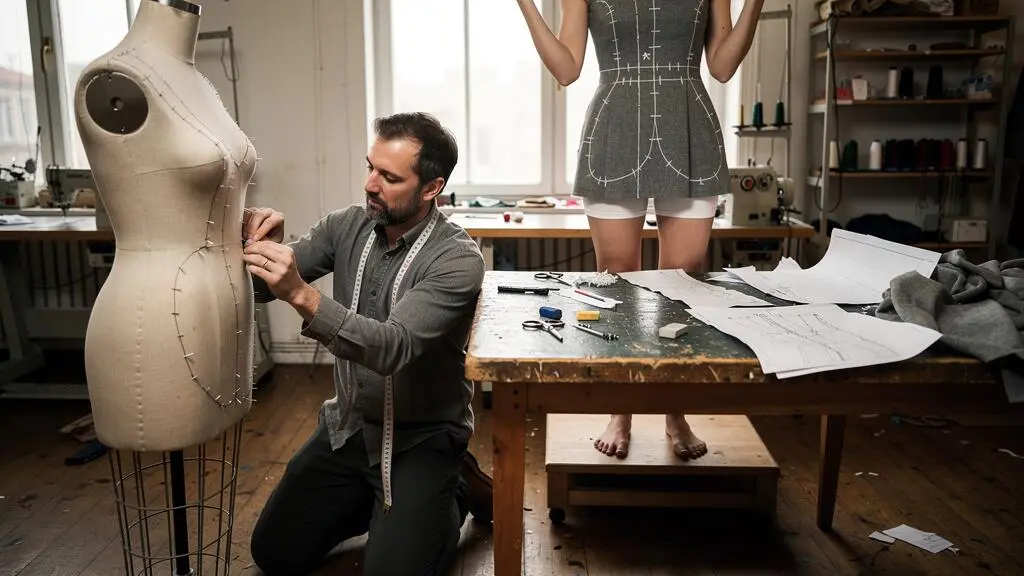
Before a finished garment leaves a tailoring atelier, it has usually passed through a series of decisions that the client never sees. Measurements become patterns. Patterns become provisional garments. A fitting reveals where fabric resists the body, where a shoulder needs balancing, and where an elegant drawing needs reconsideration.
The work is distributed among people with distinct responsibilities. A cutter develops the pattern and establishes the garment’s proportions. A tailor or seamstress assembles and refines it. A fitter evaluates its relationship with the wearer, sometimes working alongside the cutter. In a small atelier, one specialist may perform several of these roles.
Understanding this process changes the commissioning experience. The client is not simply paying for sewing or expensive fabric, but for decisions, adjustments and skilled construction. Equally, the atelier needs something more useful than admiration: clear information about the wearer’s body, habits, expectations and deadline.
The result depends on the quality of that exchange as much as the quality of the stitching.
Inside the atelier: what matters most
- Fittings test assumptions made during measuring and pattern development; additional work should be explained and agreed upon.
- A useful commission brief describes how the garment will be worn, not merely how it should look.
- The right choice between bespoke, made-to-measure and ready-to-wear depends on the available time, desired fit and opportunities for future wear.
- Why Does an Atelier Quote Jump Once Fittings Begin?
- How to Brief an Atelier So You Don’t End Up With a Beautiful Garment You Never Wear?
- Atelier, Made-to-Measure, or Ready-to-Wear: Which Makes Sense for One Big Event?
- The Last-Minute Change That Can Ruin Fit After the Final Fitting
- When Should You Start an Atelier Commission If You Need It by a Fixed Date?
- Flat Pattern Cutting or Draping: Which Is Better for Curved Bodies and Clean Lines?
- How to Read a Contemporary Collection in 10 Minutes Using Anchor Pieces and Repeats?
- Which Pattern-Making Skills Give the Fastest Fit Improvement After 4 Weeks of Practice?
Why Does an Atelier Quote Jump Once Fittings Begin?
An atelier quote may increase after fittings because the original estimate was based on assumptions about the design, materials and amount of adjustment required. Once the toile is fitted to the wearer, previously invisible technical problems can emerge. However, an increase should never be treated as automatic: the atelier should identify the additional work and explain whether it falls outside the agreed price.
A first estimate translates a proposed garment into expected operations: cutting, constructing, fitting, correcting and finishing. Some workshops include a defined number of fittings and revisions; others price particular stages separately. The contract matters more than any assumed industry convention.
During the first toile fitting, the cutter may discover that one shoulder sits lower, the wearer stands differently from the posture anticipated during measuring, or the chosen silhouette requires more shaping than the initial pattern allowed. Such findings can require further pattern development.
The distinction is important. A necessary fitting correction is not automatically an extra charge. It may already be covered by the original agreement.
There are three useful categories for examining any revised quote:
- Client-requested scope changes: adding sleeves, altering the neckline or changing a design feature after approval.
- Technical discoveries: additional pattern or construction work identified during fitting that was not reasonably anticipated in the estimate.
- Material changes: extra fabric or trimmings required because of a revised design, cutting requirement or agreed substitution.
Ask the atelier to place each proposed increase into one of these categories, describe the work involved and confirm whether it is already included in the commission. A technical discovery may justify revisiting the plan, but it does not by itself override an agreed fixed price.
Before commissioning, request an itemised or tiered estimate covering base construction, the toile, fittings, finishing and the procedure for approving changes. Where appropriate, agree an hourly or fixed change-order rate for modifications requested after the first fitting.
The University of the Arts London‘s made-to-measure pattern cutting course describes the sequence of developing a personalised block, constructing a toile, fitting it to the body and adapting the pattern. Those stages explain why fitting is part of garment development rather than merely a final inspection.
Skipping the toile to reduce the initial estimate can be a false economy. Problems found after the final fabric has been cut and assembled may require more disruptive corrections. The potential saving should be weighed against the risks for the particular design.
A clear quotation does not guarantee that nothing will change. It gives both parties a reliable way to distinguish expected refinement from genuinely new work. That clarity becomes easier to achieve when the original brief describes the garment’s intended life.
How to Brief an Atelier So You Don’t End Up With a Beautiful Garment You Never Wear?
Brief an atelier around the situations in which the garment must function, not just the appearance you want. Explain where you will wear it, how you need to move, what you find comfortable and how you intend to care for it. Reference images remain useful, but practical requirements determine whether the finished garment will actually enter your wardrobe.
Consider a hypothetical commission for an elegant evening dress. The client supplies photographs of closely fitted gowns and requests a clean, uninterrupted silhouette. Only later does the atelier learn that the garment must accommodate a seated dinner, dancing and a journey across London on public transport.
None of those activities necessarily rules out the desired design. They do, however, influence decisions about ease, closures, hem length, lining and fabric behaviour.
Wear context is a design constraint. It should be discussed before the pattern is settled.
A productive brief contains reference images annotated with the particular details you admire, accurate measurements or examples of well-fitting clothing, fabric preferences and restrictions, a realistic budget range, and a description of the intended occasions.
Include the care routine. A garment requiring specialist cleaning may be perfectly appropriate for occasional evening wear and inconvenient for frequent use. Likewise, a delicate fabric may be unsuitable for repeated travel or demanding physical movement.
The toile offers an opportunity to discover whether the initial brief has been interpreted correctly. The client should examine how it behaves rather than judging only its appearance in the mirror.
With the fitter’s guidance, sit down, walk, lift your arms and reproduce movements relevant to the garment’s intended use. A jacket may look impeccable while standing yet restrict reaching forward. A skirt may hang beautifully until you attempt to climb stairs.
These tests should occur early enough to allow changes before finishing decisions make alterations less straightforward.
There is also a conversational problem worth avoiding. Repeatedly telling the fitter that everything is beautiful can conceal useful observations. Appreciation and constructive criticism are not competing obligations.
Try separating your feedback into three statements: what feels comfortable, where you experience restriction or uncertainty, and what you would prefer to change. Describe the sensation rather than prescribing a technical correction.
A five-step atelier briefing checklist
- Annotate three to five reference images with the exact features you admire; deliver a labelled visual brief.
- Describe the garment’s expected occasions, activities and movement requirements; produce a written wear-context statement.
- Record your budget range, deadline, fabric restrictions and care preferences; provide a single constraints sheet.
- Bring suitable measurements or well-fitting garments for discussion; create a reference record for the fitter.
- Agree how fitting feedback and design changes will be recorded; establish a shared fitting-notes document.
A successful brief leaves room for professional interpretation without leaving the purpose of the garment uncertain. Once that purpose is clear, the next question is whether a fully individual commission is the right route at all.
Atelier, Made-to-Measure, or Ready-to-Wear: Which Makes Sense for One Big Event?
For a single important event, bespoke is most suitable when the design or fit requires individual development and there is enough time for fittings. Made-to-measure offers a more structured route based on an existing model or pattern system. Ready-to-wear with alterations is often the practical choice when the date is close, provided the garment’s underlying structure already works.
The terminology needs care. A bespoke atelier commission generally involves creating a garment specifically for an individual, with substantial discretion over its pattern and construction. Made-to-measure often starts from an established design or block and adjusts it to the client’s measurements. Services vary, and some ateliers use overlapping terminology.
Ready-to-wear begins with a finished garment. A skilled alteration tailor can refine its fit, but the existing cut, construction and available material impose boundaries.
The following comparison is a practical decision guide, not a universal classification of atelier services.
| Decision factor | Bespoke atelier | Made-to-measure | Ready-to-wear with alterations |
|---|---|---|---|
| Typical timeline | Potentially lengthy and dependent on complexity | Depends on supplier and production process | Often shorter if a suitable garment is available |
| Fitting requirements | Several may be needed; agreed case by case | Varies with the service | Often limited to alteration appointments |
| Relative cost | Usually a substantial individual-work investment | Varies widely by design and supplier | Can be economical, depending on purchase and alterations |
| Design flexibility | Potentially extensive before construction advances | Generally limited by available models and options | Restricted by existing construction |
| Future wear | Can be planned into the original design | Can be considered when selecting the base | Depends on the selected garment and its adaptability |
Alterations can commonly refine length, adjust certain seams or improve proportions within the available construction. They cannot reliably create extra fabric where none exists, completely reposition structural features or transform an unsuitable shoulder construction into a fundamentally different design.
The original garment must be a sound starting point. Alterations are refinement, not unrestricted reconstruction.
The other neglected question is whether you will wear the piece again. A ceremonial dress designed around one evening may have limited subsequent use. A well-considered suit, jacket or restrained evening garment may offer more opportunities.
Discuss future wear from the outset: different footwear, alternative accessories, separate use of jacket and trousers, or a design that remains appropriate beyond the event. Not every garment needs to be versatile, but the choice should be deliberate.
Commissioning bespoke under severe time pressure creates a particular contradiction. Reducing fitting opportunities may remove the very process through which the individual pattern is refined. A larger budget cannot automatically recover unavailable appointments or fabric delivery time.
The available calendar should govern the decision alongside aesthetics and budget. Once a garment reaches its final fitting, the focus shifts from creative freedom to protecting the fit that has been achieved.
The Last-Minute Change That Can Ruin Fit After the Final Fitting
Changing footwear after the final fitting is one of the easiest ways to undermine an otherwise successful event garment. A different heel height can alter the relationship between the garment and the floor, while a change in footwear may influence stance and movement. Changes in body measurements or posture can also affect fit, particularly when the garment has little remaining adjustment capacity.
At the final fitting, the atelier evaluates the garment against the conditions it expects on the day. The intended shoes and undergarments are therefore part of the fitting equipment, not incidental accessories.
This is reflected in the Pronovias UK fitting and alterations FAQs, which instruct customers to bring their planned event shoes and undergarments to fittings. The guidance describes Pronovias’s own bridalwear process rather than a universal rule for every atelier.
A longer dress is especially sensitive to footwear changes because the hem has been established relative to the wearer’s fitted stance and shoe height. A new pair of shoes can change how the garment clears the floor.
Body changes between the final fitting and the event may be less predictable. A difference around the waist, bust or hips can alter tension, drape and closure alignment. Some garments retain usable seam allowance; others offer very limited scope for adjustment after finishing.
A finished garment is not necessarily impossible to alter, but its alteration options are narrower than those available during development.
Before the final fitting, ask the atelier whether any strategic finishing points can remain accessible or reversible without compromising the garment’s appearance or strength. Possibilities depend on the design and may include certain closure adjustments or accessible seam allowances.
Also discuss an acceptable fit tolerance: what small variations in body measurement or movement the garment can accommodate comfortably. This is an individual assessment, not a standard numerical allowance.
Avoid unnecessary changes to footwear, foundation garments or styling immediately before the occasion. If an unexpected problem appears, photograph or describe it and consult the atelier before attempting another alteration.
A hurried correction can introduce fresh tension, distort a carefully balanced hem or damage finished details. Sometimes a minor imperfection that does not compromise comfort is preferable to an untested intervention.
The best protection is not an impossibly rigid fitting. It is a realistic schedule that preserves enough time for final checks while keeping major construction decisions safely behind you.
When Should You Start an Atelier Commission If You Need It by a Fixed Date?
Start an atelier commission by working backwards from the event date, reserving the fitting appointments before treating any delivery estimate as secure. The schedule must accommodate design approval, fabric procurement, pattern development, toile construction, corrections and finishing. There is no reliable universal lead time: complexity, workshop capacity and the client’s availability all influence the calendar.
An atelier does not spend every day of a commission sewing. A cutter may need to revise the pattern after a fitting before another specialist can proceed. Fabric or trimmings may have to arrive before cutting starts. Pressing, certain finishing processes and quality checks also require space in the schedule.
Some finishes require setting, drying or resting time where the materials and techniques call for it. Such requirements are construction-specific, not a fixed waiting period for all garments.
A practical backwards-planning exercise begins with six milestones:
- Confirm the event date and the date the garment must be collected or delivered.
- Agree a suitable final fitting and correction window with the atelier.
- Identify the earlier fittings required for the particular design.
- Reserve the first toile fitting, allowing time for pattern development beforehand.
- Establish when the design and fabric selection must be approved.
- Confirm material availability and the atelier’s production slot before accepting the overall schedule.
The milestones are connected. A fitting date has little value if the client cannot attend; a production slot may be unusable if the selected cloth has not arrived. Booking and confirming these dependencies should precede any firm commitment to the start date.
For context, Pronovias recommends ordering its wedding dresses eight to ten months ahead to accommodate production and alterations. That is supplier-specific bridal guidance, not a benchmark that every bespoke atelier should adopt.
Starting exceptionally early has its own disadvantages. If the wearer expects substantial body changes, the final fitting should be planned with those changes in mind. The sensible response is not necessarily to postpone the whole commission, but to discuss when the most body-sensitive decisions should be finalised.
For an urgent order, an atelier may be able to simplify the design, use fabric already in stock or reduce optional embellishments. It may also consider fewer fittings, although this increases the importance of establishing whether the design is suitable for a compressed process.
What cannot safely be compressed without consequence is the need to establish and evaluate fit. The client must also remain available for the appointments that make the work possible.
Time planning becomes easier when the client understands how a pattern is created and corrected. That raises a technical question with practical consequences: should the atelier draft the garment flat or shape it directly in fabric?
Flat Pattern Cutting or Draping: Which Is Better for Curved Bodies and Clean Lines?
Neither flat pattern cutting nor draping is inherently better for every curved body or clean-lined design. Draping lets a pattern maker explore fabric and volume directly on a three-dimensional form, while flat cutting offers a systematic way to develop and adjust patterns. The best method depends on the garment, the wearer’s proportions and the cutter’s expertise; many ateliers combine both.
In flat pattern cutting, the cutter works on paper or digitally from a block, measurements or an existing pattern. The shape is developed through controlled adjustments to seams, darts, balance and proportions.
In draping, fabric is placed and shaped on a dress form, with folds, seams and volume explored directly in three dimensions. The resulting shapes can then be transferred into a working pattern.
The two techniques are not opposing philosophies. The University of the Arts London’s pattern cutting and draping course describes both methods alongside toile fitting, working-pattern adjustments and the development of final paper patterns.
For a garment with sculptural volume, complex folds or unusual drape, working directly with fabric can make design decisions easier to visualise. For repeat commissions, a carefully developed personal block can provide a useful starting point for consistent pattern development.
One limitation matters particularly for clients with asymmetry or distinctive posture: a standard dress form does not necessarily reproduce their body. Draping on an unmodified mannequin still requires adaptation to the actual wearer.
Similarly, a flat pattern developed from an accurately fitted personal block may accommodate individual proportions very effectively. Neither technique removes the need for a fitting on the person who will wear the garment.
Clean lines are an outcome of pattern balance and fabric behaviour, not a guarantee attached to a particular method. Darts, seam placement, grain direction, internal support and the response of the cloth all influence the final appearance.
When speaking to an atelier, ask which method it intends to use, why it suits the design and what you should expect at the first fitting. Ask whether the starting point is an existing block, a new personal pattern, a draped prototype or a combination.
The answer should explain the construction logic without suggesting that one technique is universally superior.
Learning to recognise construction decisions also improves the quality of design references. Rather than bringing the atelier an entire runway collection, you can identify the specific forms and recurring details that matter to your garment.
How to Read a Contemporary Collection in 10 Minutes Using Anchor Pieces and Repeats?
Read a contemporary fashion collection by first identifying its most distinctive garments, then looking for shapes, fabrics and construction details repeated across the other looks. The standout garments provide possible anchor points, while repetition reveals how the designer develops an idea. Ten minutes is enough for a useful initial interpretation, although not for a definitive assessment of the collection.
Start with the first and last looks. They may establish or resolve an important visual theme, but they do not necessarily contain the entire collection’s meaning.
Next, examine the middle of the sequence. Identify the garments that seem to carry the strongest visual statements: perhaps an exaggerated shoulder, an unusually shaped skirt or a distinctive treatment of a familiar fabric.
These are useful working anchor pieces. They are not necessarily the most commercially important looks, nor always the most photographed.
Then look for repetition. A particular sleeve shape might return in several fabrics. A curved seam may appear in dresses, jackets and coats. A recurring proportion may connect otherwise very different garments.
The relationship between repetition and variation can reveal more than the most spectacular image alone.
The Metropolitan Museum of Art provides a useful documented example in The Met’s Rei Kawakubo exhibition galleries. Its discussion of the designer’s Abstract Excellence collection identifies 34 skirts and explains how repetition coexists with differences in colour, fabric, shape and seam direction.
That example illustrates a reading technique rather than proving that every contemporary collection follows the same structure.
For a practical ten-minute exercise, use this sequence:
- Spend two minutes examining the opening and closing looks.
- Spend three minutes selecting a few distinctive anchor pieces from the full sequence.
- Spend three minutes looking for repeated shapes, materials or construction details.
- Use the final two minutes to name the recurring design idea in one sentence.
For the atelier client, the final sentence is more useful than a large, contradictory moodboard. Instead of requesting that a dress resemble an entire collection, you might identify the curved shoulder line or repeated seam placement that interests you.
Distinguish the runway presentation from practical ordering possibilities. A dramatic showpiece can communicate a collection’s identity without being offered as a wearable commercial garment. The recurrence of a design element may suggest ways it could be adapted, but only the designer or supplier can confirm availability.
Reading a collection this way develops visual judgement. The next step is learning to recognise how those design decisions translate into fit, without confusing a client’s informed observations with the cutter’s technical responsibilities.
What to carry into your next fitting
- Recognise the difference between an attractive silhouette and a pattern that accommodates your actual posture and movement.
- Look for observable fit problems before attempting to name a construction solution.
- Use technical knowledge to make your feedback clearer while allowing the atelier to determine the correction.
Which Pattern-Making Skills Give the Fastest Fit Improvement After 4 Weeks of Practice?
For a beginner working over four weeks, accurate measuring, understanding pattern blocks and evaluating a toile are the most useful skills to prioritise for clearer fit assessment. They help reveal where shape and balance go wrong before finishing begins. However, there is no established guarantee of measurable fit improvement within four weeks; progress depends on practice, instruction and the garments examined.
The first useful skill is taking and interpreting measurements. A numerical measurement describes a dimension, but it does not fully describe posture, shoulder balance or the way someone carries their body.
A novice who understands this distinction is less likely to assume that matching waist and chest measurements guarantees a good fit.
The second skill is understanding the relationship between a basic block and an individual wearer. A block provides a starting structure. Its value comes from how accurately it can be adapted to the garment and body in question.
Learning to observe darts, shoulder lines, side seams and garment balance makes it easier to understand why an atelier adjusts a pattern after taking measurements.
The third skill is reading the toile. This involves identifying where fabric pulls, collapses, twists or restricts movement, then considering whether the cause might involve balance, insufficient ease, incorrect shaping or material behaviour.
These observations are not diagnoses. Similar visible symptoms can have different causes, and an experienced cutter may need to examine several interacting features before choosing a correction.
A sensible four-week learning sequence might devote the first week to measuring and fit terminology, the second to examining a basic block, the third to observing or fitting a simple toile, and the fourth to comparing the identified problems with subsequent corrections.
This is a suggested educational exercise, not a validated training programme or a promise of professional competence.
At the end of the period, assess your understanding with a well-fitting garment and one that fits less successfully. Try to identify the location of each visible or physical issue: shoulder, bust or chest, waist, hip, or overall balance.
Then explain what you observe and suggest a possible cause, while acknowledging uncertainty. The ability to distinguish observation from explanation is more valuable than memorising technical vocabulary.
For an atelier client, there is an important boundary. Being able to describe diagonal pulling across a bodice does not mean you should instruct the cutter to move a specific dart or alter a seam by an arbitrary amount.
The client provides information about comfort, appearance and function. The atelier determines how the pattern should respond.
Before your next appointment, prepare three observations: one aspect of the fit that works, one movement that needs checking, and one feature you would like the fitter to examine. That small preparation makes the fitting more productive without asking you to become the pattern maker.
Who is responsible for correcting a fitting problem?
The atelier’s cutter, fitter or relevant construction specialist determines the technical correction, according to how the workshop is organised. The client should explain the problem and confirm whether the proposed result meets the agreed brief. Responsibility for additional charges depends on the commission’s terms and whether the work falls within the original scope.
Can an atelier reuse my pattern for another garment?
Some ateliers retain personal blocks or patterns that can support subsequent commissions. Reuse does not eliminate the need to check measurements, posture, design differences or fabric behaviour. Ask whether the workshop keeps patterns, for how long, and whether reuse affects the quotation. Ownership and retention arrangements should be confirmed directly.
Should you bring someone with you to an atelier fitting?
A trusted companion can help assess the garment’s suitability for an occasion, provided the atelier permits visitors. However, too many competing opinions can obscure the wearer’s own comfort and priorities. Agree in advance whose feedback matters and allow the fitter to conduct the technical assessment without interruption.
What should happen if you dislike the finished garment?
Identify whether the concern relates to fit, workmanship, an agreed design requirement or a change of personal preference. Compare the result with the approved brief and fitting notes, then ask the atelier to explain what can reasonably be corrected. Any remedy, additional work or charge will depend on the agreement and applicable consumer protections.
Is a toile always necessary for a bespoke commission?
Not every bespoke service follows an identical process, and the need for a separate toile depends on the garment, pattern, complexity and atelier’s methods. A toile can provide an opportunity to assess fit and design before cutting the final fabric. Ask how the workshop evaluates and corrects fit if it proposes working without one.