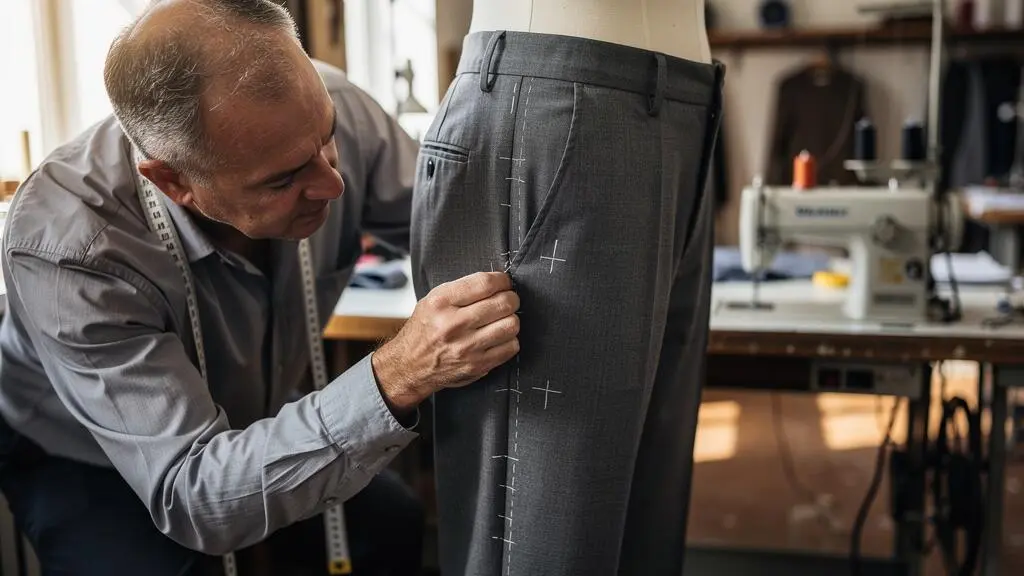
Precision stitching determines more than whether a garment looks neatly assembled. It influences how fabric panels respond to movement, whether seams remain comfortable under tension and how effectively their construction withstands repeated wear and laundering.
A straight line of stitches is only the beginning. Thread tension, stitch length, seam allowances, fabric alignment and reinforcement all contribute to performance. A beautifully topstitched pair of trousers can still develop fraying interior edges, while a plain-looking seam may be exceptionally well constructed.
For shoppers, the challenge is separating visible craftsmanship from meaningful durability. For makers, it is understanding why an apparently minor construction choice can change how cloth hangs, stretches and recovers.
The most useful assessment combines three observations: how the garment behaves on the body, how the seams are constructed and whether their finishing suits the fabric. None guarantees a particular lifespan, but together they provide a far stronger basis for judging quality than decorative stitching alone.
Precision stitching: what matters most
- Balanced stitching and accurately aligned fabric panels help seams sit smoothly, although fabric skew and shrinkage can still cause twisting.
- Interior seam finishes and reinforcement at stress points often reveal more about durability than prominent decorative topstitching.
- Inspect seam smoothness, test movement gently and check vulnerable construction details before paying a premium.
- Why Does Neat Stitching Reduce Twisting and Pulling When You Walk?
- How to Spot Poor Stitch Tension in 60 Seconds Without Turning the Garment Inside Out?
- Topstitching or Inner Seams: Which Matters More for Trousers You Wear Twice a Week?
- The “Looks Perfect” Stitch Detail That Hides Weak Seam Finishes
- When Should You Reinforce Seams So a Small Pull Doesn’t Become a Full Tear?
- Why Do Hand-Finished Seams Feel Better After 30 Wears Than Fast-Stitched Ones?
- How to Choose Trousers That Work With Trainers Without Looking Like You Forgot to Change?
- How Can You Spot Traditional Craftsmanship Before You Pay Premium Prices?
Why Does Neat Stitching Reduce Twisting and Pulling When You Walk?
Neat, balanced stitching helps fabric panels move together without unnecessary gathering or localised pulling. When seam allowances are aligned and thread tension suits the material, the seam can follow the garment’s intended shape. However, twisting trousers are not always caused by stitching: fabric grain, cutting accuracy and laundering-related distortion also matter.
A seam joins two separate pieces of fabric, each responding to movement and tension. Correctly adjusted stitching secures those pieces without drawing excessive fabric into the stitch line. The result should be a seam that lies flat and follows the intended contour rather than forming ridges or puckers.
Excessive thread tension can compress the seam. Uneven feeding can join slightly different lengths of fabric, leaving one panel gathered against the other. According to the Coats technical bulletin on seam puckering, these are among several mechanisms that can distort sewn fabric. Stitch density, thread selection and dimensional changes during laundering can also contribute.
Crucially, a seam that hangs straight before washing may not remain straight afterwards. Fabric skewness or torque can shift a trouser’s side seam towards the front or back of the leg. This may originate in the textile itself rather than the sewing operation.
The CottonWorks textile quality-testing resource identifies skewness and torque as recognised problems affecting garment appearance and dimensional stability after laundering.
A practical fitting-room assessment begins with the garment hanging naturally. Hold the trousers by the waistband and observe whether the legs hang without obvious spiralling. Put them on, check the side seams in a mirror, then walk and sit before checking again.
Look for persistent diagonal pulling, seams migrating noticeably around the leg and fabric gathering near the knee or hip. These observations may indicate a fitting, cutting or construction issue, but they cannot isolate thread tension as the cause.
Allow for the garment’s intended silhouette. A curved seam on anatomically shaped trousers is not automatically defective, and movement-related folds are not equivalent to permanent distortion.
The decisive distinction is between a seam that accommodates natural movement and one that introduces or reveals persistent distortion. Once that distinction is understood, the next useful check is the stitching itself.
How to Spot Poor Stitch Tension in 60 Seconds Without Turning the Garment Inside Out?
A quick exterior inspection can reveal obvious stitch-tension problems by checking seam puckering, stitch consistency and behaviour under gentle movement. Inspect the crotch, pocket openings or other accessible stress points, then look for unusual gathering, skipped stitches or exposed threads. This is a screening method, not a validated test of hidden seam strength.
Begin with the garment relaxed and adequately lit. Run your eyes along a continuous seam, noting whether the stitch spacing looks consistent for that particular construction. A deliberate change in stitch type or density is not necessarily a defect.
Next, look for ridges or small repeated folds beside the stitches. Persistent puckering may reflect excessive thread tension, uneven fabric feeding or an unsuitable combination of thread, needle and textile. Its appearance alone does not identify which factor is responsible.
Finally, support both sides of an accessible seam and apply a small amount of normal movement, without forcing it open. Check whether stitching separates conspicuously, the fabric gathers or an existing gap becomes apparent.
The following signs deserve closer examination:
- Visible thread loops: these may indicate an imbalance between upper and bobbin-thread tensions, although the precise adjustment cannot be diagnosed reliably from the garment’s outer face alone.
- Repeated seam puckering: this suggests unwanted fabric distortion but may arise from several causes unrelated to tension settings.
- Skipped or missing stitches: gaps in a stitch sequence can interrupt seam continuity, particularly where several fabric layers meet.
- Localised seam opening: a gap under ordinary movement may indicate inadequate seam security, insufficient allowance or fabric slippage.
Prioritise areas subjected to repeated movement: crotch seams in trousers, lower fly junctions, armholes in fitted garments and the edges of heavily used pockets. A seam that appears satisfactory across a flat back panel may behave differently under concentrated strain.
Do not pull hard enough to damage merchandise. Nor should an audible sound during stretching automatically be interpreted as thread failure: fabric and construction can produce sounds without a stitch breaking.
More detailed diagnosis may require examining the reverse of the seam or conducting procedures unsuitable for a shop. The retail check can flag questionable workmanship; it cannot establish the complete cause or certify future performance.
A smooth exterior is encouraging, but the next question is where the garment’s construction actually carries its working loads.
Topstitching or Inner Seams: Which Matters More for Trousers You Wear Twice a Week?
For trousers worn regularly, the strength and finishing of structural seams usually deserve priority over decorative topstitching. Topstitching can reinforce selected areas, but it does not automatically strengthen the main assembly. Interior seams determine how panels remain joined, while suitable raw-edge finishes help prevent fraying during wear and laundering.
Topstitching is the visible line of stitching applied to the outer surface of a garment. It may secure a folded edge, stabilise a seam allowance, strengthen a particular assembly or simply provide decoration. Its function depends on how the garment has been constructed, not how prominent the thread looks.
Interior assembly seams carry a different responsibility. They join the fabric panels that form the garment. Their security depends on the stitch formation, seam allowance, fabric and thread compatibility, and any additional construction supporting the join.
Interior edge finishes principally control fraying. They are not interchangeable with structural stitching: a carefully overlocked raw edge cannot compensate for a failed assembly seam, and a strong assembly seam does not necessarily prevent its exposed allowance from gradually unravelling.
For trousers worn twice a week, compare these construction features:
| Assessment | Topstitching | Interior seams and finishes |
|---|---|---|
| Main function | Decorative, stabilising or reinforcing, depending on construction | Joining panels and controlling exposed fabric edges |
| Most revealing areas | Pocket edges, fly, waistband and reinforced seams | Crotch, inseam, seat seam and seam allowances |
| Potential weakness | Attractive stitching may add little structural value | Insecure joins or vulnerable raw edges can affect serviceability |
| Useful quality check | Confirm whether the stitching actually secures an assembly | Inspect seam integrity, edge finishing and stress points |
Workwear and denim often employ visible reinforcement as an intentional part of their construction. A second line of stitching can contribute strength when it participates in a suitably designed seam. Nevertheless, two decorative lines do not automatically outperform one well-engineered structural seam.
Look inside the garment before treating elaborate external stitching as evidence of quality. A tidy crotch assembly with adequate allowances and appropriate finishing is generally a more meaningful durability indicator than contrasting thread around an otherwise lightly constructed pocket.
Good workmanship should make sense on both sides of the fabric. That principle matters especially when an impeccable exterior conceals unfinished or vulnerable edges.
The “Looks Perfect” Stitch Detail That Hides Weak Seam Finishes
A flawless exterior row of stitches can hide weak interior construction because appearance and raw-edge protection are separate operations. The outside may be precisely sewn while exposed seam allowances remain vulnerable to fraying. To judge durability, inspect how the inside edges are secured and whether the finish suits the fabric’s tendency to unravel.
External precision is easy to assess at a glance. Interior finishing requires turning the garment over or looking beneath a lining, which makes it easier to overlook when comparing clothes on a rail.
For woven fabrics that fray readily, a raw edge left unprotected may progressively lose fibres through handling and laundering. This does not mean that every visible raw edge is a manufacturing defect. The risk depends on fabric construction, treatment, garment design and exposure to abrasion.
The Sewing & Craft Alliance‘s Seam Finishes instructions explain how methods such as zigzag stitching, clean finishing and pinking can be used to manage raw edges. The publication also distinguishes between finishes suitable for different fabrics and laundering requirements.
Compare the following interior details:
- Overlocked edges: look for continuous stitching that encloses or stabilises the allowance appropriately without visible gaps or loose sections.
- Clean-finished allowances: a folded-under and stitched edge can contain a fraying edge, provided its construction is suitable for the fabric’s weight.
- Open seams: pressing the allowances apart can reduce bulk, but their individual edges may still require finishing.
- Facings and lining attachments: inspect whether they are securely positioned without excessive pulling, loose ends or exposed vulnerable fabric.
- Raw or pinked edges: assess whether the textile resists fraying and whether the chosen finish suits expected wear and washing.
There is a legitimate counterexample. Some premium garments use deliberately minimal internal finishes to reduce bulk, preserve softness or accommodate fabrics that do not unravel easily. A raw edge on a stable knitted or specially constructed fabric should not be judged by the same standards as one on a loosely woven cloth.
Likewise, an elaborate lining does not prove that the concealed seam allowances are secure. A lining can improve comfort and appearance while making structural inspection more difficult.
The important question is whether the finish is appropriate and secure, not whether it is the most complicated. Where construction meets concentrated stress, however, additional reinforcement may become essential.
When Should You Reinforce Seams So a Small Pull Doesn’t Become a Full Tear?
Reinforce a seam when early damage shows that the joined fabric is no longer carrying ordinary movement securely. Warning signs include loosening stitches, fabric pulling away from a seam or a small tear beside a stressed junction. Addressing the problem before further wear can limit damage, although the repair must match the failure mechanism.
In trousers, the crotch, pocket corners and belt-loop attachments experience concentrated loads. These locations combine directional pulling, repeated movement and transitions between different fabric thicknesses.
A straight seam may be adequate across a relatively uniform panel but require additional support where stitching ends abruptly or a narrow attachment transfers force into the surrounding fabric.
Three common faults require different responses.
- Loose or broken thread: identify whether a stitch end has simply become unsecured or whether a section of the seam has lost continuity. Secure or resew the affected area as appropriate.
- Seam slippage: fabric yarns move apart near the stitching while the thread may remain intact. Repair may require adjusting the construction or adding suitable support, not merely tightening the existing stitches.
- Fabric tearing: the textile itself has failed. Reinforcement must distribute stress into sound surrounding fabric rather than concentrate it at the tear’s edge.
Choose reinforcement according to the garment’s movement requirements. A sewn fabric patch can spread load over a larger area, but its thickness and flexibility must suit the cloth. Additional stitching may secure a seam where the underlying fabric remains sound.
Fusible reinforcement can offer support, yet it also alters the local stiffness and drape. On a soft trouser leg, a rigid repair may become uncomfortable or produce a visible change in the way the fabric falls. Heat and adhesive compatibility must also be considered.
Five checks before a small seam failure becomes a major repair
- Locate the exact defect and record whether it involves thread, fabric or both; the deliverable is a clearly identified failure point.
- Inspect the surrounding seam for opening, displaced yarns or further damage; the deliverable is a defined repair area.
- Stop wearing the garment if ordinary movement is enlarging the defect; the deliverable is a stable garment ready for repair.
- Select resewing, edge support or a flexible reinforcement according to the damaged material; the deliverable is a repair approach matched to the fault.
- After repair, check the seam through gentle normal movement and inspect the result; the deliverable is a join that remains secure without conspicuous pulling.
Reinforcement is not automatically beneficial if placed indiscriminately. An excessively stiff patch can create a new concentration of stress around its perimeter. Similarly, repeated stitching through already weakened fabric may enlarge the damaged area.
If the seam has opened substantially or the cloth is extensively torn, a professional alteration or reconstruction may be more appropriate than a small local repair.
Once structural security is addressed, the next distinction concerns comfort: how seam finishing and stitch flexibility influence what the wearer feels over time.
Why Do Hand-Finished Seams Feel Better After 30 Wears Than Fast-Stitched Ones?
Hand-finished seams can feel more comfortable when their construction reduces bulk, preserves flexibility or prevents rough allowances from rubbing against the body. However, thirty wears is not an established performance threshold, and hand stitching is not inherently superior to machine stitching. Comfort depends primarily on the fabric, thread, seam design and quality of execution.
The advantage sometimes associated with hand finishing comes from control. A skilled maker can adjust stitch placement, securing individual areas without introducing unnecessary bulk or tension. Hand-felled details, carefully finished hems and discreet attachments may also improve how particular garment sections feel against the body.
That does not mean hand sewing is uniformly softer. An unsuitable hand stitch may be too loose to secure an assembly or too tight to allow the fabric to move naturally.
Similarly, industrial stitching speed is not, by itself, proof of inferior workmanship. Machine settings, fabric handling, needle selection and appropriate stitch formation are more meaningful than the claim that the seam was sewn slowly.
Stitch density provides a useful example. Very dense stitching can be unsuitable for certain fabrics, increasing the risk of structural distortion. Yet insufficient stitching may leave another seam inadequately secured. There is no universal stitch count that guarantees comfort or durability across garments.
Repeated laundering and wearing add another dimension. Fabric and sewing thread may change differently after washing, contributing to seam distortion. In a garment that initially feels comfortable, this can alter how the join lies against the wearer.
When inspecting hand-finished garments, run your fingertips gently across accessible hems and facings. Look for secure stitch ends, controlled allowances and transitions that do not create unexpected ridges. Compare the construction to a competent machine-finished equivalent rather than assuming the handmade option is automatically preferable.
Also distinguish softness from lasting integrity. A seam may feel supple from the first wear but lack secure attachment. Conversely, a structurally robust seam can remain uncomfortable because its allowances are bulky or badly positioned.
Hand finishing is most valuable when the technique produces a tangible functional benefit: cleaner edges, adaptable movement, an unobtrusive hem or a secure attachment where machine construction would be unnecessarily bulky.
Over time, the meaningful test is whether the garment retains an appropriate fit, comfortable seams and sound construction through its actual care routine. These qualities become especially apparent in trousers, where stitch balance also affects the silhouette.
How to Choose Trousers That Work With Trainers Without Looking Like You Forgot to Change?
Choose trousers with a deliberate ankle length, a controlled leg shape and a hem that sits consistently above or around the trainers. Straight or slightly tapered styles are versatile starting points. Accurate cutting and balanced seam construction help maintain the intended silhouette, although styling and footwear proportions matter independently of stitch quality.
Trainers introduce a different visual shape from formal leather shoes. Their soles, padded uppers and often rounded toes change how a trouser hem meets the footwear.
The most important consideration is the relationship between the hem opening and the trainer’s volume. A wide trouser leg can work with substantial trainers when its length is deliberate. A narrow taper may pair neatly with lower-profile footwear, provided the hem does not cling awkwardly around the shoe.
Three hem treatments offer different results:
- Clean ankle finish: the fabric ends near the ankle with little or no pooling, making the relationship between the trousers and trainers look intentional.
- Controlled break: the hem contacts the shoe and forms a modest fold, which can work well with straight-cut casual tailoring.
- Turned-up hem: a cuff can introduce a clear boundary between trouser and trainer, particularly when its width and fabric weight suit the overall proportions.
Precision stitching contributes by helping the trouser leg retain its intended assembly. If the side and inseams introduce unwanted gathering, the hem may not hang as designed. However, fabric torque or inaccurate cutting can also make a leg rotate, even when stitching itself is neatly executed.
Use three practical fitting-room observations before committing to a pair.
- Stand naturally and check whether each leg follows its intended line without persistent diagonal twisting.
- Walk several steps and observe whether the hem repeatedly catches on the trainer or moves to an unintended position.
- Sit, stand and move again to see whether the fabric recovers its normal drape around the knees and ankles.
These are fit observations, not controlled durability tests. A fabric with noticeable stretch recovery may behave differently from a crisp woven wool, and either can be appropriate for a well-chosen silhouette.
Resist the temptation to overcomplicate the construction. Very sculpted or heavily technical trousers can look forced with simple everyday trainers. Straight or gently tapered trousers, an appropriate hem length and uncomplicated finishes often provide a more adaptable result.
The strongest choice is a pair that hangs cleanly, feels comfortable and remains proportionate to the shoes. Once the silhouette works, its construction details deserve the same scrutiny as any premium garment.
What to remember before judging craftsmanship
- Prioritise the quality of structural joins and stress-point reinforcement over decorative stitching alone.
- Consider whether interior finishing matches the fabric’s properties rather than automatically favouring the most elaborate method.
- Judge craftsmanship through observable construction and behaviour, not broad claims about handmade production or premium quality.
How Can You Spot Traditional Craftsmanship Before You Pay Premium Prices?
Traditional craftsmanship is best assessed through specific construction details rather than labels such as ‘artisan’ or ‘handmade’. Examine stitch security, interior finishes, pattern matching, reinforcement and the quality of hems and facings. Some techniques reveal skilled handwork, but premium value depends on whether those techniques improve the garment’s fit, comfort, repairability or durability.
Start with the visible joins. Stitch lines should follow the intended design without unnecessary distortion. On patterned fabrics, look at whether stripes or checks meet consistently at important seams, allowing for deliberate design choices and curved construction.
Then inspect areas where workmanship is less visible. A carefully controlled seam allowance, secure thread ends and properly finished interior edges demonstrate attention to construction beyond the showroom-facing surface.
Useful markers include:
- Secure hand-finished details: discreet hand-set hems or facings can indicate specialist work when the stitches are evenly controlled and properly anchored.
- Appropriate reinforcement: bar tacks or other secure strengthening techniques at pocket corners, belt loops and similar stress points can serve a functional purpose.
- Well-managed seam allowances: raw edges should be treated appropriately for the textile, with sufficient allowance and sound assembly.
- Accurate pattern alignment: considered matching across visible joins can demonstrate careful cutting and assembly.
- Suitable hem construction: blind stitching, hand finishing or machine hemming should hold securely without unnecessarily restricting the fabric.
None of these details proves that a garment was entirely handmade. Many premium clothes combine industrial machinery with selected hand operations. A discreet hand-finished hem is evidence of a particular technique, not proof that every structural seam was sewn by hand.
For this reason, investigate what a brand actually means by ‘handmade’. Does the description identify hand cutting, hand stitching, finishing operations or simply manual assembly using industrial equipment? Specific descriptions are more useful than an undefined craftsmanship claim.
Fabric provenance can contribute to transparency but does not establish seam quality. An expensive textile can be poorly assembled, while a relatively ordinary material can be constructed with considerable precision.
The same applies to price. Certain traditional techniques require skilled labour and additional time, but their cost does not automatically translate into superior durability. A robust, well-adjusted machine seam may outperform a decorative hand stitch in a heavily loaded area.
A practical purchase decision should therefore distinguish three kinds of value: aesthetic refinement, wearing comfort and structural performance. These can overlap, but they are not identical.
Consider a hypothetical comparison between two similarly priced pairs of wool trousers. One displays elaborate contrast stitching and prominent design details but has poorly controlled interior allowances. The other has understated exterior stitching, securely finished seams and reinforced pocket openings. For frequent wear, the second pair may offer the more convincing construction, although neither garment’s actual lifespan can be determined from inspection alone.
The final decision should also account for laundering instructions, ease of alteration, access to repairs and whether the construction suits the intended frequency of wear.
On the next shopping trip, compare two garments using the same sequence: observe the drape, examine the stitching, inspect the interior and test ordinary movement. Choose the construction that answers those checks convincingly rather than the one that merely looks more elaborate on the rail.
Does a higher stitch count always make a garment stronger?
No. Stitch density must suit the fabric, thread and seam function. Excessive density can contribute to distortion in susceptible materials, while insufficient stitching may compromise a join. Evaluate the whole construction rather than treating stitch count as a universal quality score.
Can precision stitching prevent all shrinkage after washing?
No. Dimensional changes depend on the properties of the fabric and thread, their preparation and the laundering process. Well-adjusted stitching can reduce certain assembly-related defects but cannot guarantee that the textile will retain its original dimensions.
Are overlocked seams a sign of cheap clothing?
Not necessarily. Overlocking is a legitimate construction or edge-finishing method used across different garment categories. Its suitability depends on the textile and seam design. The relevant questions are whether it is correctly executed, structurally appropriate and able to control fraying where required.
Should both trouser legs hang identically when trying them on?
Both legs should follow the intended cut without obvious unexplained distortion, but anatomical differences, garment design and posture may affect their appearance. Persistent twisting or asymmetrical pulling deserves examination; it does not automatically identify a sewing-tension defect.
Can a tailor improve poorly finished seams after purchase?
Often, provided sufficient sound fabric and seam allowance remain. A tailor may secure loose stitching, finish vulnerable edges or reinforce local stress points. Major distortion caused by cutting inaccuracies or fabric torque can be considerably harder to correct, so assessment before purchasing remains important.