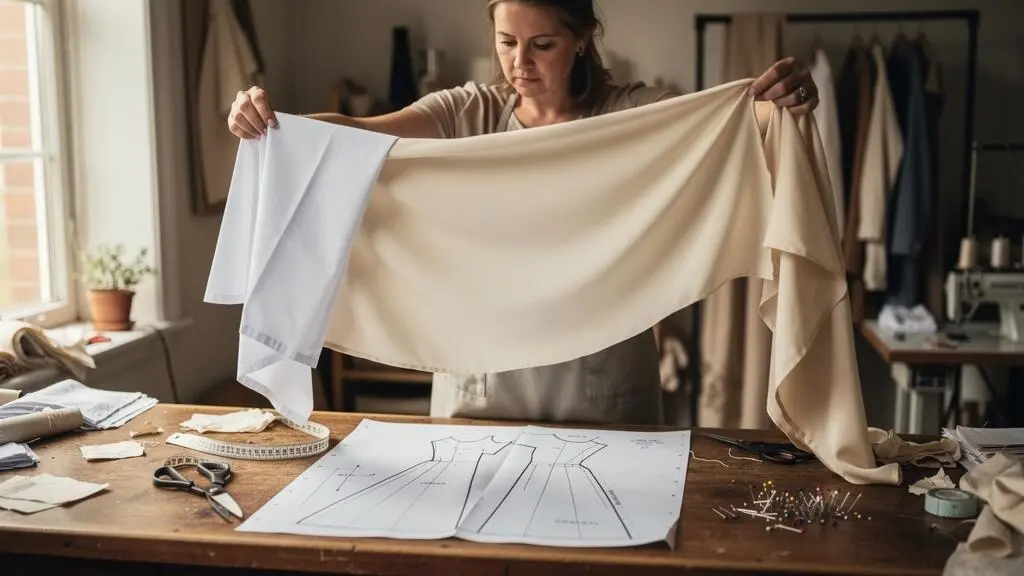
A fabric can look beautifully fluid on a shop display and turn unexpectedly stiff, clingy or shapeless once sewn into a garment. The problem is rarely the sewing pattern alone. It is the relationship between the textile’s weight, flexibility, construction and the way a particular garment distributes that fabric around the body.
To predict fabric drape before buying or cutting, examine how the material folds under its own weight, responds to diagonal movement, recovers from compression and behaves against the body. Then match those observations to the design: a gathered dress, bias-cut skirt and tailored work dress each demand different behaviour.
For UK dressmakers, weather, commuting, layering and changing indoor temperatures add another dimension. A material that falls elegantly in a warm fitting room may behave differently on a windy pavement or after several hours beneath a coat.
The most useful approach combines a short physical test, careful reading of online specifications and an honest assessment of how the finished garment will actually be worn.
Fabric drape: the essentials before you commit
- Test movement, not just softness. Observe hanging folds, diagonal give and crease recovery rather than judging by touch alone.
- Match fabric behaviour to garment shape. Crisp fabrics support volume; fluid fabrics produce softer folds but may follow body contours more closely.
- Check real wearing conditions. Opacity, moisture, static, layering and recovery matter as much as how attractive the fabric looks on the bolt.
- Why Does the Same Dress Pattern Look Completely Different in Two Fabrics?
- How to Test Drape in a Fabric Shop Using Only Your Hands and 30 Seconds?
- Woven or Knit: Which Drape Works Better for All-Day Workwear Comfort?
- The Fabric Choice That Makes Skirts Cling and Show Every Line Under Daylight
- When Should You Avoid “Fluid” Fabrics Because Weather Will Ruin the Look?
- How to Evaluate a “Premium” Fabric Label in 3 Checks When You Can’t Touch It Online?
- Why Do Modern Fabrics Feel Lighter Yet Sometimes Less Breathable Than Older Clothes?
- How Do You Judge Premium Textiles Without Falling for Price-Tag Theatre?
Why Does the Same Dress Pattern Look Completely Different in Two Fabrics?
The same dress pattern can produce dramatically different silhouettes because fabric drape depends on more than weight or fibre content. Bending stiffness, resistance to distortion and directional flexibility determine whether material stands away from the body or collapses into soft folds. The effect becomes especially visible in full skirts, gathers and bias-cut garments.
Imagine sewing the same A-line dress twice: once in crisp cotton poplin and once in fluid viscose challis. These are hypothetical fabric choices, not a controlled comparison of specific commercial textiles.
The poplin version is likely to maintain a more defined A-line silhouette, particularly if the cloth is tightly constructed and firmly finished. Its skirt may stand farther from the thighs, forming fewer, more angular folds. At the waist or gathered bodice, the excess fabric can create visible volume.
The challis version may fall in narrower, softer folds, following the hips and legs more closely. Gathers can look less pronounced because the fabric collapses rather than projecting outward. Yet the result depends on the actual challis construction and finish, not simply its viscose content.
Three mechanical properties help explain the difference:
- Bending stiffness: how strongly fabric resists folding under its own weight. Higher resistance generally encourages a more structured silhouette.
- Shear behaviour: how readily the textile changes shape as its yarn directions shift relative to one another. This matters when fabric must conform to curved surfaces and complex folds.
- Weight per unit area: the mass of fabric, usually expressed in grams per square metre (gsm). Weight influences how gravity acts on the cloth but cannot predict its shape alone.
138 woven fabrics
An original experimental study measured drape and mechanical properties across 138 woven samples. It identified a strong relationship between drape coefficient and bending rigidity relative to fabric weight, demonstrating why mass alone is insufficient to explain how woven fabric hangs.
Harumi Morooka and Masako Niwa, 1976: research on fabric drape coefficients and mechanical properties.
Construction also explains why two fabrics labelled 100% cotton can behave differently. Yarn characteristics, weave density, finishing and fabric geometry all affect bending and movement. Fibre names alone do not reveal these details.
Pattern design magnifies material differences. Full skirts expose changes in fold depth, gathered bodices reveal how readily fabric compresses, and bias cuts make diagonal flexibility particularly important. Straight, relatively close-fitting panels may disguise some differences, although they can still alter comfort and fit.
Before cutting, consider where the pattern needs fabric to stand away, follow a curve or fall freely. A fabric that performs well in one area may struggle in another.
The practical lesson is to choose the intended shape first, then assess which textile mechanics will produce it. A brief hands-on test makes that prediction considerably more useful.
How to Test Drape in a Fabric Shop Using Only Your Hands and 30 Seconds?
A 30-second fabric drape test combines four observations: how the cloth hangs over your hand, how it behaves when gathered, how it moves diagonally and how it looks against the light. These checks cannot reproduce a finished garment, but they quickly reveal structure, fluidity, crease tendencies and potential transparency before purchase.
Ask the shop assistant whether you may handle a loose section or sample. Use enough fabric to see its natural folds without stretching it tightly. Inspect the material away from the compressed edge of the bolt whenever possible.
- First 8 seconds — let it hang. Place the fabric over your forearm or open hand. Observe whether it forms pronounced ridges, broad waves or soft folds that collapse together.
- Next 7 seconds — gather and release. Gently scrunch a handful, then open your palm. Notice both its softness under compression and whether creases remain visible.
- Next 8 seconds — test the diagonal. Hold a small area along the bias and apply gentle tension. Look for controlled diagonal give or pronounced distortion. Avoid pulling hard enough to damage the cloth.
- Final 7 seconds — check light and surface. Hold the fabric towards a window or bright area. Look for transparency, reflective sheen and changes in appearance as it moves.
The shape of the hanging folds provides an initial clue. More rigid fabrics often retain projecting, defined shapes, while flexible materials collapse into softer waves. Fold width alone is not a precise measurement, however: the amount of material, its orientation and your grip also affect what you see.
Pay particular attention to crease recovery. After releasing the scrunched fabric, watch whether prominent marks soften quickly or remain visible. A material that keeps distinct creases may also show signs of sitting, carrying a bag or being compressed beneath outerwear. This is a practical screening observation, not a scientifically calibrated prediction of how it will look after an hour.
Compare similar-sized sections under similar conditions. Shop lighting can conceal transparency or exaggerate sheen, while cloth hanging vertically from a bolt may look smoother than an unsupported cut piece. A single layer can also behave differently from a doubled bodice, lined skirt or garment with substantial seam allowances.
Your five-check fabric shop decision record
- Photograph the hanging folds. Record one clear image showing whether the cloth projects outward or falls softly.
- Document crease recovery. Note whether visible marks disappear, soften or persist after the scrunch test.
- Check diagonal behaviour. Write down whether the bias shows little give, controlled movement or pronounced distortion.
- Verify opacity. Record whether one layer remains opaque against strong light and whether two layers improve coverage.
- Match the sample to the pattern. Write one specific decision: suitable, suitable with a modification, or unsuitable for the intended garment.
A short test works best when it answers a specific design question. Rather than asking whether the cloth feels nice, ask whether it can hold a collar, release a gathered waist, move around the knees or remain opaque as a skirt.
Once the basic drape is understood, the next decision is how that movement will feel over a full day of wearing the garment.
Woven or Knit: Which Drape Works Better for All-Day Workwear Comfort?
Neither woven nor knitted fabric is automatically more comfortable for workwear. Knits generally accommodate body movement through looped construction, while conventional wovens often provide greater dimensional stability and a defined silhouette. The better choice depends on how the garment must look, how much you move, and whether it can recover its shape after hours of wear.
For an office dress worn through meetings, commuting and prolonged sitting, the important question is not simply whether the material stretches. It is whether that stretch remains controlled and whether the fabric continues to hang attractively after repeated movement.
Traditional woven fabrics usually offer comparatively limited stretch along the warp and weft unless their construction or fibre blend provides additional give. They can produce sharp seams, stable hems and tailored shapes. Yet insufficient ease across the shoulders, hips or knees may make a garment uncomfortable when reaching or sitting.
Knits can follow movement more easily. Their loops deform as the wearer bends, reaches and sits. However, recovery varies. A fabric that stretches comfortably in the fitting room may gradually develop stretched elbows, knees or a loose seat if it does not recover adequately.
Hybrid fabrics offer useful alternatives. A stretch woven may retain a tailored appearance while accommodating movement. Ponte and other substantial double knits can offer more body than lightweight jersey, making them attractive for work dresses, trousers and structured separates.
The following comparison gives a starting point rather than a universal rule.
| Typical working day | Fabric direction | What to check |
|---|---|---|
| Mostly meetings and formal presentations | Stable woven or suitable stretch woven | Defined silhouette, shoulder mobility and crease recovery |
| Frequent commuting and extended sitting | Substantial knit, ponte or comfortable stretch woven | Seat recovery, knee movement and surface durability |
| Mixed desk work and active movement | Flexible woven or stable double knit | Balance between freedom of movement and shape retention |
| Warm offices or layered workwear | Construction suited to temperature and movement | Airflow, moisture management, lining and drape together |
A second concern is how the surface ages. Friction at underarms, elbows, the seat and bag-contact areas can encourage pilling or abrasion in susceptible materials. Some knits also lose their original shape through repeated stretching, although these problems are not exclusive to knitted fabrics.
Test recovery by gently stretching a sample within its normal range and releasing it. Compare the surface and dimensions before and after handling. For garments you expect to wear frequently, a washable sample and a small test seam provide more useful evidence than a softness rating.
Comfortable movement matters, but even a fabric with excellent recovery can disappoint when it clings unexpectedly or reveals more than intended in daylight.
The Fabric Choice That Makes Skirts Cling and Show Every Line Under Daylight
Skirts are more likely to reveal body contours, underwear or lining seams when the fabric is lightweight, very fluid, insufficiently opaque or highly reflective. Static electricity can make some textiles cling more closely, but fluid drape can create a similar appearance without static. Identifying which mechanism is responsible determines the most effective solution.
Consider a smooth, lightweight skirt that hangs beautifully on a hanger but follows every curve when worn. The fabric may simply lack enough body to stand away from the hips and thighs. Adding antistatic treatment will not necessarily change that mechanical behaviour.
Static cling is different. Friction between the outer fabric, lining, hosiery and body can create electrical charge. Some manufactured fibres are susceptible to this effect, particularly in dry conditions, but the behaviour also depends on surface properties, humidity and the materials in contact.
The University of Georgia Cooperative Extension’s textile fibre reference identifies static accumulation as a potential characteristic of fibres including nylon and acrylic. It also describes fibre-specific tendencies towards wrinkling and other appearance changes. These characteristics are useful warnings, not guarantees about any individual fabric.
Daylight reveals a separate risk. A fabric can appear adequately opaque under subdued shop lighting yet show silhouettes or underlayers when strongly backlit. Surface sheen can also emphasise creases and changes in the shape of the body, even when the textile itself is not transparent.
Test the fabric over a contrasting background and against a bright window. Then place two layers together and repeat. This reveals whether a lining or underlayer might improve coverage. Do not judge opacity solely by looking directly through fabric held flat: examine folds and tension as well, because a garment rarely remains perfectly flat when worn.
Choose the remedy according to the problem:
- Insufficient opacity: consider a denser fabric or a suitable opaque lining.
- Fluid fabric following contours: choose material with more body, introduce additional skirt fullness or review the intended fit.
- Static-related cling: test lining compatibility, reduce problematic friction and consider an appropriate antistatic product where fabric care permits.
- Highly visible seam or underwear outlines: assess seam construction, underlayers, lining and fit together.
Adding a lining can improve coverage and sometimes change the way a skirt falls, but a poorly matched lining may introduce bulk, friction or new static problems. Antistatic sprays can address electrical cling temporarily; they cannot make a very fluid textile structurally stiffer or truly opaque.
A fabric that passes the indoor test still needs to suit the conditions outside, particularly when wind, rain and outerwear are part of an ordinary UK day.
When Should You Avoid “Fluid” Fabrics Because Weather Will Ruin the Look?
Avoid exceptionally lightweight, fluid fabrics when the garment must retain a controlled silhouette through strong wind, wet weather or repeated compression beneath outerwear. Such materials can move beautifully indoors yet become difficult to manage outside. For exposed garments and frequent commuting, slightly more body, suitable layering or a practical finish may produce more dependable results.
Wind is the most immediate problem. A very fluid skirt can follow gusts, lift, twist around the legs or lose its intended shape while walking. A heavier or more structured textile may offer greater resistance, although cut, skirt fullness and garment construction also influence movement.
Rain introduces a different issue. Wet hems can become heavier, cling against hosiery or skin and show changes in colour or transparency. These effects depend on absorbency, fabric construction and the amount of moisture involved.
Viscose and some silk fabrics can absorb moisture, but it would be misleading to assume that every such textile necessarily sags or loses its shape in ordinary UK humidity. Different yarns, finishes and constructions respond differently. The useful question is whether the specific sample retains an acceptable appearance under the moisture exposure the garment may encounter.
Consider the garment’s main purpose before choosing its drape:
| Wearing context | Potential problem | Practical choice |
|---|---|---|
| Indoor occasion or controlled environment | Limited exposure to wind or rain | Fluid fabrics can work well when opacity and fit are suitable |
| Daily outdoor commuting | Wind distortion and damp hems | Consider more body, manageable skirt volume and appropriate outer layers |
| Frequent wear beneath a coat | Crushing, creases and friction | Prioritise recovery and test fabric against the intended lining |
| Outer garments exposed to showers | Wet appearance and moisture absorption | Assess weather suitability and any relevant water-resistant finish |
Layering deserves particular attention. Fabric that falls freely when worn alone can become trapped between a coat and the body. Repeated sitting, bag friction and compression may change its appearance. Some fabric combinations also create static, especially when the outer garment and lining rub together.
Recreate that situation before committing: place the sample beneath the coat or lining fabric you expect to use, compress it gently, then examine the surface when released. This is an informal compatibility test, not a substitute for testing care or water resistance.
Weather-resistant finishes may help in suitable applications, but they can also affect handle, flexibility and care requirements. A finish should never be assumed to improve drape simply because it makes a fabric more practical outdoors.
For online shopping, these considerations make product specifications particularly important: the best fabric description is one that helps predict real behaviour, not merely one that sounds luxurious.
How to Evaluate a “Premium” Fabric Label in 3 Checks When You Can’t Touch It Online?
Evaluate an online premium fabric through three checks: fibre composition, weight in gsm and the quality of the seller’s technical information. Together, these reveal useful clues about flexibility, structure and suitability for your garment. They do not guarantee drape, so a physical swatch remains the strongest practical check when you cannot handle the full fabric.
Check 1: Read the complete fibre composition. A fibre label is the beginning of an investigation, not a quality certificate. Cotton can feel crisp or soft, wool may be springy or fluid, and viscose fabrics can vary substantially in construction.
Elastane content indicates that an elastic component is present, but its percentage does not tell you exactly how a fabric stretches or recovers. A blend with elastane does not automatically lose crispness; the weave or knit structure, finishing and other fibres remain important.
Similarly, wool content can suggest potentially useful resilience, but cannot guarantee recovery in the finished material.
Check 2: Examine the gsm figure. Grams per square metre describes fabric mass relative to area. It does not describe thickness, stiffness, breathability or quality by itself.
As a broad shopping orientation, rather than a technical standard, you might encounter lightweight dress fabrics around 80–150 gsm, general shirting and dress fabrics around 120–200 gsm, and more substantial garments using fabrics above those ranges. These categories overlap considerably and should never override the requirements of the specific pattern.
Instead of asking whether a higher gsm means premium quality, compare the stated weight with a textile you already know. Two materials of similar weight can still drape differently, as the earlier mechanical research illustrates.
Check 3: Evaluate the seller’s evidence. Useful listings identify fabric width, composition, gsm, weave or knit type, care requirements and relevant finishing details. Close-up images should reveal surface texture, while photographs of the material hanging or folded help communicate its handle.
A photograph cannot reliably establish stiffness, but a seller who provides multiple meaningful views makes comparison easier. Missing specifications are a reason to request clarification, not automatic proof of poor quality.
When the listing uses words such as “buttery”, “luxury”, “premium” or “beautiful drape”, ask what observable characteristic supports the claim. A description of softness is not equivalent to evidence that the fabric will work in your proposed silhouette.
The practical safeguard is to order a swatch when available. Test its folds, opacity and recovery against the intended garment. Small samples have limitations because they cannot reproduce the weight and movement of an entire skirt, but they are still more informative than relying on a studio photograph alone.
If swatches are unavailable, check the seller’s minimum order and returns policy before buying. Purchasing a small usable quantity can make sense for a test project, provided it is compatible with the overall fabric requirement.
Once composition, construction and weight are understood, one further distinction becomes essential: a light, beautifully draping fabric is not necessarily comfortable in warm or enclosed conditions.
Why Do Modern Fabrics Feel Lighter Yet Sometimes Less Breathable Than Older Clothes?
Some modern fabrics feel light yet allow relatively little airflow because weight and permeability describe different properties. A thin, tightly constructed textile may restrict air movement, while a heavier but more open fabric may permit more ventilation. Moisture transport, surface finishes and fabric thickness also affect comfort, so neither fabric age nor fibre type reliably predicts breathability.
Modern textile manufacturing can produce fine yarns, dense constructions and functional finishes with very different performance profiles. A lightweight fabric may feel delicate in the hand while its construction limits airflow. Conversely, a substantial-looking open weave or knit may feel better ventilated.
It is tempting to conclude that older clothes were generally more breathable because some vintage garments used heavier natural-fibre textiles. That conclusion is too broad. Historical garments varied greatly in weave, lining, fibre blend and finish, while contemporary fabrics include highly permeable technical constructions as well as tightly constructed materials.
Three separate properties need to be assessed:
- Lightness: how much the textile weighs for a given area, commonly recorded in gsm.
- Breathability and moisture transfer: how readily air or water vapour passes through the material. These are related but distinct performance measurements.
- Drape: how the fabric folds and hangs under gravity, influenced by its mechanical behaviour.
A 2025 study on thermal and moisture management in knitted workwear examined eighteen knitted fabrics used in workwear and protective clothing systems. The research assessed factors including fabric mass, thickness, air permeability, thermal resistance and water-vapour resistance.
Measured performance in knitted workwear
Researchers examined eighteen knitted textile samples obtained from thirteen T-shirts and five polo shirts. Fabric masses ranged from 109 to 310 g/m².
The investigation found that thermophysiological performance depends on several characteristics, including thickness, mass and moisture-transfer behaviour. One polyester-elastane sportswear sample showed favourable moisture-management and drying characteristics. These findings concern the tested workwear textiles, not every synthetic or fashion fabric.
This distinction matters when selecting fabric for a flowing summer blouse, work dress or skirt worn with tights and a jacket. Excellent drape may make a textile attractive visually, yet the complete outfit can feel uncomfortable if heat and moisture are poorly managed.
Without laboratory equipment, a simple airflow comparison can offer a limited clue. Hold clean samples of similar size and test how readily air passes through them, using a gentle airflow method. This can indicate obvious differences in air permeability, but it cannot measure water-vapour resistance or establish how breathable the material will feel throughout the day.
A more meaningful personal comparison is to wear comparable garments under similar conditions. For instance, a synthetic jersey and a cotton poplin of similar weight may feel different against the skin, but any difference cannot automatically be attributed to the fibres alone.
Pay attention to the complete garment: lining, fit, air space, layering, moisture absorption and drying behaviour may influence comfort as much as the fabric selected for its outward appearance.
These separate performance measures also provide a stronger basis for judging premium claims: genuine quality should be connected to properties that matter for the intended garment, not simply to price or reputation.
What matters before paying more
- Decide which performance characteristic is essential for the garment: controlled structure, fluid movement, comfort, opacity or recovery.
- Separate measurable information, such as composition and gsm, from descriptive marketing language that cannot establish finished-garment behaviour.
- Assess quality through the fabric’s suitability for its purpose, including construction, finishing, durability and care, rather than assuming a premium price guarantees a better result.
How Do You Judge Premium Textiles Without Falling for Price-Tag Theatre?
Judge premium textiles by the quality and consistency of their construction, the suitability of their finishing, their recovery and their performance in your intended garment. Price, brand positioning and prestigious fibre names can indicate production choices, but none guarantees better drape. A well-matched ordinary fabric may produce a more successful garment than an expensive textile chosen for its label.
The phrase “premium cotton” might refer to desirable fibre characteristics, specialist finishing or simply marketing positioning. Similarly, an expensive silk, wool or linen fabric can be beautiful in its own right yet unsuitable for a pattern that demands a different type of structure.
Fibre identification and performance claims should be treated differently. The composition label provides information about what the textile contains; it does not certify softness, durability, breathability or drape quality.
For example, US federal textile rules generally require covered products to disclose fibre composition according to applicable requirements, as explained in the Federal Trade Commission‘s guidance on textile and wool labelling. Those US rules should not be treated as a statement of UK law, nor does compliance amount to an assessment of garment quality.
For UK buyers, check the applicable product and seller information rather than assuming that a product described as premium has passed any particular quality standard.
Four observations are more useful than the price tag.
- Construction consistency: examine whether the weave or knit appears even, with no unexpected irregularities, gaps or defects. Distinguish intentional slub or texture from unwanted faults.
- Finishing quality: inspect the surface, handle and consistency of colour. A finish should support the intended appearance and care requirements rather than merely impress at first touch.
- Colourfastness: review the seller’s care and testing information. If safe and appropriate, follow the manufacturer’s instructions for testing a washable swatch before combining colours. A visual inspection alone cannot establish colourfastness.
- Recovery and durability: test gentle stretching and compression, then observe whether the sample retains its intended surface and shape. Consider likely abrasion points in the finished garment.
Higher pricing can sometimes reflect genuine production costs. Longer-staple fibres, carefully controlled manufacturing, sophisticated finishing and smaller production runs may require more resources. Yet these factors need to be evidenced and relevant to the finished garment; a costly process is not automatically a guarantee of superior performance for every use.
For a tailored dress, a reliably stable woven fabric may offer better value than an expensive textile that stretches or collapses unexpectedly. For a softly gathered blouse, the reverse can be true: comfortable fluidity may matter more than firmness or substantial weight.
The most dependable purchasing routine combines the checks established throughout this guide. Start with the garment pattern and identify where the fabric must support volume, follow curves or move freely. Use composition and gsm to shortlist possibilities, then examine construction, finish and seller information. Handle a swatch, assess its folds and recovery, and check opacity under daylight. Finally, consider laundering, layering, local weather and the activities the garment will experience.
Do not rely on a single successful test. A fabric may hang well but crease heavily, recover beautifully but lack opacity, or have an excellent surface finish while proving uncomfortable in the intended setting.
When the decision remains uncertain, make a small sample of the relevant garment detail. A test gather, pleat, seam or hem can reveal how the material responds to construction. For a high-cost project with significant fitting requirements, a toile in a fabric with similar behaviour can help assess the pattern, although it will not reproduce every property of the final textile.
Before committing to the full garment, select the fabric that passes the checks most relevant to your pattern and real wearing conditions. Record what the sample does, not merely what the product description promises. That simple habit makes future fabric purchases easier to compare and the finished result more predictable.
Can you accurately predict fabric drape from gsm alone?
No. GSM measures fabric mass per unit area, not bending stiffness, shear behaviour or surface characteristics. Two textiles with similar gsm values can hang differently because their constructions and finishes differ. Use gsm to compare likely fabric weight, then examine hanging folds and recovery to assess how each material might behave in your garment.
Can a small fabric swatch reveal how a full skirt will hang?
A swatch can reveal useful clues about softness, crease recovery, transparency and surface texture, but it cannot fully reproduce the folds created by an entire skirt. The number of panels, cut direction, seam weight and total fabric volume will affect the outcome. For important projects, test a larger sample or a representative garment detail where practical.
Does prewashing change fabric drape?
It can. Washing may alter the handle, dimensions or surface finish of a textile, depending on its construction and treatment. Prewash a suitable sample according to the manufacturer’s instructions, then compare it with an unwashed piece. This helps identify changes before cutting, particularly when the finished garment is intended to be regularly laundered.
Why does a fabric drape differently on the bias?
Bias orientation changes how the fabric’s yarn structure responds to tension and distortion. In many woven fabrics, this allows greater diagonal movement than along the straight grain, making the material conform differently to curves. The extent varies by weave, finishing and other properties. A bias-cut garment may also change length as the fabric settles, making sample testing particularly useful.
What should you do when an online fabric listing has no drape photograph?
Ask the seller for a photograph or short demonstration showing the fabric hanging freely, alongside its composition, gsm, width and construction details. Request a swatch when available. If those details remain unavailable, compare the uncertainty with the cost and importance of the project before purchasing. Descriptions such as “soft” or “luxurious” cannot reliably replace evidence of how the textile hangs.