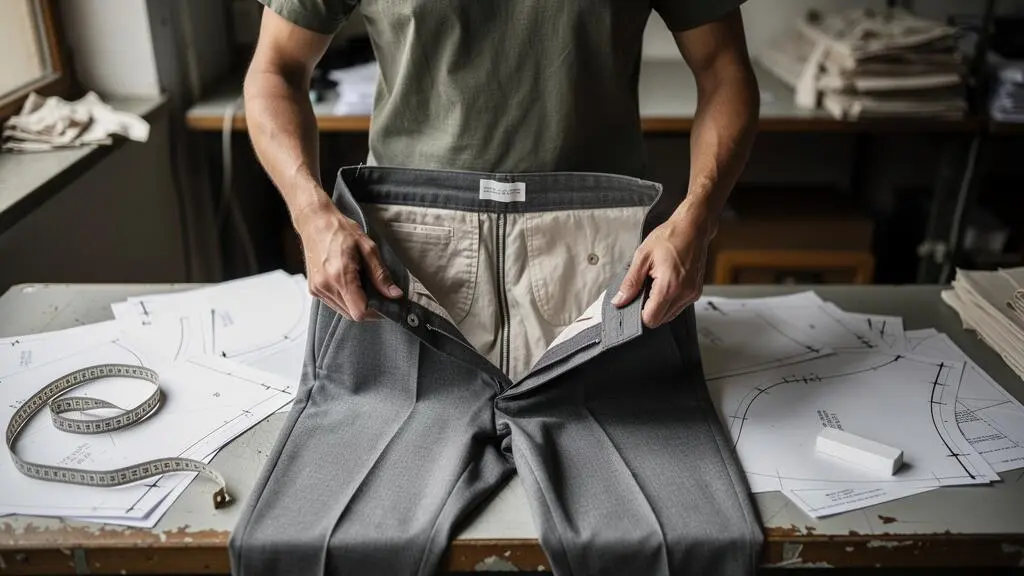
Clothing can look simple on the outside while containing surprisingly sophisticated engineering underneath. The difference between trousers that remain comfortable throughout a working day and those that pull when sitting, or between a jacket that moves naturally and one that restricts the shoulders, often comes down to pattern design, seam construction and material selection.
Wearable engineering is the process of designing these elements to work together. It considers how the body changes shape during movement, where a garment needs additional room, how fabric responds to repeated stress and how different fibres behave against the skin. The objective is not to make every garment look technical. It is to make its technical qualities almost invisible during everyday use.
For UK consumers, this matters across ordinary situations: commuting in changeable weather, sitting at a desk, walking between appointments and wearing the same trousers for several hours. A well-engineered garment balances mobility with silhouette, comfort with structure and durability with appearance. Understanding the construction makes it easier to recognise genuine functional design rather than relying on labels such as flexible, premium or comfort fit.
The essentials of wearable garment engineering
- Comfort depends on pattern ease, garment geometry and seam placement as much as fabric softness.
- Mobility features such as gussets, shaped panels and articulated construction allow clothing to follow natural movement.
- Long-term performance depends on matching fibres, stitching, reinforcement and garment construction to the intended use.
- Why Do Some “Simple” Trousers Feel Comfortable for 10 Hours While Others Don’t?
- How to Spot Mobility Features in Clothes Without Doing a Full Changing-Room Workout?
- Fashion Outerwear or Technical Shell: Which Works Better for a 30-Minute UK Commute?
- The Construction Shortcut That Causes Seams to Split After 5 Wears
- When Should You Add a Gusset or Extra Ease During Alterations Instead of Sizing Up?
- How to Read Fibre Blends So You Don’t End Up Sweaty, Static, and Uncomfortable?
- How to Choose Trousers That Work With Trainers Without Looking Like You Forgot to Change?
- Are Synthetic Fibres Always Bad, or Are Some Actually the Best Choice for Daily Wear?
Why Do Some “Simple” Trousers Feel Comfortable for 10 Hours While Others Don’t?
Two pairs of plain-looking trousers can behave very differently over a full working day, even when their fabrics feel similarly soft. The difference often lies in the pattern: how much room has been allowed around the hips, seat and knees, where the seams sit, and how the waistband follows the body. Comfortable trousers accommodate movement without relying on excess fabric everywhere.
The first important factor is functional ease. A pattern drafted for someone standing still does not necessarily accommodate the same person sitting, climbing stairs or bending down. The dimensions of the lower body change with posture, so the garment needs enough additional space to accommodate those changes without pulling against the body.
Research by Simeon Gill and Steve Hayes, published in the International Journal of Fashion Design, Technology and Education, examines the relationship between lower-body dimensions and functional postures. The study highlights why functional ease needs to be considered during garment development. It does not establish one universal allowance for every body or trouser design. The university research on functional ease in garment patterns provides a useful technical foundation for understanding this principle.
Several construction details influence how this ease feels in practice:
- Seat and hip shaping: a correctly shaped seat accommodates sitting without excessive pulling across the back.
- Crotch depth and rise: the relationship between front rise, back rise and crotch curve affects how the trousers sit when the hips bend.
- Knee allowance: enough room around the knee helps prevent fabric tension when climbing stairs or crouching.
- Waistband geometry: a shaped waistband can follow the body’s contours more closely than a rigid, poorly matched straight band.
- Seam placement: seams positioned away from high-pressure areas can improve the sensation of comfort during prolonged wear.
There is also a distinction between draped comfort and engineered comfort. Loose fabric may initially feel unrestricted, but it can sag, shift and bunch as the wearer moves. Engineered comfort uses shaped panels, strategically distributed ease and, where appropriate, stretch materials to maintain a more consistent relationship between garment and body.
Structure remains important. A trouser pattern designed exclusively around movement may lose the crisp silhouette expected in an office or more formal setting. A stable woven fabric, carefully shaped panels and moderate stretch can provide a more useful compromise than simply maximising looseness.
Different postures, different dimensions
Research on lower-body functional ease examines dimensional changes between standing and functional positions. Its findings support movement-aware pattern development, not a universal numerical allowance or a guaranteed duration of comfort.
Research published in the International Journal of Fashion Design, Technology and Education.
To assess this principle, consider three everyday movements: sitting at a desk, climbing stairs and bending to pick something up. If the trousers pull sharply at the crotch, tighten across the seat or restrict the knees, the problem may be the distribution of ease rather than the overall size.
Once the relationship between fit and movement is understood, the next challenge is recognising these features before buying. Many of the most useful details are hidden inside the garment.
How to Spot Mobility Features in Clothes Without Doing a Full Changing-Room Workout?
Mobility features can often be identified through a short visual inspection rather than a full series of physical tests. Look for additional fabric panels around the crotch and underarms, shaped seams, articulated sections and pleats positioned to support movement. These details provide more useful evidence of functional construction than vague product descriptions such as flexible or active fit.
The most practical approach is to inspect the garment from the outside first, then examine its internal construction if the retailer allows it. The aim is to identify where the designer has anticipated movement and added fabric, altered seam placement or changed the garment’s geometry.
For trousers, start with the crotch area. A gusset is an additional piece of fabric inserted into a seam intersection, often creating more room for the legs to move independently. Some designs use diamond-shaped or triangular panels to distribute movement across a larger area rather than concentrating tension at the crotch seam.
Next, examine the knee and leg construction. Articulated knees use shaping or additional seams to accommodate the natural bend of the leg. Pleats can also create extra volume, although their position and depth determine whether they genuinely support movement or primarily change the appearance of the garment.
For jackets and shirts, inspect the shoulder and underarm area. Raglan sleeves extend diagonally towards the neckline rather than following a conventional shoulder seam. Other designs use shaped back panels, additional underarm fabric or carefully positioned sleeve seams to accommodate reaching and arm rotation.
The direction of a side seam can also provide clues. Forward- or backward-shifted seams may reflect a deliberate pattern choice, although seam position alone does not prove that the garment offers better mobility.
Fabric composition offers another indication. A small proportion of elastane may contribute stretch and recovery, while bias-cut sections can provide movement through the direction of the fabric weave. However, neither a stretch label nor a particular fibre percentage guarantees good performance. Pattern geometry and fabric construction still matter.
Retailer descriptions should therefore be checked against physical features:
| Design signal | What to inspect | What it may indicate |
|---|---|---|
| Gusseted crotch | Additional panel at the crotch | More room for leg movement |
| Articulated knees | Shaping or seams around the knees | Construction adapted to knee flexion |
| Raglan sleeves | Diagonal sleeve construction | Different shoulder and sleeve geometry |
| Stretch woven fabric | Fibre composition and fabric behaviour | Potential additional fabric flexibility |
| Shaped back panel | Curved or additional back sections | Pattern adaptation around the upper body |
A useful distinction is between an identifiable construction feature and a marketing expression. Terms such as articulated knees or gusseted construction refer to recognisable design characteristics. Words such as flex, comfort fit and movement technology do not have a single universal technical definition that guarantees a particular performance.
Some features also introduce compromises. Deep pleats may add volume, while stretch fabrics can alter their appearance after repeated use. A highly technical trouser may be appropriate for walking or cycling but less suitable for a formal office outfit.
A five-step garment mobility inspection
- Inspect the crotch and underarm areas for additional panels, gussets or shaped fabric pieces. Deliverable: a note of the visible mobility features.
- Check the knee, seat and back for articulated construction or strategically positioned pleats. Deliverable: a list of shaped sections.
- Examine sleeve and side-seam positioning. Deliverable: a simple description of the garment’s seam layout.
- Read the fibre composition and distinguish confirmed stretch content from general performance claims. Deliverable: a recorded fibre breakdown.
- Compare the construction with the garment’s intended setting, considering silhouette and formality. Deliverable: a purchase decision based on identifiable features.
These checks are useful for everyday clothing, but they become especially important when the garment must also protect against weather. Outerwear introduces a second engineering challenge: balancing technical performance with appearance.
Fashion Outerwear or Technical Shell: Which Works Better for a 30-Minute UK Commute?
For a typical 30-minute UK commute, neither a purely fashionable coat nor a highly technical outdoor shell is automatically the best choice. A minimalist technical jacket or hybrid raincoat may provide a more practical balance between weather protection, breathability and office-appropriate styling. The right option depends on exposure, walking intensity, temperature changes and how reliably the garment handles rain.
UK commuting often involves several different environments within a short period: walking outside, waiting for transport, entering a heated train or bus and arriving at an office. A garment that performs well in only one of these conditions may become uncomfortable during the rest of the journey.
A traditional fashion coat may offer a structured silhouette and work well with tailoring. However, its performance in prolonged wet conditions depends on the fabric, finish and construction. A water-repellent treatment can help rain bead on the surface, but this should not automatically be confused with a waterproof membrane.
A technical shell approaches the problem differently. It is designed around weather protection, with performance depending on the membrane or coating, fabric construction and finishing details. Features such as taped seams, adjustable cuffs and protective closures can make a meaningful difference to the garment’s overall performance.
The distinction between water resistance and waterproof construction is particularly important. A water-resistant garment may be suitable for light showers but should not be assumed to provide reliable protection throughout repeated wet-weather exposure. A waterproof claim should be assessed against the actual product specifications, including the construction of its seams and closures.
Breathability is another consideration. A waterproof outer layer that allows insufficient moisture vapour to escape may feel uncomfortable during brisk walking, particularly when the wearer moves between cold outdoor conditions and heated transport.
For a commute, the following criteria provide a practical comparison:
| Criterion | Fashion outerwear | Technical shell | Hybrid design |
|---|---|---|---|
| Visual formality | Often prioritised | Depends on design | Can combine tailored and technical details |
| Rain protection | Depends on fabric and finish | Depends on membrane or coating and seams | Depends on the protective construction |
| Breathability | Varies by material | Depends on the technical specification | Varies by construction |
| Wind protection | Depends on fabric and closures | Often a design objective | Depends on the outer layer |
| Compatibility with tailoring | Often straightforward | Can be more difficult | Potentially strong |
Hybrid outerwear offers an interesting middle ground. Wool-blend coats with protective construction, heritage-style raincoats and membrane-lined overshirts can combine familiar silhouettes with functional details. Nevertheless, the category name alone proves nothing about actual waterproof performance.
Inspect the hood, if present, to see whether it offers useful coverage. Check whether cuffs close securely, whether a storm flap protects the front fastening and whether exposed seams appear appropriately protected. Product specifications are more reliable than assumptions based on appearance.
For office use, the most versatile choice is often a coat whose outer appearance remains compatible with everyday tailoring while its construction addresses the conditions it will actually encounter. That may mean choosing a restrained technical shell or a properly specified hybrid rather than relying on a fashion label.
Weather protection is only one part of garment performance. The same attention to hidden construction becomes essential when assessing why otherwise attractive clothing develops holes, splits or loose seams after relatively little use.
The Construction Shortcut That Causes Seams to Split After 5 Wears
A seam can fail because its construction cannot withstand the forces generated when the garment is worn. The problem may involve the thread, stitch type, seam configuration or stitch density, rather than the fabric itself. High-strain areas such as trouser crotches, underarms and hip seams deserve particular attention because repeated movement places additional demands on their construction.
The expression after five wears should not be interpreted as a scientifically established failure threshold. There is no universal rule that a particular construction shortcut causes every garment to split after five uses. The more useful question is whether the seam has been designed to tolerate the fabric’s behaviour and the movements expected during wear.
Several construction variables influence seam integrity:
- Sewing thread: its properties need to be appropriate for the fabric and intended application.
- Stitch type: different stitches behave differently under tension and repeated movement.
- Seam type: the way fabric panels are joined influences how forces are distributed.
- Stitch density: the number and spacing of stitches affect the seam’s structural behaviour.
These are also the four engineering variables identified in ASTM International‘s D1683/D1683M-22 standard for testing failure in sewn seams of woven fabrics. The method examines seam performance under an applied force, including thread rupture and fabric yarn displacement. The ASTM standard on sewn seam strength provides a technical reference for understanding why seam performance depends on more than the apparent neatness of the stitching.
This is particularly relevant to garments containing elastane. Stretch fabric can extend when the wearer moves, but the seam must also accommodate the deformation. If the stitching cannot tolerate the movement, the thread may break even when the textile itself remains intact.
However, it would be inaccurate to claim that every stretch fabric must use one specific stitch or that a straight stitch is always unsuitable. The appropriate construction depends on the fabric, seam design, machine setup and intended performance.
Visual inspection can reveal warning signs, although it cannot replace a laboratory strength test. Turn the garment inside out and examine the areas where panels meet. Look for irregular stitching, loose thread, visible gaps, excessive puckering and areas where the fabric appears stretched around the seam.
Flat-felled seams, overlocked edges and reinforced joins each have different construction characteristics. An overlocked edge can help prevent fraying, but its presence alone does not establish that the entire seam has sufficient strength. Similarly, a bar tack can reinforce a specific stress point without compensating for an inadequately designed seam elsewhere.
When damage appears, distinguish between an isolated repairable problem and a recurring construction weakness. A few broken stitches may be repaired by a tailor, particularly when the surrounding fabric and seam allowance remain intact. Repeated failures in exactly the same place may indicate a pattern or construction issue that needs more than simply replacing the thread.
Early signs such as slight puckering or loose stitching deserve attention before the seam opens completely. Repairing a developing problem may be more straightforward than reconstructing a damaged area, especially if the fabric has also begun to tear.
When a garment is structurally sound but still restricts movement, replacing the stitching may not solve the problem. The next question is whether its pattern needs additional room in a specific location.
When Should You Add a Gusset or Extra Ease During Alterations Instead of Sizing Up?
A gusset or targeted ease insertion is worth considering when a garment fits reasonably well overall but restricts movement in one specific area. Sizing up is generally more appropriate when the entire garment feels too tight. The distinction matters because increasing the size changes several dimensions simultaneously, whereas a targeted alteration can address a local restriction without unnecessarily changing the overall silhouette.
For example, trousers may fit correctly around the waist but pull at the crotch when sitting or cycling. Increasing the size could create unwanted looseness around the waist, hips and thighs while leaving the underlying pattern problem only partially resolved.
A gusset introduces an additional fabric panel into an existing construction. Its purpose is to redistribute tension and create additional room where movement is restricted. Depending on the design, the inserted panel may be diamond-shaped, triangular or another compatible shape.
Targeted ease insertion offers another option. A tailor may be able to release an existing seam allowance or introduce additional fabric to increase room in a specific area. The feasibility depends on the original construction, the amount of available material and the desired finish.
Different garments present different alteration challenges:
- Trousers: a crotch restriction may justify assessing whether a gusset or additional ease can be introduced without disrupting the seat and leg shape.
- Jackets: pulling across the upper back when reaching may indicate insufficient back ease or a pattern that does not accommodate the wearer’s movement.
- Shirts: tightness around the shoulders or upper back may require a different intervention from simply increasing the waist or chest measurement.
- Workwear: repeated bending, reaching and lifting may make targeted movement allowances particularly relevant.
There are practical limits. A gusset needs suitable seam allowances and fabric that can be incorporated without creating an obvious mismatch. If the garment has very narrow allowances, fragile material or complex internal construction, the alteration may be difficult or uneconomical.
Shoulders and armholes are especially challenging areas. Their geometry affects the entire relationship between the sleeve and body, so changing them after construction can require substantial work. A simple adjustment to another seam will not necessarily resolve an underlying shoulder-pattern problem.
Before paying for an alteration, it is useful to describe the exact movement that causes discomfort. A tailor can then assess whether the issue comes from insufficient room, seam placement, crotch geometry or a broader fitting problem.
There is also a durability consideration. When the garment consistently pulls against a particular seam, introducing appropriate ease may reduce repeated tension in that area. However, this benefit depends on the quality of the alteration and the suitability of the original garment.
Pattern modifications address the space available to the body. Material selection addresses a different part of the comfort equation: how the fabric interacts with moisture, temperature and friction.
How to Read Fibre Blends So You Don’t End Up Sweaty, Static, and Uncomfortable?
A fibre composition label is best understood as a description of the materials used, not as a complete prediction of comfort. Natural and synthetic fibres have different moisture-related properties, but the finished fabric’s construction, thickness, finishing and position on the body also influence how it feels. The most suitable blend depends on whether the garment sits against the skin, provides insulation or acts as an outer protective layer.
One important distinction is between moisture absorption and moisture transport. Some fibres absorb more moisture into their structure, while others absorb comparatively little. These characteristics influence how a textile behaves when exposed to perspiration, but they do not independently determine whether a finished garment will feel dry or clammy.
For example, the Royal Society of Chemistry‘s chapter The Scope of Textile Fibres presents comparative moisture-regain values for several fibres under reference conditions of 20°C and 65% relative humidity.
| Fibre | Moisture regain | Reference conditions |
|---|---|---|
| Wool | 14–18% | 20°C and 65% relative humidity |
| Cotton | 7–8% | 20°C and 65% relative humidity |
| Polyester | 0.4% | 20°C and 65% relative humidity |
| Nylon 6,6 | 4.1% | 20°C and 65% relative humidity |
These figures describe moisture regain as a property of the fibres under specified conditions. They are not direct measurements of how comfortable every garment made from those fibres will feel. The Royal Society of Chemistry’s scientific chapter on textile fibres also discusses the relationship between moisture content and electrical conductivity.
This relationship helps explain why static electricity can become noticeable in clothing. Moisture content influences electrical conductivity, while friction between materials can contribute to the accumulation of electrical charge. Dry indoor conditions, including heated environments, can make static more noticeable in some garments.
However, it is misleading to treat every synthetic fibre as uncomfortable. Polyester can be useful in outer layers, sportswear and quick-drying garments. Its relatively low moisture regain does not automatically mean that every polyester fabric traps perspiration. Fabric construction and moisture transport also matter.
When reading a composition label, consider the role of each component:
- Cotton: absorbs moisture and is widely used in everyday garments, although its performance depends on fabric weight and construction.
- Wool: has a higher moisture-regain value than cotton and polyester in the cited reference conditions.
- Polyester: offers low moisture regain and can contribute to durability, drying performance and shape retention depending on the textile construction.
- Nylon: can provide useful strength and abrasion resistance, with moisture properties that differ from polyester.
- Elastane: is used to introduce stretch, although the appropriate quantity and construction depend on the garment’s intended behaviour.
Layering changes the decision. A synthetic outer layer may provide useful protection, while a different material next to the skin may offer a more comfortable combination for the wearer. A base layer designed for moisture transport is not necessarily equivalent to a heavy polyester fabric with a different construction.
Recycled polyester also deserves a precise interpretation. Recycled content describes the origin of the material, not its moisture-management performance. Sustainability claims and wearing comfort should be evaluated separately rather than treated as interchangeable qualities.
For everyday clothing, the most useful approach is to examine the entire blend and its position on the body. A fabric that works well as a shell jacket may not offer the same experience as a close-fitting garment worn directly against the skin.
Material selection influences how a garment behaves, but appearance still matters. The final test is whether the construction and silhouette work together with the shoes and other clothing worn every day.
Key considerations before choosing everyday clothing
- Look beyond the size label and assess how the garment accommodates the body’s movement.
- Check that the construction, fabric and intended use are compatible, especially around high-stress areas.
- Evaluate the finished silhouette as well as the technical features, including how the garment works with footwear.
How to Choose Trousers That Work With Trainers Without Looking Like You Forgot to Change?
Trousers can work well with trainers when their leg shape, hem length and fabric structure create a deliberate visual relationship with the footwear. A clean hem that sits close to the top of the trainer, combined with a straight or slightly tapered leg, generally produces a more intentional appearance than excess fabric pooling around the ankle. The key is balancing casual footwear with a trouser silhouette that retains its shape.
The first consideration is the hem break. This describes how the trouser hem meets the shoe. Too much fabric can gather around the ankle, making the trousers appear oversized or unfinished. A shorter hem can create a cleaner transition, although the appropriate length depends on the cut, the wearer’s proportions and the trainer design.
Three common silhouettes are worth considering:
- Straight-leg trousers: create a balanced line and can work with a range of trainer shapes when the hem is appropriately proportioned.
- Slightly tapered trousers: narrow towards the ankle and can provide a more defined relationship with low-profile trainers.
- Relaxed trousers: offer additional volume but need a deliberate hem length to avoid excessive fabric gathering over the footwear.
Fabric structure also matters. Firm cotton twill, structured cotton blends and wool-blend trousers can maintain a clearer silhouette when paired with casual footwear. Very fluid fabrics may fall differently around a trainer than they do around formal shoes with a different shape and height.
The trainer itself should be considered as part of the outfit. A slim, minimal shoe creates a different visual balance from a bulky technical trainer. The trouser width and hem need to respond to that difference rather than being selected independently.
There is also a distinction between a casual outfit and a technical outfit. Performance trousers with elasticated hems may work well for sport or travel, but they can create a visual mismatch when combined with a tailored shirt or structured jacket. In many everyday situations, keeping the trousers relatively tailored while allowing the trainers to introduce the casual element produces a more coherent combination.
Context determines how far this combination can go. A clean trainer-and-trouser pairing may be suitable for a relaxed office or weekend setting but less appropriate for a formal meeting. Dress expectations should be assessed before deciding that one combination works everywhere.
A practical test is to evaluate the complete outfit rather than judging the trousers in isolation. Consider the hem from the front and side, the amount of fabric gathering around the shoe, and whether the upper half of the outfit supports the same level of formality.
Comfort remains important, but it should not be the only criterion. A pair of trousers that moves well and looks balanced with trainers is more likely to remain useful across several everyday situations than one that works only with a specific shoe.
Footwear and silhouette complete the visible side of garment engineering. Fibre selection brings the different considerations together, raising a broader question about when synthetic materials are actually the more practical choice.
Are Synthetic Fibres Always Bad, or Are Some Actually the Best Choice for Daily Wear?
Synthetic fibres are not inherently unsuitable for everyday clothing. They can offer useful properties such as abrasion resistance, shape retention, low moisture regain and quick drying, making them practical in outerwear, workwear and garments exposed to frequent use. Natural fibres also have valuable properties, particularly for certain next-to-skin applications. The best choice depends on the garment’s position, construction, expected use and maintenance.
The natural-versus-synthetic debate becomes more useful when replaced with a functional question: what does the garment need to do?
For example, a polyester outer layer may be appropriate when durability and resistance to repeated wear are priorities. Nylon may be useful where abrasion resistance is important. Cotton can be suitable for everyday clothing, while wool offers distinct moisture-related and thermal properties.
None of these characteristics guarantees comfort or performance independently. A synthetic garment can feel uncomfortable if its construction is unsuitable for the activity, while a natural-fibre garment can perform poorly if its pattern, fabric weight or finishing is inappropriate.
Environmental considerations require the same level of precision. One important concern associated with synthetic textiles is the release of microfibres during domestic washing. These fibres can enter wastewater, creating a pollution issue that depends on material, construction, finishing and washing conditions.
A 2021 experimental study, Domestic laundry and microfiber pollution: Exploring fiber shedding from consumer apparel textiles, evaluated 37 synthetic and natural apparel textile samples over five consecutive domestic washing cycles.
9.6–1,240 mg/kg per wash
The study reported this range of microfibre release across the textile samples examined. The results varied substantially with material, construction and treatment and should not be interpreted as a universal emission rate for all clothing.
Experimental findings from the 2021 study on domestic laundry and microfiber pollution.
The study also found that cotton and wool samples released microfibres. This is an important qualification: textile fibre pollution cannot be attributed exclusively to synthetic materials.
Another comparison in the experiment found that the mechanically treated polyester samples released six times more microfibres than the woven nylon samples examined. This finding applies to those specific samples and does not establish that polyester universally releases six times more fibres than nylon.
The research therefore supports a more nuanced assessment of clothing materials. Fibre type matters, but so do the manufacturing process, textile construction and treatment. The experimental study on microfiber shedding from consumer apparel textiles provides evidence that both synthetic and natural textiles can contribute to fibre release during washing.
Durability introduces another important consideration. A garment that retains its shape and remains wearable through frequent use may be more useful to its owner than one that deteriorates quickly. However, this does not prove that synthetic garments always have a lower environmental footprint over their entire life cycle. Such a comparison would require broader evidence covering production, maintenance, longevity and disposal.
For consumers, the most useful decision framework combines three questions:
- Where is the garment worn? A material suitable for an outer shell may not be ideal for a close-fitting base layer.
- How frequently will it be used? Everyday workwear and occasional formal clothing have different performance requirements.
- What is likely to fail first? The weak point may be the fibre, the seam, the fit, the fastening or the fabric finish.
This final question connects material selection to the rest of garment engineering. A durable fibre cannot compensate for a poorly constructed seam. Stretch fabric cannot solve an incorrectly drafted pattern. A comfortable blend cannot guarantee a good fit if the garment restricts movement.
Equally, a garment should not be judged solely by whether its fibres are natural or synthetic. The relationship between material, pattern, construction and intended use determines how well it performs in daily life.
Before purchasing, consider the garment as a complete engineered product. Its fibres, seams, proportions and movement allowances should all serve the same purpose: making the clothing comfortable, practical and appropriate for the way it will actually be worn.
What is wearable engineering in clothing?
Wearable engineering is the application of technical design principles to clothing construction. It combines pattern drafting, functional ease, material selection, seam engineering and garment geometry to improve movement, comfort and durability while maintaining the intended appearance.
Does a higher elastane percentage always make trousers more comfortable?
No. Elastane can provide additional stretch, but comfort also depends on the fabric construction, recovery, pattern shape and distribution of ease. A garment with more elastane can still restrict movement if its cut or construction is unsuitable.
How can you tell whether a garment has genuinely reinforced seams?
Inspect the inside of the garment for consistent stitching, suitable seam construction and additional reinforcement at stress points. Look for loose threads, puckering and visible gaps. These checks provide useful visual clues, although they cannot establish the seam’s actual tensile strength without appropriate testing.
Can a tailor improve the mobility of a garment that feels too restrictive?
Sometimes. A tailor may be able to release existing seam allowances, add targeted ease or insert a gusset. The possibilities depend on the original pattern, available fabric, seam allowances and garment construction. Some shoulder and armhole alterations are particularly difficult.
Are natural fibres always more breathable than synthetic fibres?
Not necessarily. Natural and synthetic fibres differ in moisture absorption, but the performance of a finished textile also depends on its weave or knit, thickness, finishing and ability to transport moisture. A well-designed synthetic fabric can be suitable for particular activities and outer layers, while some natural-fibre fabrics may be less comfortable in certain conditions.