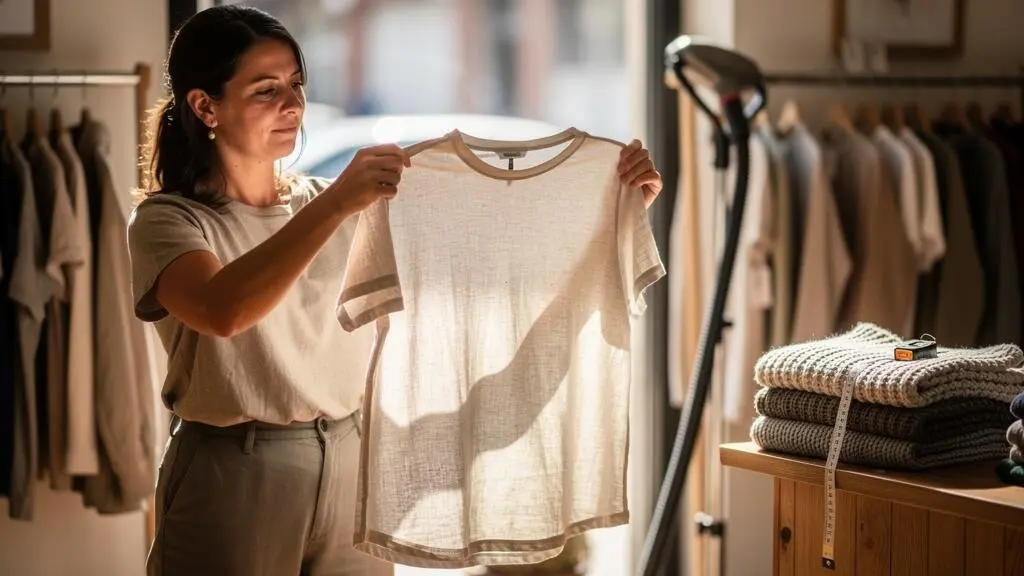
Modern fabrics are not a single category of material. The phrase usually describes contemporary combinations of fibres, yarn structures, fabric constructions and finishing treatments designed to deliver particular benefits: stretch, lighter weight, moisture management, crease resistance or easier maintenance.
A technical-looking polyester shirt, a high-twist wool suit and cotton chinos containing a small amount of elastane can all qualify. What separates them is not necessarily their age or sophistication, but how their construction affects everyday wear.
For UK shoppers, this distinction matters because labels such as “tech fabric”, “performance weave” and “temperature regulating” often describe intended benefits without providing comparable measurements. A garment may feel beautifully light in a fitting room yet become uncomfortable on a crowded train. Another may resist creasing but develop an unwanted sheen after repeated wear.
The sensible approach is to assess each fabric against the job it needs to do: staying comfortable, recovering its shape, surviving regular laundering and looking presentable throughout the week.
Modern fabrics: what matters before buying
- Fabric weight, breathability, moisture management and crease resistance are different properties. One does not guarantee another.
- Fibre percentages are useful clues, but weave, yarn construction, finishes and care requirements also determine performance.
- The best everyday fabric depends on the garment’s purpose, wearing conditions and realistic maintenance routine—not whether its fibres are natural or synthetic.
- Why Do Modern Fabrics Feel Lighter Yet Sometimes Less Breathable Than Older Clothes?
- How to Decode ‘Performance Fabric’ Claims So You Don’t Overheat on the Commute?
- Modern Blend or 100% Natural: Which Works Better for Crease-Free Travel Days?
- The Modern Fabric Finish That Starts to Shine in Photos After 3 Months
- When Should You Choose Modern Fabrics If You Want to Cut Ironing Time by 50%?
- How to Read Fibre Blends So You Don’t End Up Sweaty, Static, and Uncomfortable?
- Chinos, Wool, or Tech Trousers: Which Is Best for a 3-Day Office Week?
- Are Synthetic Fibres Always Bad, or Are Some Actually the Best Choice for Daily Wear?
Why Do Modern Fabrics Feel Lighter Yet Sometimes Less Breathable Than Older Clothes?
Modern fabrics can feel lighter without allowing more air to pass through them because fabric weight and air permeability are independent properties. Fine yarns, compact knits, dense weaves and certain finishing processes can create lightweight garments with restricted airflow. The result is clothing that feels almost weightless on the shoulders but uncomfortable during a warm commute.
Three characteristics explain the apparent contradiction: weight describes how much material is present, drape describes how it hangs, and air permeability describes how readily air passes through its structure. None can reliably be inferred from the others.
Consider two hypothetical summer blazers. One uses a relatively open wool weave that allows some air movement. The other uses a finer, lighter synthetic fabric with a compact construction. The second blazer might weigh less, yet its restricted ventilation could make it feel warmer during a crowded train journey.
The comparison is not simply modern versus traditional. Heavy cotton twill can restrict airflow, while an open synthetic mesh can be highly permeable. Linen often offers useful warm-weather comfort, but its performance still depends on weave density and garment design.
Brushed surfaces add another complication. Their raised fibres can create a soft, insulating layer next to the skin, making a fabric feel cosy even when it is relatively thin. That is desirable for winter clothing but potentially uncomfortable in a summer shirt.
Finishing treatments also matter. Calendering compresses and smooths a fabric surface and may reduce air passage depending on the construction. Some coatings can restrict permeability, while other finishing processes are designed to preserve it. It would be misleading to assume every anti-crease treatment blocks pores or that normal washing necessarily makes a fabric less breathable.
A useful 30-second shop-floor inspection involves three checks:
- Hold the fabric towards a window or light source to examine how open or compact the weave appears.
- Gently attempt to breathe through a clean, suitable fabric area away from your face, if shop hygiene rules permit. Treat the resistance as a rough comparison, not a scientific measurement.
- Place the fabric briefly against your inner wrist to assess texture and immediate skin comfort.
These observations cannot predict measured thermal comfort, but they can expose differences that a “lightweight” label conceals. For a garment intended for warm conditions, look for information on air permeability, moisture transport and lining construction rather than relying on weight alone.
Once weight and ventilation are treated separately, performance claims become easier to question—and much easier to compare.
How to Decode ‘Performance Fabric’ Claims So You Don’t Overheat on the Commute?
To judge performance fabric claims, identify the precise property being promised and ask how the manufacturer measured it. Moisture-wicking, quick-drying, breathable and wrinkle-resistant describe different characteristics. Terms such as “tech”, “advanced” or “climate-smart” have no single standardised textile performance meaning, so they should never replace measurable product information.
The important distinction is between a specific claim and its supporting evidence. A brand can advertise a fabric as engineered for commuters without revealing anything about its ventilation, drying behaviour or crease recovery.
Established textile testing methods demonstrate why these properties must be considered separately. AATCC‘s 2026 textile testing program identifies distinct methods covering liquid moisture management, vertical and horizontal wicking, drying time, water vapour transmission, fabric appearance after laundering and wrinkle recovery.
That does not mean every garment using performance language has undergone those tests.
| Claim | What it should describe | What to check |
|---|---|---|
| Lightweight | Low fabric mass | Weight in g/m², where available |
| Moisture-wicking | Movement of liquid moisture through or along fabric | Relevant moisture-management or wicking test |
| Quick-drying | How quickly moisture leaves the textile under defined conditions | Drying test and stated conditions |
| Breathable | Air movement, water vapour transfer or both, depending on the claim | Which property was measured and by which method |
| UV-protective | Protection against ultraviolet radiation | UPF rating and applicable test method |
| Wrinkle-resistant | Resistance to creasing or recovery after deformation | Appearance or wrinkle-recovery testing |
| Temperature-regulating | Some form of thermal response or comfort management | Specific mechanism, test conditions and demonstrated benefit |
Moisture-wicking does not automatically mean cooling. A fabric can move sweat away from the skin while still limiting heat loss. Evaporation depends on environmental humidity, airflow, fabric construction and the clothing layers worn above it.
For a commuter walking to the station before entering a heated train, a wicking base layer could be useful, but a dense outer layer may still trap warmth. Likewise, quick drying after washing does not guarantee adequate ventilation during wear.
Another distinction is whether performance comes from the fibre or yarn construction or from an added treatment. Stretch may come from elastane, mechanical fabric construction or both. Water repellency may depend on a surface finish. Some finishes gradually lose effectiveness through wear or laundering, but their service life cannot be reliably predicted from a universal wash-count rule.
Composition and care labels provide useful starting information, although they do not normally identify every chemical treatment. When a brand advertises a durable performance finish, request its technical specification or evidence of performance after laundering.
Choose claims according to the commute itself. Crease recovery may matter more than drying speed for someone sitting in a coat for an hour, while ventilation may be the priority for a brisk walk followed by crowded public transport.
The same evidence-first approach is particularly useful when shopping for travel clothing, where crease resistance is often advertised as though every fabric achieves it in the same way.
Modern Blend or 100% Natural: Which Works Better for Crease-Free Travel Days?
Modern blends can be convenient for travel because some synthetic fibres provide useful resilience and shape recovery. However, 100% natural fabrics are not automatically poor travellers. High-twist wool can recover well from temporary creasing, while tightly folded cotton may wrinkle noticeably. Yarn twist, weave construction, finishing and packing conditions matter alongside fibre composition.
Start by distinguishing an occasional crease from a persistent fold. A garment may develop visible lines inside luggage but recover after hanging, while another retains sharp creases until pressed.
Fabric construction influences that recovery. High-twist yarns can introduce resilience, while tightly compressed fabrics may retain folds depending on fibre characteristics and finishing. Some blends combine fibres with different responses to pressure and moisture, producing a practical balance rather than a universal advantage.
The following comparison is a qualitative buying guide, not a ranking derived from controlled laboratory tests.
| Fabric | Potential advantage | Main consideration |
|---|---|---|
| High-twist wool | Good potential crease recovery and comfortable drape | Varies by weave, lining and care requirements |
| Cotton-elastane | Stretch and familiar cotton-rich feel | Elastane does not guarantee crease resistance |
| Polyester-viscose | Can balance shape retention and softer drape | Thermal comfort depends heavily on construction |
| Wrinkle-treated cotton | Potentially easier to maintain than untreated cotton | Finish longevity and permitted care methods vary |
For a short trip with a tightly packed carry-on bag, an easy-care blend may be practical because a minor amount of creasing can often be tolerated without ironing. A high-twist wool garment is another credible option, particularly when it can be hung between wears.
For travel involving prolonged wear in warm conditions, the calculation changes. Air movement, sweat handling, odour accumulation, fabric weight and the possibility of changing clothes may matter more than immaculate crease recovery. A natural-fibre-rich blend can be a good candidate, but it should be assessed as a finished garment rather than assumed to outperform all synthetics.
Wrinkle resistance also has a maintenance cost. Some fabrics achieve it mainly through their fibre and yarn properties, while others depend on finishing processes. A particular treatment may change over time, and repeated processing can affect durability depending on the chemistry and conditions used. It is not justified to assume every treated garment wears out faster.
Before an important trip, conduct a simple home comparison:
- Choose two clean garments under consideration.
- Fold a similar-sized section of each and compress it under comparable conditions overnight.
- Unfold both and observe whether the creases disappear immediately, gradually or only after steaming.
- Repeat with a gentle roll to imitate a different packing method.
This informal test is not a laboratory measurement, but it reveals useful differences under conditions resembling your own packing habits.
Even when a fabric emerges from a suitcase looking smooth, long-term surface wear can affect how professional it appears in photographs and office lighting.
The Modern Fabric Finish That Starts to Shine in Photos After 3 Months
Some smooth, calendered or resin-finished fabrics can develop unwanted shine where repeated friction changes the surface texture. Elbows, cuffs and trouser seats are particularly exposed. Three months is a possible observation period, not a reliable lifespan prediction: fabric construction, finishing, wearing frequency and abrasion determine whether and when the effect appears.
The underlying issue is how light reflects from a surface. A matte textile generally scatters light across fibres and yarns with varied orientations. When friction compresses or polishes an area, reflection can become more directional, creating a shiny patch.
Calendering deliberately produces a smoother surface by passing fabric through rollers under controlled conditions. Other finishing treatments can also affect surface smoothness and appearance. Neither process automatically means a garment will develop premature shine.
Repeated contact is often the decisive factor. Sitting against a desk chair, resting elbows on a table or rubbing cuffs against a coat can gradually alter exposed zones. Wool, synthetic blends and natural-fibre fabrics may all show surface changes, although their appearance and severity vary.
Photography makes these differences easier to notice because directional lighting can exaggerate contrasts between polished and unpolished areas. Under certain camera angles, a garment that looks satisfactory in diffuse daylight may show a reflective patch during a video call or flash photograph.
Prevention begins before purchase. Examine the garment under angled light and check high-contact areas for existing polish or surface variation. A matte, textured weave may conceal gradual wear better than an exceptionally smooth finish, although texture alone does not establish abrasion resistance.
Rotate frequently worn workwear when possible, avoid unnecessary friction and follow the specified care routine. Careful steaming may improve some temporary compression marks, but it cannot be assumed to restore permanently altered fibres or finishes.
Dry cleaning is not automatically a solution or a cause. Its effect depends on the garment, cleaning process and pressing conditions. Excessive heat or pressure can worsen shine in some materials, making professional handling important.
Remember that finishing chemistry is not necessarily disclosed on the composition or care label. A detailed brand specification may offer more information, but an absence of finishing details should not be interpreted as proof that a treatment was never applied.
Surface appearance is only one part of garment longevity. Ease of ironing and laundering can also determine whether a technically sophisticated fabric remains worthwhile.
When Should You Choose Modern Fabrics If You Want to Cut Ironing Time by 50%?
Choose easy-care modern fabrics when a substantial share of your ironing comes from woven shirts, tailored trousers or other crease-prone garments. A 50% reduction is a personal target, not an established benefit of modern fabrics generally. The actual saving depends on which garments you replace, how they are washed and dried, and how much pressing they require afterwards.
Someone who already wears mostly jerseys and knitwear may save almost no time by purchasing wrinkle-resistant clothing. Someone who presses several cotton shirts each week has considerably more scope for reducing the workload.
The relevant fabric options include certain polyester blends, high-twist wool constructions and cotton garments with crease-resistant finishing. These can reduce maintenance under suitable conditions, but there is no universal guarantee that a particular composition will eliminate ironing.
A more reliable method is to measure the task before shopping. For one representative week, record the garments ironed and the approximate minutes spent on each. Then identify which items might be replaced or managed differently.
Hypothetical example: calculating an ironing-time target
Suppose a commuter spends 60 minutes ironing each week: 40 minutes on woven shirts and trousers and 20 minutes on other garments. Replacing some crease-prone items with suitable easy-care alternatives reduces the first category to 10 minutes while the other category remains unchanged.
The new total would be 30 minutes, representing a 50% reduction in this hypothetical wardrobe. This is an arithmetic illustration, not a measured result or a prediction for a particular fabric.
Garment handling can contribute as much as the material. Prompt removal from the washing machine, appropriate spinning, careful reshaping and hanging can reduce folds that otherwise become difficult to press.
Care restrictions should be considered before purchase. Some garments tolerate tumble drying; others require gentler temperatures or air drying. A fabric that saves ironing but introduces an inconvenient drying routine may not save much overall effort.
The FTC guidance on clothing care labels explains why care instructions must have an adequate basis under the applicable US rules. Although that regulatory framework is not UK law, the practical lesson is transferable: maintenance requirements should be checked before assuming an easy-care garment will suit a household’s routine.
For UK buyers, the garment’s own care instructions remain the immediate reference, alongside any supplementary information provided by the manufacturer.
A five-step check before investing in easy-care clothing
- Record your current ironing. Produce a one-week list of garments and minutes spent pressing each one.
- Identify the main workload. Mark the two or three garment types responsible for the largest share of time.
- Compare replacement fabrics. Create a shortlist recording fibre composition, construction and any supported crease-resistance claim.
- Check maintenance compatibility. Record the washing, drying and pressing requirements for every shortlisted garment.
- Measure the outcome. Compare weekly ironing minutes after changing your wardrobe or laundry routine and calculate the percentage difference.
The next step is understanding fibre composition, which helps explain why some easy-care garments feel comfortable while others create new problems with heat or static.
How to Read Fibre Blends So You Don’t End Up Sweaty, Static, and Uncomfortable?
Read fibre percentages as a starting point rather than a complete comfort prediction. The largest component indicates which fibre contributes most by weight, while smaller components may substantially affect stretch, recovery or surface behaviour. Sweating, static and skin comfort also depend on fabric construction, finishing, humidity and the other garments worn with it.
A label stating 65% polyester and 35% cotton tells you the proportions by fibre weight. It does not specify whether the garment is a dense woven shirt, a loose knit or a brushed fabric. Those differences can alter how the finished textile feels.
Official FTC guidance on textile fibre-content labelling explains the use of fibre names and percentages under US textile rules. UK shoppers should use the fibre-composition information provided for their market rather than treating US regulatory details as universally applicable.
The largest fibre percentage is important, but it does not necessarily dominate every characteristic. A relatively small elastane component can noticeably affect stretch, while the structure of the yarn and the position of each fibre within a fabric can change its surface feel.
Static electricity illustrates why percentages alone are insufficient. Friction transfers electric charge between materials, and dry conditions can allow that charge to persist. Synthetic garments may be particularly noticeable in heated winter environments, especially when rubbing against other fabrics.
However, there is no dependable universal percentage threshold at which a polyester blend becomes staticky. Fibre combinations, surface finishes, humidity, garment fit and neighbouring layers all matter. A 50% polyester garment should not automatically be expected to behave like every other fabric with the same composition.
Sweat discomfort is similarly individual. Polyester can transport moisture effectively in suitable constructions, but some dense polyester-rich garments may feel clammy. Cotton can absorb moisture, although a damp cotton garment may remain wet against the skin under particular conditions.
Blends frequently involve trade-offs. Adding synthetic fibres may help shape retention or durability, but that improvement does not guarantee better moisture management. Conversely, choosing a natural-rich composition does not guarantee low static, minimal pilling or a comfortable summer fit.
One practical way to improve future purchases is to review clothing already owned. Select garments that consistently feel too warm, generate static or pill unexpectedly. Compare their labels, construction and typical wearing conditions with garments that perform well.
Record the findings as a personal buying profile. For example, someone might discover that compact polyester-rich office shirts feel uncomfortable during their commute while open-knit garments with similar fibre content do not. The distinction points towards construction rather than a simplistic ban on polyester.
Those observations become especially useful when choosing work trousers, where comfort, presentation and maintenance need to coexist over several office days.
Chinos, Wool, or Tech Trousers: Which Is Best for a 3-Day Office Week?
For a three-day office week, wool trousers are often worth considering when smart appearance and crease recovery matter most; chinos suit a more casual dress code, while technical trousers can be convenient for frequent washing and low-maintenance travel. None is automatically best. The decision depends on commute conditions, laundering preferences, garment construction and workplace expectations.
Three office days create a useful opportunity for rotation. Someone owning two appropriate pairs can alternate between them and allow each garment to air between wears. This can reduce the need for immediate cleaning, provided the trousers remain hygienic and presentable.
The question is therefore not simply which fabric looks most professional, but which one fits the actual rhythm of the working week.
| Consideration | Chinos | Wool trousers | Tech trousers |
|---|---|---|---|
| Office appearance | Usually suited to casual or smart-casual workplaces | Often suited to more formal settings | Depends on cut, texture and finish |
| Crease behaviour | Varies considerably; cotton-rich versions may crease | Good potential recovery with suitable wool construction | Often designed for easy-care performance, but claims need checking |
| Odour management | Depends on use, moisture and laundering | Can often be aired between suitable wears | Varies by fibre, finish and wearing conditions |
| Typical maintenance | Many are machine washable | Care varies; some require specialist cleaning | Many are machine washable, subject to label instructions |
| Potential drawback | Visible creasing | Care cost or restrictions | Heat retention or surface shine in some constructions |
Wool deserves consideration for office rotation because some wool fabrics recover from light creasing after hanging. Airing can also be helpful when a garment is not visibly soiled, but it does not replace necessary cleaning. A wool garment’s maintenance requirements depend on its construction and label.
Chinos provide a practical middle ground for less formal workplaces. A cotton-rich weave can be comfortable and familiar, particularly when the cut allows movement. The drawback is that certain chino fabrics crease readily around knees and hips.
Tech trousers often appeal to commuters seeking stretch, shape retention and machine-washable convenience. Yet a smooth synthetic surface may look less formal in some workplaces, and performance-oriented construction does not guarantee ventilation or a lasting matte appearance.
Instead of averaging every feature, choose a non-negotiable priority. For regular video meetings, evaluate shape, drape and surface reflection. For an active train commute, prioritise comfort and ventilation. If ironing is the main frustration, test crease recovery and laundering convenience.
The best pair may also depend on the season. A lightweight wool weave, cotton twill and dense synthetic fabric will not respond identically to warm weather, even when their overall garment weights seem similar.
Ultimately, none of the three categories should be judged solely by whether its fibres are natural or synthetic. That distinction deserves a more careful assessment of durability, comfort and environmental impact.
Key takeaways before making a fabric choice
- Evaluate the finished garment and its intended use rather than treating natural or synthetic fibre content as a quality verdict.
- Separate personal comfort and garment longevity from environmental concerns; good performance in one area does not settle the others.
- Think in terms of cost and usefulness per wear, realistic cleaning requirements and how long the garment is likely to remain serviceable.
Are Synthetic Fibres Always Bad, or Are Some Actually the Best Choice for Daily Wear?
Synthetic fibres are not inherently unsuitable for everyday clothing. Polyester, polyamide and elastane can provide valuable strength, stretch, recovery and easy-care performance in appropriately designed garments. Their disadvantages—including potential discomfort in certain constructions, microplastic fibre shedding and recycling challenges—must be considered separately rather than treated as evidence that every synthetic garment is a poor choice.
The natural-versus-synthetic debate often combines three questions that should remain distinct: how a garment feels, how long it lasts and what environmental consequences it creates.
For daily wear, synthetic fibres can be useful in garments exposed to repeated movement, abrasion or washing. Stretch trousers, durable outerwear and certain activewear designs may benefit from fibres selected for mechanical resilience and shape retention.
However, that advantage is not automatic. A poorly constructed polyester garment can fail quickly, while a well-made natural-fibre garment may remain useful for years. Claims that synthetic blends necessarily last several times longer than natural alternatives require product-specific evidence rather than generalisation.
Natural fibres also have varied properties. Wool can provide resilience and useful moisture interactions, linen may offer comfort in warm conditions, and cotton can be suitable for frequent everyday contact with skin. Their performance changes according to yarn type, weave, weight and treatment.
A good purchasing approach is to match material to function. A wool-polyester blend might be worth considering for an outer jacket where durability and appearance matter. A cotton-rich fabric might suit a casual base layer, while a synthetic stretch construction could be useful for active movement.
Environmental impact complicates the picture further. The European Environment Agency briefing on textile microplastics identifies the wearing and washing of synthetic textiles as recognised pathways for microplastic release.
200,000–500,000 tonnes annually
Estimated global quantity of textile-derived microplastics entering the marine environment, as reported in the European Environment Agency’s synthesis of existing research. This is a range of estimates, not a direct measurement of annual emissions from any particular garment or country.
European Environment Agency, Microplastics from textiles: towards a circular economy for textiles in Europe.
That environmental problem should not be confused with breathability. A textile can manage sweat effectively while still releasing synthetic microfibres during laundering. Likewise, a natural-fibre garment can shed fibres, although those are not automatically plastic microfibres.
Recyclability is another separate issue. Mixed-fibre constructions can complicate material recovery, but a single-fibre garment is not necessarily recycled in practice. Collection systems, sorting, design, contamination and available processing methods also influence the outcome.
Practical steps to reduce impacts include keeping useful clothing in service, avoiding unnecessary laundering, following suitable care instructions and considering effective filtration options. Laundry bags or filters may capture some released fibres, but they should not be presented as eliminating microplastic pollution.
Wash frequency and load size should follow garment hygiene, appliance guidance and fabric-care requirements. There is no universal load size or wash schedule that minimises environmental impact for every textile.
The most meaningful decision is therefore fitness for purpose over fibre ideology. Consider whether the garment performs well, remains comfortable, is realistically maintainable and can withstand repeated use.
Before buying your next everyday garment, compare its composition, construction, care instructions and intended use with an item you already wear successfully. That single comparison offers a more reliable basis for choosing modern fabrics than a fashionable label or an unsupported performance promise.
Does a higher fabric weight always mean better quality?
No. Fabric weight describes mass per unit area, not overall quality. A heavier fabric may provide structure or insulation, while a lighter one may offer suitable drape and comfort. Durability depends on fibre quality, yarn construction, finishing, stitching and intended use.
Can a fabric be breathable and water-resistant at the same time?
Yes. Breathability and water resistance describe different properties. Some textile constructions and membranes are designed to limit liquid water penetration while allowing some water vapour transfer. Actual comfort depends on the material, environmental conditions and the complete garment system.
Does 5% elastane make a garment more comfortable?
Not necessarily. Elastane can contribute stretch and recovery, even at relatively low proportions, but the effect depends on yarn structure, fabric construction and garment fit. Increased stretch does not automatically improve breathability, skin comfort or longevity.
Can the fibre-composition label reveal whether a shirt has a chemical finish?
Not reliably. Fibre-composition information identifies the fibres used, while care instructions explain suitable maintenance. Neither normally provides a complete inventory of finishing chemicals or surface treatments. A manufacturer’s technical specification is a better place to investigate a claimed finish and its durability.
Is a more expensive performance fabric necessarily longer-lasting?
No. Price and technical marketing language do not independently demonstrate durability. Assess fabric construction, stitching, abrasion-prone areas, maintenance requirements and any relevant test evidence. A well-made ordinary fabric may offer better long-term value than a poorly constructed garment with numerous performance claims.