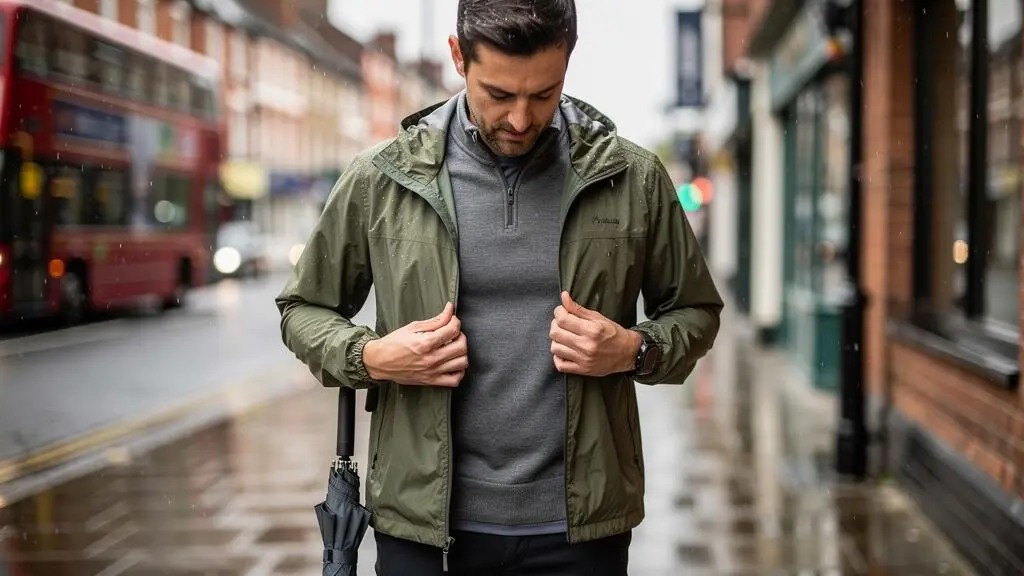
A chilly platform, a windy walk to the office and an overheated train carriage can all happen within the same UK commute. Dressing warmly enough for one part of that journey often makes another uncomfortable. Add a heavy jumper beneath a waterproof coat, and the result may be a damp back, a bulky waistline and clothing that feels awkward once the coat comes off.
The solution is not simply to wear fewer layers. It is to give each garment a specific function: move moisture away from your skin, retain warmth when necessary or protect against wind and rain. Then choose fits and lengths that work together rather than compete for space.
For most mild-to-cool commutes, the goal is a flexible outfit that can respond to changing conditions without requiring a complete change of clothes. That means thinking about how quickly you warm up when walking, how easily you can ventilate your outerwear and whether the remaining outfit still looks appropriate at work.
Getting those decisions right makes layering feel deliberate rather than cumbersome.
UK layering essentials at a glance
- Separate moisture management, insulation and weather protection so you can adjust warmth without rebuilding your outfit.
- Prevent bulk by staggering garment lengths, controlling fabric thickness at the waist and leaving room for insulating air.
- Choose layers that ventilate easily and still look complete when you remove your coat on a heated train or in the office.
- Why Does Layering Sometimes Make You Colder Outside and Sweaty Inside?
- How to Layer in 3 Levels So You Can Handle Rain, Wind, and Heated Trains?
- Trench or Technical Jacket: Which Outer Layer Looks Smarter on the Way to Work?
- The Layering Mistake That Creates a “Lumpy” Midsection Even in Great Clothes
- When Should You Build an Outfit That Still Works After You Take Off the Coat?
- How to Read Fibre Blends So You Don’t End Up Sweaty, Static, and Uncomfortable?
- How to Build a Capsule Around 3 Layering Pieces So You Can Handle 5–15°C Days?
- How Do You Build a Minimalist Capsule Wardrobe That Works in Unpredictable UK Weather?
Why Does Layering Sometimes Make You Colder Outside and Sweaty Inside?
Layering can make you sweaty indoors and cold outdoors when your clothing retains more moisture than it can release. Walking generates heat and perspiration, particularly beneath a protective jacket. If your inner clothes become damp, they may feel cold when activity slows. The problem is often moisture management rather than a lack of insulation.
Two different processes matter. Insulation helps retain warmth by limiting heat loss, partly through air trapped within and between garments. Breathability concerns how readily moisture vapour can move through a clothing system. A garment can insulate effectively yet feel uncomfortable if perspiration accumulates beneath it.
Consider a cotton T-shirt, thick jumper and waterproof jacket during a brisk walk to the station. The outer garment limits exposure to rain, but the combination may also restrict moisture escape. If the cotton becomes damp, removing the jumper on a heated train does not immediately make the T-shirt dry.
The Met Office explanation of humidity describes how high relative humidity can make sweat evaporation more difficult. This is relevant to damp British conditions, although humidity varies considerably by place, season and weather system. It does not mean every UK commute prevents perspiration from evaporating.
American layering advice developed around colder or drier outdoor activities may not always translate neatly to a humid Manchester commute. The relevant difference is the actual combination of humidity, temperature, wind, activity and clothing, not simply the country.
A useful personal diagnostic is a 15minute brisk-walking trial in your intended outfit. Check the collar, upper back and underarms afterwards. If the fabric feels damp, note whether perspiration developed before you became uncomfortable or after you entered a warmer environment. This is a practical self-check, not a validated scientific test.
Instead of immediately replacing the jumper with something thinner, experiment with opening the jacket front, loosening cuffs or using underarm ventilation where available. Venting during activity may help prevent excess moisture from accumulating in the first place.
Once you know whether perspiration or cold exposure is the main issue, you can choose the right adjustment instead of adding another garment.
How to Layer in 3 Levels So You Can Handle Rain, Wind, and Heated Trains?
Use three functional levels: a base layer to manage moisture, a mid layer to provide adjustable insulation and an outer shell to protect against wind and rain. The system works because each level can be changed independently. You do not always need three garments, but you need to understand which function is missing before adding one.
This approach is consistent with the Appalachian Mountain Club‘s winter layering advice, which distinguishes moisture transfer, insulation and weather protection. Its outdoor principles are useful for commuting, even though office dress codes require different garment choices.
The three levels have different responsibilities:
- Base: a fine merino top, suitable synthetic performance garment or other comfortable next-to-skin piece that manages perspiration without excessive folds.
- Mid: a removable fine-knit jumper, cardigan, lightweight insulated layer or structured overshirt that adds warmth when required.
- Shell: a wind-resistant or waterproof jacket selected according to the exposure expected during the journey.
A heavily insulated waterproof coat combines two functions, which can be convenient during consistently cold weather. It is less adaptable when a journey alternates between a windy street and a crowded, heated carriage. A separate mid layer lets you reduce insulation without losing your weatherproof option.
For commute calibration, start with a hypothetical ten-minute outdoor waiting period at the forecast temperature. Ask whether you would be reasonably comfortable while stationary, then consider how much warmer a brisk walk and train ride might feel. This is a planning exercise, not a universal temperature prescription.
Between 5°C and 15°C, consider adjusting the system by changing one component at a time:
| Conditions | Suggested combination | Adjustment |
|---|---|---|
| Mild, windy, around 15°C | Comfortable base plus light wind-resistant shell | Leave the mid layer packed away unless needed. |
| Cool, unsettled, around 10°C | Base, fine-knit mid and protective shell | Remove the mid indoors and ventilate the shell while walking. |
| Colder, exposed, around 5°C | Base, warmer mid and weather-appropriate shell | Prioritise wind protection and sufficient space for insulating air. |
These combinations are starting points, not tested comfort thresholds. Wind, rain, individual cold tolerance and walking speed can substantially change what feels appropriate.
Fit is equally important. A close-fitting base is useful, but forcing several tight garments together can compress insulating material and reduce comfort. You want enough room for movement and loft without leaving so much excess fabric that every layer bunches beneath the next.
When checking an outfit, raise your arms, bend forward and sit down. If sleeves pull, shoulders bind or the jumper visibly compresses beneath the shell, adjust the fit before assuming you need less insulation.
The next decision is choosing an outer layer that delivers the required protection without undermining the outfit underneath.
Trench or Technical Jacket: Which Outer Layer Looks Smarter on the Way to Work?
A trench coat usually looks smarter over tailored office clothes, while a technical jacket is often more practical for active walking and persistent rain. Neither is automatically the better commuter layer. Choose according to outdoor exposure, perspiration, waterproof performance and workplace expectations rather than appearance alone.
A classic trench provides a long, relatively structured silhouette that can sit naturally over a blazer, shirt or fine knit. A technical shell prioritises weather management through its fabric construction, closures and potentially adjustable ventilation.
However, both categories vary considerably. Some trenches use breathable woven fabrics and provide only modest rain protection. Others incorporate coatings or membranes. Likewise, technical jackets range from lightweight wind shells to fully waterproof garments with substantial protection and more complex construction.
| Decision factor | Trench coat | Technical jacket |
|---|---|---|
| Professional appearance | Usually integrates naturally with tailoring and formal office clothes. | Can look smart in a clean, understated design, but sporty details may clash with formal clothing. |
| Breathability while walking | Depends on fabric, lining, coating and how easily the front can be opened. | Depends on membrane and design; adjustable openings may offer greater ventilation control. |
| Packability | Often relatively bulky to fold or carry. | Lightweight models can pack compactly; heavier shells may not. |
| Silhouette over tailoring | Length and cut often accommodate blazers and structured knitwear. | Requires enough room in the chest, shoulders and hem to avoid compressing formal layers. |
| Sustained rain | Protection varies; water-resistant fabric alone may be insufficient. | A genuinely waterproof design with appropriate seam construction is generally better suited to prolonged exposure. |
One overlooked issue is the interaction between the trench fabric and your base layer. A coated cotton trench may resist rain but limit moisture escape, particularly if it has a substantial lining. Cotton-rich outer fabrics may also take time to dry after becoming saturated. These characteristics depend on the actual construction rather than the trench label.
For a door-to-door walk with significant exposure, a waterproof technical shell is a sensible starting point. For a journey involving short walks and extended time on trains, a trench may provide a better balance between office appearance and everyday protection, provided the forecast does not exceed its rain resistance.
A hybrid wardrobe avoids treating the decision as permanent. A muted navy, charcoal or olive technical shell over tailored pieces can look restrained rather than overtly sporty. Alternatively, a trench with a removable technical liner can improve versatility, although a liner does not automatically make the outer coat waterproof.
Check how the coat behaves while moving, too. A sharp silhouette standing still is less useful if the shoulders pull over your blazer, the hem restricts your stride or the front cannot be opened conveniently during a warm train journey.
Whichever outer layer you favour, its cut will only look clean if the garments beneath it are arranged to avoid unnecessary bunching.
The Layering Mistake That Creates a “Lumpy” Midsection Even in Great Clothes
A lumpy midsection often comes from stacking multiple fabric edges at the waist. A tucked-in top, a jumper ending at the waistband and an outer layer sitting at the same height can create overlapping folds. The solution is to control garment lengths, thickness and structure rather than simply choosing tighter clothes.
Think about where each layer ends. A tucked base creates one transition inside the trousers. If a chunky mid layer finishes directly over the waistband, it adds thickness at the same point. An unstructured jacket ending nearby can exaggerate the accumulation.
Bulk is partly a proportion problem. Two outfits can contain a similar amount of fabric yet look different because one distributes that material smoothly while the other concentrates it around the stomach and hips.
A useful approach is to keep at least one transition particularly clean. For example, wear a fine, close-fitting base beneath a mid layer that ends clearly above the hip or extends comfortably below the trouser waistband. Leave a structured overshirt open to create a continuous vertical line rather than forcing every garment to finish together.
Fabric weight matters alongside length. An inner layer should generally be thin and smooth enough not to produce pronounced ridges under the next garment. Outer layers can then provide progressively more visual structure.
A chunky knit beneath a structured coat may look intentional because the outer garment holds its shape. The same knit beneath a very lightweight, unstructured jacket may create visible bumps. This is a styling relationship, not a fixed rule about which fibres can be combined.
There is also an important distinction between close-fitting and restrictive clothing. A fine merino or silk-blend base with comfortable elasticity may lie flatter than a loose, thin woven shirt that gathers at the waist. The problem is uncontrolled excess material, not necessarily a close fit.
Inspect the outfit while seated as well as standing. Waistband pressure and fabric movement can reveal bunching that a mirror check in an upright position misses.
Once the silhouette works under a coat, the next test is whether the outfit remains convincing when that coat is removed.
When Should You Build an Outfit That Still Works After You Take Off the Coat?
Build a coat-independent outfit whenever you will spend substantial time indoors, particularly at work, in meetings or at dinner. Your base and visible mid layer should look intentional without relying on the outer coat to complete the silhouette. For short stops indoors, weather protection and convenience may matter more than the appearance of every intermediate layer.
The simplest way to achieve this is to dress for the destination first. Choose the trousers, shirt, knitwear or other pieces you would comfortably wear throughout the working day. Then add the removable insulation and weather protection required to reach that destination.
This reverses a common habit of choosing a warm coat and filling the space beneath it with whatever layers seem practical.
Imagine two hypothetical journeys. One commuter walks to an office, removes their coat and spends most of the day in meetings. Another walks between outdoor appointments with only brief indoor stops. The first benefits from a polished fine-knit cardigan or structured overshirt. The second may reasonably favour a functional fleece or lightweight insulating garment, even if it looks more outdoors-oriented.
For office days, useful mid layers include fine-gauge merino jumpers, neat cardigans and lightweight structured knits. A shawl-collar cardigan may provide enough visual character to carry the outfit without a jacket. A simple crew-neck knit can work over a shirt if the collar and hem remain controlled.
Design the visible outfit before adding the shell. Otherwise, you may end up using the outer coat to conceal mismatched lengths, excess fabric or a mid layer you would not want to wear alone.
There are limits. A thin, polished cardigan may not provide enough insulation for a long exposed walk during a cold snap. Heavy, persistent rain may justify a more protective system even if its appearance is less office-friendly. Practical safety and thermal comfort should take precedence where conditions demand them.
A useful compromise is to carry one particularly functional insulating piece for exceptional weather while keeping your everyday indoor outfit streamlined. The additional garment can remain in your bag when conditions are milder.
Achieving that balance also depends on the fibres you choose, because fabric composition influences how layers feel both outdoors and in heated rooms.
How to Read Fibre Blends So You Don’t End Up Sweaty, Static, and Uncomfortable?
Read fibre labels according to what each garment needs to do, not whether its marketing describes it as technical, premium or breathable. For a base layer, prioritise moisture comfort and drying behaviour. For a mid layer, consider insulation and shape. For an outer layer, examine weather resistance and construction. Static, washing performance and fit also matter.
A percentage label tells you the garment’s fibre composition, but it cannot predict comfort on its own. Fabric weight, knit or weave structure, finishing treatments, garment fit and the conditions in which you wear it can all change performance.
When comparing blends, ask four practical questions:
- How much moisture might the garment absorb or retain next to my skin?
- Will it dry comfortably during normal use or after washing?
- Does its surface create cling or static against adjacent layers?
- Will its shape, texture and care requirements suit repeated commuting use?
Cotton-rich fabrics are often comfortable for ordinary indoor wear, but cotton can retain moisture and feel cold once wet. Fine merino blends can provide an appealing combination of next-to-skin comfort and insulation, while nylon is sometimes added for durability. Polyester-wool blends can serve different purposes depending on their proportions and construction.
| Fibre or blend | Useful layer position | What to check |
|---|---|---|
| Cotton-rich fabrics | Office shirts or casual visible layers, especially in lower-sweat situations | Moisture retention, drying time and comfort during active commuting. |
| Merino-nylon blends | Base layers or fine-knit mid layers | Wool percentage, feel against skin, durability and laundering instructions. |
| Polyester-wool blends | Base or mid layers depending on construction | Breathability, fabric thickness, static tendency and ease of care. |
| Fleece fabrics | Insulating mid layers | Thickness, wind exposure, appearance and how smoothly the shell fits over them. |
| Water-resistant technical fabrics | Outer shells | Actual waterproof construction, ventilation, seam protection and care requirements. |
Static electricity adds another consideration. Fabrics can cling or produce small discharges when electrical charge accumulates, particularly under conditions that make charge dissipation difficult.
A scientific study of textile electrical properties identifies fibre composition and environmental conditions, including humidity and temperature, as influences on textile electrical behaviour. It does not demonstrate that every polyester garment causes uncomfortable static in an office.
Nevertheless, if a synthetic base repeatedly clings beneath a particular jumper in a heated room, the combination is worth reassessing. Try different fabric pairings and consider whether the garment’s fit, surface texture or dryness contributes to the problem.
For shopping, check the actual percentage breakdown and care symbols. A garment marketed as a performance layer might be suitable for active use, but that description alone tells you little about its precise fibre content or washing requirements.
With a clearer understanding of how materials behave, you can build a smaller selection of garments that covers a wider range of commuting conditions.
How to Build a Capsule Around 3 Layering Pieces So You Can Handle 5–15°C Days?
Start with three complementary pieces: a comfortable base that looks appropriate indoors, a removable mid layer that adds warmth without bunching, and a protective shell that works with smart and casual outfits. Across 5–15°C, vary which pieces you wear and how you ventilate them. More severe conditions may require substitutions or additional insulation.
The important distinction is between owning three versatile core pieces and wearing all three every day. At 15°C, especially during active walking, a base and light shell may be sufficient. Near 5°C, a warmer mid layer and more effective wind protection may become priorities.
The British Mountaineering Council‘s hill-walking clothing advice supports using several relatively thin, removable layers and warns that wet cotton clothing can become particularly cold. Its recommendations concern outdoor activity, so the three-piece office capsule remains a practical adaptation rather than a tested universal formula.
Choose your core around the following requirements:
- One versatile base: a comfortable, relatively fine garment that can be worn visibly without looking like specialist underwear.
- One adaptable mid: a knit or structured layer that adds useful warmth without creating heavy folds around the waist.
- One dependable shell: a coat or jacket with appropriate wind and rain protection, enough layering room and a silhouette compatible with your wardrobe.
For a hypothetical commuter wardrobe, this might mean a fine charcoal merino top, a navy cardigan and an understated waterproof jacket. Their neutral colours make them easier to combine with existing trousers, shirts and shoes without requiring more outerwear.
When conditions change, substitute rather than automatically stack. If the day is colder, replace the fine mid layer with a warmer one. If heavier rain is forecast, choose a genuinely waterproof shell instead of a lighter wind-resistant jacket. If the train journey is likely to be warm, favour garments that can be removed quickly without disturbing the rest of the outfit.
The upper end of the temperature band deserves special attention. Insulation can usually be added or removed, but perspiration trapped inside a poorly ventilated outfit may take longer to resolve. Prioritising comfort during active, warmer periods can help prevent a cold, damp return journey.
Your five-step layering capsule audit
- Identify your typical conditions: write down the temperatures, wind exposure and rain conditions that commonly affect your commute. Deliverable: a short weather profile.
- Select the base: choose a garment comfortable against your skin and presentable without a coat. Deliverable: one candidate base that passes an indoor mirror check.
- Check mid-layer proportions: try the mid over your base while standing, sitting and reaching. Deliverable: an outfit with no obvious waistband bunching or movement restriction.
- Test the shell: wear it over the complete outfit and practise opening it for ventilation. Deliverable: one combination that moves comfortably and adjusts easily.
- Complete a trial commute: note where you feel too warm, too cold or damp, then decide which single garment to change. Deliverable: a written adjustment for your next journey.
Once the core works, future purchases become easier to evaluate against your actual needs instead of simply adding more clothing options.
Key takeaways before building your full wardrobe
- Judge every potential addition by which specific problem it solves: moisture, warmth, wind, rain or professional presentation.
- Prefer pieces that combine with your existing clothes without creating new fit or fabric conflicts.
- Plan for occasional exceptional weather with a practical backup rather than making every everyday outfit heavier.
How Do You Build a Minimalist Capsule Wardrobe That Works in Unpredictable UK Weather?
Build a minimalist UK capsule by selecting versatile garments that can be combined according to moisture, insulation and weather-protection needs. Prioritise a comfortable base, interchangeable mid layers and reliable outerwear. Then assess each combination for indoor appearance, movement and proportion. A good capsule offers adaptable options, not a guarantee that one outfit suits every forecast.
Unpredictable British conditions make adaptability particularly valuable. Rather than maintaining completely separate wardrobes for every minor temperature change, develop a small collection whose pieces can respond to different levels of wind, rainfall and activity.
Start with the clothes you already wear successfully indoors. Identify the tops, trousers and knitwear that fit comfortably, look appropriate for your daily routine and work together visually. This establishes the wardrobe’s foundation before technical weather requirements are introduced.
Next, identify missing functions. Perhaps your wardrobe already contains several warm jumpers but lacks a lightweight shell for wet, mild days. Alternatively, you may own a good waterproof jacket but no removable mid layer that works over office clothes.
Prioritising those gaps usually produces a more coherent capsule than buying another general-purpose coat.
A useful purchase filter is to rate each candidate on five practical dimensions: moisture comfort, insulating usefulness, weather protection where relevant, compatibility with existing silhouettes and indoor presentation. Not every garment needs to excel at all five. Instead, it should perform its intended role well without compromising the other pieces in the system.
| Candidate garment | Primary role | Questions before buying |
|---|---|---|
| Fine merino top | Base and visible indoor top | Does it feel comfortable, manage normal commuting moisture and work with existing trousers and mid layers? |
| Lightweight cardigan | Removable insulation and indoor styling | Does it lie flat at the waist, fit beneath a shell and look complete without a coat? |
| Structured overshirt | Alternative mid layer | Does it add a useful degree of warmth while maintaining a clean silhouette? |
| Packable waterproof shell | Rain and wind protection | Is its construction appropriate for the intended exposure, and can it be ventilated and carried conveniently? |
| Smart trench | Professional outerwear | Does its actual weather resistance match the commute, and does it fit over the chosen office layers? |
The point is not to purchase every candidate. It is to identify where one new item could improve several existing outfit combinations. A shell that works over both a cardigan and an overshirt may offer more value than a highly specialised coat that pairs with only one outfit.
Evaluate clothing as complete systems, too. A fabric that performs well alone can feel unpleasant when paired with another surface. A warm mid layer may be less effective if its loft is compressed beneath the outer jacket. A smart coat may be inconvenient if it cannot be removed and carried comfortably during a train journey.
Keep a contingency option for unusual conditions. A lightweight protective shell stored in a work bag may be useful when the forecast changes, while an additional insulating layer may be more relevant during a cold spell. The appropriate backup depends on what you are otherwise wearing and how long you expect to be exposed.
Even a thoughtfully assembled capsule cannot eliminate discomfort in every situation. A cold, windy platform and a crowded, heated carriage create competing demands. The practical goal is to make adjustments quick, predictable and manageable.
Before buying anything new, assemble three outfits from your existing wardrobe for a mild, a wet and a colder commuting day. Test how each looks without its coat, check whether you can ventilate or remove a layer easily, and note the one function your current clothes cannot reliably provide.
Should your base layer be tight or loose?
A base layer should generally sit close enough to the skin to avoid excessive bunching, without restricting breathing or movement. Stretch, garment construction and personal comfort matter more than achieving a tight appearance. Leave enough room for the next layer to sit smoothly over it.
Can a waterproof jacket still make you sweaty?
Yes. Waterproof protection and breathability are different characteristics, and even breathable fabrics may struggle to release moisture during intensive movement or humid conditions. Opening the front, adjusting cuffs and using purpose-built ventilation can help, provided the weather allows it.
Is merino always better than polyester for commuting?
No. Merino and polyester garments vary in thickness, construction, moisture behaviour and care requirements. Merino may be appealing for its feel and versatility as a visible layer, while suitable polyester performance fabrics may dry quickly and work well during active travel. Compare the complete garment rather than the fibre name alone.
What should you do if your coat fits but pulls over a jumper?
Check whether the restriction comes from the jumper’s thickness, the coat’s armholes or the combined shoulder fit. Try a finer mid layer or an outer garment with more layering room. Simply sizing up the coat may create excess fabric elsewhere, so assess the complete silhouette and movement before changing sizes.
How can you stop layered clothes bunching when sitting on a train?
Avoid concentrating several thick hems around the trouser waistband. Use a smooth base, stagger garment lengths and check that your mid layer has enough ease through the waist and hips. Sitting down during a fitting is a useful way to identify folds that are not obvious while standing.