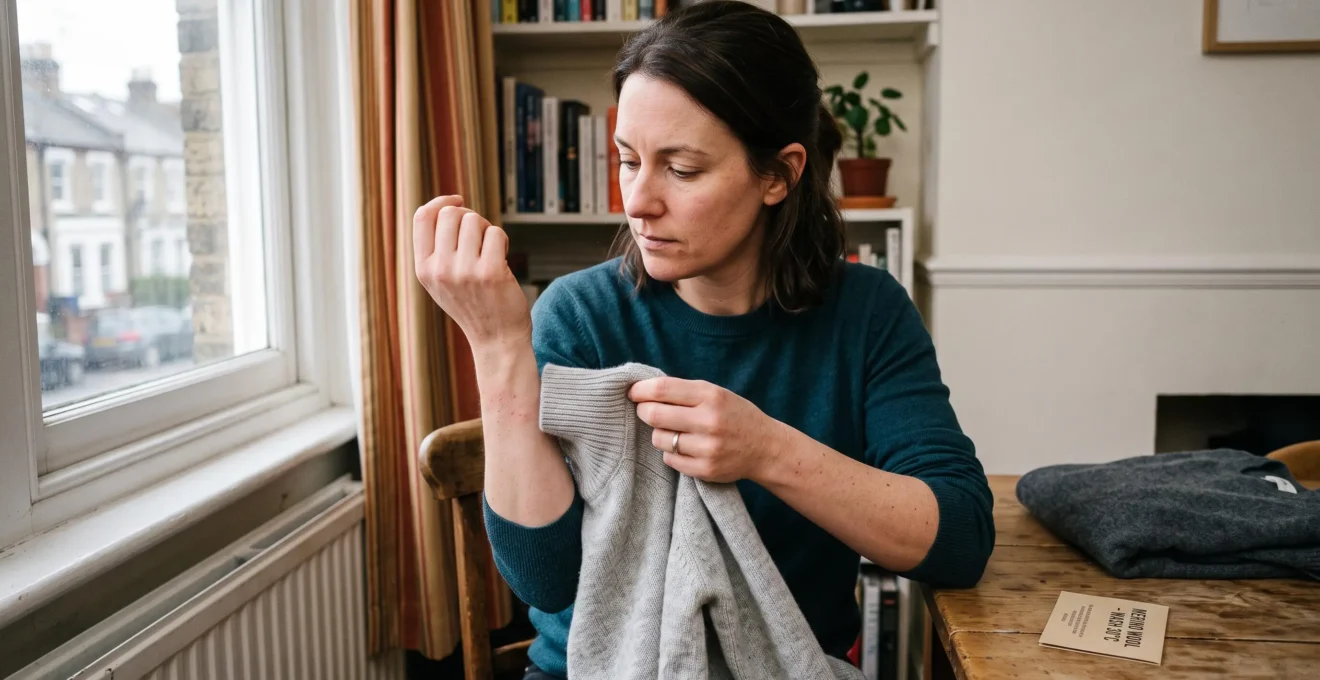
A merino wool sweater can be an excellent everyday layer for British weather, but the word “merino” on a label does not guarantee a comfortable or durable jumper. Two garments with the same fibre composition can feel remarkably different against the neck, develop bobbles at different rates and respond differently to washing.
For professionals moving between chilly platforms and overheated offices, or students carrying backpacks across campus, the right choice depends on more than softness in the changing room. Fibre characteristics, yarn twist, knitting density, garment weight and everyday friction all influence how a jumper behaves after repeated wear.
The most dependable everyday option is generally a comfortably fine, appropriately weighted merino knit with sufficiently stable construction for your routine. It should feel acceptable against your own skin, recover after gentle stretching and have care instructions you can realistically follow. Even then, no natural-fibre jumper is completely immune to pilling or changes in shape.
Choosing merino knitwear that lasts
- Test the finished fabric against sensitive skin instead of relying on “fine merino” claims or micron figures alone.
- For backpacks and frequent commuting, prioritise a stable, reasonably dense knit and suitable yarn construction over maximum initial softness.
- Choose an appropriate garment weight, follow its care label, dry it flat and allow recovery time between wears.
- Why Do Some Merino Sweaters Itch Even When the Label Says “Fine Merino”?
- How to Choose a Merino Sweater That Won’t Pill Quickly When You Carry a Backpack?
- Merino or Cotton Knit: Which Works Better in Overheated Offices?
- The Laundry Habit That Shrinks Merino Jumpers Even on “Cool Wash”
- When Should You Rest a Merino Sweater So It Doesn’t Bag at Elbows?
- Coat or Knitwear: Where Does Premium Fabric Make the Most Noticeable Difference?
- How to Read Fibre Blends So You Don’t End Up Sweaty, Static, and Uncomfortable?
- How Do You Judge Premium Textiles Without Falling for Price-Tag Theatre?
Why Do Some Merino Sweaters Itch Even When the Label Says “Fine Merino”?
Some merino sweaters itch because relatively coarse or stiff fibres protrude from the finished fabric and stimulate sensitive skin. The fibre grade matters, but so do yarn construction, fabric finishing and direct skin contact. A “fine merino” description cannot guarantee that every part of a knitted garment will feel equally soft.
Wool discomfort is often described as an allergy, although mechanical irritation and a genuine allergic skin reaction are different issues. Woolmark‘s research factsheet on wool and skin irritation summarises scientific literature associating fabric prickle with coarse fibres projecting from the surface, rather than wool inherently acting as an allergen.
The research identifies protruding fibres above approximately 30 microns as important contributors to mechanical irritation. That figure is not a universal comfort limit: the sensation depends on the finished textile and the wearer’s skin sensitivity. Comparable irritation can arise from sufficiently coarse fibres of other materials.
Micron count describes fibre fineness, not the entire garment. A fine-fibre specification does not reveal the yarn’s twist, number of plies, surface finish or how the knitted loops behave against skin. A yarn combining fibres of different characteristics may also feel less uniform than its headline specification suggests.
Yarn construction creates another distinction. Tighter twisting can produce a more compact, resilient yarn, but may change how the fabric feels. Looser constructions can have a soft, airy hand while allowing more surface movement. Neither construction automatically predicts itch: protruding fibre characteristics and finishing still matter.
The most useful comparison is between the sweater and your own skin. Before removing the tags, try the following practical screening method:
- Place a clean section of the knit against the inside of your wrist for approximately 30 seconds.
- Repeat against the side of the neck if that area will touch the jumper during wear.
- Notice prickling, scratchiness or discomfort rather than judging softness only with your fingertips.
- Try the sweater over a thin base layer to distinguish direct-contact irritation from general discomfort.
This is a consumer screening technique, not a clinically validated allergy test. If it irritates your skin quickly, the label’s fineness claim is a poor reason to ignore that experience.
UK winter conditions add another variable. Centrally heated indoor air and seasonal skin dryness can affect comfort, while detergent residues or sensitivity to laundry products may complicate the picture. These are possible individual factors, not proven explanations for every merino-related itch.
Once a jumper passes the comfort test, the next challenge is whether its surface can tolerate the friction of your actual commute.
How to Choose a Merino Sweater That Won’t Pill Quickly When You Carry a Backpack?
For regular backpack use, choose a merino sweater with a stable knit, suitable yarn twist and good surface cohesion rather than simply the softest fabric available. Shoulder straps repeatedly rub and compress the same areas, making pilling possible even on expensive knitwear. Better construction reduces the risk but cannot eliminate it.
Pilling occurs when loose or migrating fibres become entangled into small balls on the fabric surface. Friction from backpack straps, shoulder bags, desks and even coat linings increases the opportunity for bobbles to form.
According to Woolmark’s explanation of fabric pilling, longer fibres, suitable yarn twist and greater fabric cover can help reduce pilling propensity. The organisation also makes clear that pilling cannot be completely ruled out.
A useful distinction is between surface softness and structural stability. A fluffy yarn can feel exceptionally pleasant when new, yet may have more exposed fibres vulnerable to abrasion. A firmer surface can be better suited to frequent bag contact, provided it remains comfortable.
The following comparison describes general construction tendencies, not guaranteed performance outcomes.
| Characteristic | Potential advantage | What to check |
|---|---|---|
| Longer staple fibres | May reduce the number of fibre ends escaping the yarn | Whether the manufacturer discloses fibre length or pilling tests |
| Shorter staple fibres | Can contribute to a soft, fuzzy surface | Whether surface fuzz develops rapidly under rubbing |
| Higher yarn twist | Can improve fibre cohesion | Whether the yarn remains comfortable and flexible |
| Loosely twisted yarn | Can produce a softer, airier handle | Whether exposed fibres are vulnerable at contact points |
| Denser fabric construction | May provide a more stable surface | Whether the knit recovers after handling without feeling excessively rigid |
Do not confuse yarn properties with seam construction. Fully-fashioned shaping and neatly linked shoulders can be signs of considered garment manufacture, but they do not independently prove resistance to strap-induced pilling. Inspect both the shoulder join and the knitted surface beside it.
Before purchasing online, search reviews for photographs showing the garment after sustained use, especially around shoulders and underarms. Images taken after two months or more may be informative, but elapsed time alone says little without knowing how often the sweater was worn or washed.
If pilling develops, use a suitable knitwear comb or fabric shaver cautiously and follow the garment’s care guidance. Aggressive or repeated shaving can risk catching loops or removing more material than intended. De-pilling improves appearance; it does not change the underlying construction or eliminate future friction.
For heavy daily backpack use, another practical option is to wear a smoother protective outer layer over the knit, where weather and indoor temperatures permit.
Resistance to friction matters, but the sweater must also feel comfortable when you arrive indoors and the temperature rises.
Merino or Cotton Knit: Which Works Better in Overheated Offices?
Lightweight merino is often a better all-round option than a heavy cotton knit for commuters moving between cold outdoor air and warm offices. Wool can absorb and release moisture vapour, helping manage changing conditions, while cotton readily absorbs liquid moisture and may feel damp after sweating. However, garment weight, ventilation and layering matter more than fibre names alone.
Consider a familiar British winter journey: walking to a station in cold air, standing in a heated train carriage and spending the afternoon in an office where removing a layer is not always convenient. The challenge is not simply staying warm. It is avoiding excessive insulation during the warmest part of the day.
Merino can be useful across these transitions because wool fibres interact with moisture vapour and the material often performs well in layered clothing. A fine-gauge jumper over a breathable shirt may provide adequate outdoor warmth beneath a coat without requiring a bulky indoor layer.
Cotton has advantages too. It can feel cool and familiar against the skin, and many cotton garments are straightforward to launder. Yet absorbed sweat may leave a cotton knit feeling wet for longer than desired, particularly when the wearer moves from active commuting to sitting still.
Neither fibre makes an overheated room comfortable by itself. A heavy merino jumper may trap too much warmth, just as a dense cotton jumper can. Breathability depends on fabric construction, layering and the opportunity to remove clothing, not solely on fibre composition.
| Decision factor | Lightweight merino | Cotton knit |
|---|---|---|
| Changing temperatures | Often useful for transitional layering | Comfortable when conditions remain fairly stable |
| Perspiration | Can manage moisture vapour and is generally odour resistant | Absorbs liquid moisture readily and may remain damp |
| Laundry | Requires attention to the specific care label | Often convenient, but washing temperatures still depend on the garment label |
| Skin comfort | Depends on fineness, yarn construction and personal sensitivity | Often comfortable for people sensitive to wool prickle |
| Indoor overheating | Choose a fine-gauge, lightweight garment | Choose a light, breathable construction |
For a university lecture hall or office with unpredictable heating, start by assessing the jumper’s thickness rather than assuming merino automatically regulates every temperature. Lightweight knitwear is easier to combine with a removable jacket than a bulky winter sweater.
Odour resistance is another reason to consider merino for repeated commuting days. Still, it is not a promise that a worn jumper will never need washing, especially after heavy sweating.
The next ownership decision is just as important as the purchase: how to clean a comfortable jumper without undermining its fit.
The Laundry Habit That Shrinks Merino Jumpers Even on “Cool Wash”
A cool wash can still damage an unsuitable merino jumper if the programme subjects it to excessive mechanical action. Wool felting involves fibre movement under wet conditions, with agitation and temperature contributing to the risk. The safest approach is to follow the garment’s care label, select an appropriate wool programme when permitted and avoid unnecessary washing.
Many owners focus entirely on temperature. Yet a cool, vigorous cycle is not equivalent to a gentle wool cycle. Drum movement, spin settings, detergent choice and the garment’s own finishing all affect washing outcomes.
Importantly, machine washing is not inherently harmful to every merino sweater. Some wool garments are specifically designed and labelled for machine washing. These can withstand repeated correct washing without the shrinkage associated with unsuitable treatment.
Woolmark’s wool sweater washing instructions distinguish machine-washable garments from those requiring different treatment. The guidance recommends appropriate wool detergents, suitable programmes and flat drying.
The practical risk is treating every wool jumper as though it can be washed with ordinary mixed laundry. A garment labelled for hand washing or dry cleaning should not be put through a standard machine programme simply because the water feels cool.
Wool’s natural odour resistance also makes airing a sensible first response after light wear. Rather than adopting an inflexible rule to wash after three or five uses, assess actual odour, perspiration, stains and the conditions in which the garment was worn.
After washing, support the wet garment fully. A soaked knit hanging from its shoulders can stretch under its own weight, distorting the neckline, sleeves or overall length. Flat drying on a suitable surface allows the jumper to retain its intended shape more reliably.
A five-step merino care routine you can actually follow
- Read the sewn-in care label and record whether the jumper permits machine washing, hand washing or another specified treatment. Your deliverable is a confirmed care method.
- After light wear, check the garment for odour and marks before deciding to wash. Your deliverable is a clear air, spot-clean or wash decision.
- If machine washing is permitted, select the recommended wool or delicate programme and appropriate detergent, following the label’s instructions. Your deliverable is a compliant wash setting.
- After washing, lay the sweater flat, arrange the sleeves naturally and reshape it without force. Your deliverable is a correctly supported drying garment.
- Once completely dry, check the shoulders, cuffs and body shape before storing it folded. Your deliverable is a clean, dry jumper ready for its next wear.
Small changes in dimensions after washing deserve attention, but one successful or unsuccessful cycle does not establish how every future wash will behave. Some untreated wool garments may experience additional shrinkage with unsuitable repeated washing, while correctly cared-for machine-washable wool is designed to tolerate repeated laundering.
Good washing habits protect the fabric, while recovery time between wears helps address a different problem: gradual stretching at the elbows and cuffs.
When Should You Rest a Merino Sweater So It Doesn’t Bag at Elbows?
Give a frequently worn merino sweater time between uses, ideally rotating it with another jumper rather than wearing it continuously. A day of rest is a practical starting habit, while longer breaks may help after heavy wear or damp conditions. There is no established universal resting period that guarantees elbows will never lose their shape.
Elbow bagging occurs when repeated bending stretches the knitted loops and the fabric does not fully return to its original dimensions. Cuffs can behave similarly because pulling sleeves up, flexing wrists and repeated handling place them under mechanical stress.
The recovery of a knit depends on several factors: fibre elasticity, yarn structure, knitting density, garment weight and the extent of stretching. Moisture and wear conditions can also influence how a garment behaves, but an exact timetable for recovery cannot be inferred from a merino label.
Rotation is a sensible maintenance habit, not a repair guarantee. For someone wearing knitwear most weekdays, alternating two or three jumpers gives each garment opportunities to air and settle between uses.
After removing a sweater, check for early warning signs:
- Cuffs that remain slightly wider than they were before wear.
- A persistent horizontal crease or loose area around the elbows.
- A neckline that no longer sits evenly after ordinary use.
- A body or sleeve that looks noticeably longer after repeated stretching.
A single crease is not proof of permanent deformation. Compare the jumper after it has rested and returned to normal dry conditions. If the shape reliably recovers, the fabric is behaving differently from one that remains distorted after multiple wears.
Storage matters too. Fold dry knitwear on a shelf or in a drawer rather than leaving a heavier jumper suspended on a narrow hanger. When airing, use a supported arrangement that does not stretch the shoulders.
If elbows have already become baggy, gentle reshaping may offer some improvement. Steam can relax certain knitted fabrics, but test the care instructions first and avoid excessive heat or aggressive pulling. Severely distorted garments may not regain their original shape completely.
When the same problem repeatedly returns, reassess fit, sleeve movement and the fabric’s construction alongside the frequency of wear. Resting alone cannot compensate for a fundamentally unstable knit.
This reinforces a broader buying principle: the quality you pay for should match the part of your wardrobe that receives the most demanding everyday use.
Coat or Knitwear: Where Does Premium Fabric Make the Most Noticeable Difference?
Premium knitwear can deliver a more noticeable everyday comfort benefit than premium coat fabric when the jumper sits close to your skin for many hours. A coat’s fit, weather protection, lining and construction remain important, however. The better investment depends on how frequently each garment is worn and which performance problems you are trying to solve.
A coat is highly visible. Its silhouette, surface, drape and finishing help define an outfit, and quality can be apparent before anyone looks closely. But a good coat also relies on features beyond the fibre: pattern cutting, shoulder construction, insulation, closures and protection against wind or rain.
A sweater is experienced differently. Its fabric may contact the neck, wrists and torso throughout an entire working day. Scratchiness, moisture discomfort, overheating and loss of shape become noticeable during ordinary movement, even when the garment looks attractive.
Allocate your budget according to contact hours and performance needs. A hypothetical commuter who spends most of the working day in knitwear, but wears a coat mainly outdoors, may experience more comfort-related value from upgrading the inner layer.
That does not mean an expensive merino jumper is automatically better value than an affordable coat. Someone who spends hours outside in wet or windy weather may benefit more from improving outerwear protection and fit.
Layering also changes how fabrics perform together. A quality merino sweater beneath a modest but suitable coat can offer useful close-to-skin comfort, while an expensive coat cannot fully compensate for an itchy or poorly ventilated sweater underneath.
Conversely, the finest merino cannot replace a coat’s weather-protection function. Wool can help with insulation and moisture management, but an exposed lightweight jumper is not equivalent to an appropriate outer shell in persistent British rain.
A sensible wardrobe investment sequence is therefore based on actual shortcomings rather than prestige:
- If skin irritation or uncomfortable temperature changes dominate your day, improve the knitwear first.
- If wind, rain or inadequate insulation cause the main discomfort, address the coat.
- If both work adequately, favour the garment with the greater expected useful wear and fewer existing substitutes.
Consider the cost across repeated uses rather than comparing ticket prices in isolation. A jumper worn in a regular rotation may accumulate substantial use, although its long-term value still depends on pilling resistance, care requirements and how well it retains its fit.
Once knitwear becomes the priority, its fibre label deserves closer scrutiny: a premium-looking jumper may contain much less merino than its name suggests.
How to Read Fibre Blends So You Don’t End Up Sweaty, Static, and Uncomfortable?
Read a merino blend by checking the actual fibre percentages, then asking what each component contributes to the garment. Wool, nylon, polyester, acrylic and elastane behave differently, but the blend’s construction also matters. A small synthetic addition may support durability or stretch, while a high synthetic share can change moisture feel, static behaviour and care requirements.
For shoppers in Great Britain, UK government guidance on textile labelling explains requirements for declaring textile fibre composition. Its stated territorial coverage is England, Scotland and Wales; Northern Ireland has its own applicable regulatory context.
The composition label is a more concrete starting point than expressions such as “merino blend” or “wool touch”. Those descriptions do not, by themselves, explain how much wool the garment contains or how its fibres are arranged.
For example, a hypothetical jumper containing 80% merino wool and 20% nylon is materially different from one containing 20% merino and 80% acrylic. Both compositions might be marketed using wool-related language, yet they should not be assumed to offer equivalent comfort or performance.
The percentages describe what is present, not exactly how the fabric will behave.
| Fibre | Potential role | What the label cannot establish |
|---|---|---|
| Merino wool | Moisture-vapour management, insulation and odour resistance | Whether the finished garment will feel non-itchy |
| Nylon or polyamide | Strength and abrasion resistance in suitable constructions | Whether backpack-contact areas are actually reinforced |
| Elastane | Additional stretch and recovery in suitable fabric structures | Whether the sweater will retain its shape indefinitely |
| Polyester | Durability, dimensional properties and potentially faster drying | Whether the wearer will feel dry or comfortable throughout the day |
| Acrylic | Lightweight insulation and a wool-like aesthetic | Whether the knit will resist pilling or static |
| Cotton | Familiar softness and moisture absorption | How quickly the finished blend will dry |
Static is worth considering in centrally heated UK buildings, where dry indoor conditions may encourage charge accumulation. Some synthetic fabrics are particularly prone to noticeable static, although the outcome depends on humidity, construction, finishing and combinations of materials. A modest synthetic component does not automatically make a jumper electrically uncomfortable.
Similarly, polyester and other synthetic fibres do not universally trap sweat against skin. Their behaviour depends on fabric structure and moisture-management finishing. However, a garment’s percentage of merino alone cannot guarantee that it will deliver the same feel or odour resistance as a predominantly wool garment.
Ask what the synthetic content is doing. A small reinforcement component may be useful in a frequently worn knit. A much larger share warrants closer inspection of comfort, construction and care claims.
Also check where the fibres are located. A garment with a separate inner face, outer face or strategically reinforced panels may feel different from a uniformly blended yarn, even if its overall fibre percentages look similar. The statutory label may not reveal every detail of yarn arrangement.
There is no defensible universal percentage that guarantees an acceptable merino blend. Instead, compare the stated composition with the qualities you want: softness against skin, temperature comfort, friction resistance and practical washing.
Once the composition is clear, the final question is whether the price reflects meaningful textile quality or mainly the way the garment is presented.
What to remember before paying more
- Separate fibre quality from garment construction: a fine-fibre claim cannot replace inspecting the finished knit.
- Judge fabric against your own use, particularly backpack friction, sensitive skin, indoor heat and laundering requirements.
- Assess price through expected wear, comfort and upkeep rather than brand positioning or material descriptions alone.
How Do You Judge Premium Textiles Without Falling for Price-Tag Theatre?
Judge a premium merino sweater by separating fibre characteristics, construction quality and brand pricing. A high price may reflect expensive raw material or careful manufacture, but it can also include positioning and retail costs. The strongest buying decision combines a skin-comfort test, close inspection of the knit, verified composition and realistic expectations about long-term wear.
Start with the fibre. A credible specification should identify the material clearly and, where available, provide meaningful technical details. A micron figure can help describe fineness, but it cannot tell you the full story about fibre length, yarn twist, finishing or pilling resistance.
Next examine construction. Check whether the fabric appears consistent, whether the shoulders and underarms are neatly finished and whether collars and cuffs feel secure without becoming rigid. Fully-fashioned shaping or linked seams can indicate more deliberate construction, but neither feature independently guarantees durability.
Then consider the retail price. Branding, distribution, design, service and other commercial factors influence what the buyer pays. These are not necessarily illegitimate costs, but they should not be mistaken for proof that the yarn is technically superior.
A hands-on inspection helps distinguish observable quality from marketing language:
- Inspect the shoulder and underarm seams for irregular joins, loose ends or visibly insecure stitching.
- Gently stretch a small section of fabric and release it, checking whether it returns towards its original shape without distortion.
- Test the fabric against the wrist or neck to check actual comfort.
- Examine the knitted surface for excessive loose fuzz, uneven tension or obvious inconsistencies.
- Compare the care label, fibre composition and retailer’s specifications with the premium claims being made.
Fabric density deserves a closer look, although a heavier jumper is not automatically better. Compare garments of similar gauge and intended use. A stable, coherent knit may be preferable for daily friction, while a lighter, more open construction may be more comfortable indoors.
Do not assume a dense fabric proves the use of longer fibres or stronger yarn. Density and weight alone cannot establish staple length, twist level or manufacturing quality.
For an online purchase, useful evidence includes accurate close-up photographs, detailed composition, care requirements and reviews that describe performance after repeated wear. Information about pilling tests or manufacturing specifications can strengthen the assessment when the retailer provides it.
The final comparison should be about cost per useful wear, not price alone. Consider the following explicitly hypothetical example.
Illustrative three-year ownership comparison
Suppose Jumper A costs £120 and delivers 120 satisfactory wears during its useful life. Its purchase cost is £1 per wear. Jumper B costs £75 but provides only 50 satisfactory wears before discomfort, wear or loss of shape leads its owner to stop using it. Its purchase cost is £1.50 per wear.
These figures are hypothetical, not observed product-test results. They exclude laundry, repairs and other ownership costs. The example illustrates why a higher initial price can sometimes represent better value, but only when the garment actually delivers greater useful wear.
A two- to three-year assessment is useful for judging ownership outcomes, provided it reflects real rotation patterns rather than assuming every jumper lasts for a fixed number of wears. Track whether the fabric remains comfortable, whether bobbling becomes persistent, how often washing is needed and whether elbows and cuffs retain their intended shape.
Premium knitwear earns its price through repeatable performance. A sweater that looks beautiful on delivery but becomes uncomfortable or difficult to maintain may offer less value than a less expensive one suited to daily use.
Choose the jumper that passes your own comfort test, matches your commute and can be cared for consistently. Keep the receipt and record how it behaves through repeated wear; those observations are more useful for future purchases than any premium label on its own.
Can you wear a merino wool jumper directly against bare skin?
Yes, if the finished fabric feels comfortable to you. Fine merino can work well as a next-to-skin layer, but fibre diameter and garment construction affect prickling. Try the wrist or neck test before purchasing, and use a thin base layer if direct contact causes discomfort.
Does a merino sweater need washing after every wear?
Not necessarily. Merino wool is naturally odour resistant, so airing between lightly worn days may be sufficient. Wash when there is noticeable odour, perspiration-related soiling or visible dirt, always following the garment’s care label. There is no universal wear-count rule for every sweater.
Is a slightly fuzzy new merino jumper necessarily poor quality?
No. Some yarns and finishes are intentionally soft or lightly fuzzy. The more useful question is how the surface changes with wear and friction. For demanding use, such as carrying a backpack every day, inspect the knit’s stability and look for meaningful longer-term wear feedback.
Can a merino sweater labelled machine-washable still shrink?
Incorrect treatment can still cause problems, but properly labelled machine-washable wool is designed to tolerate repeated washing when its instructions are followed. Use the recommended programme and detergent, respect temperature and drying restrictions, and avoid assuming that every merino garment has the same care requirements.
Should you buy a size larger to allow for merino shrinkage?
Usually not as a general precaution. Buy for the intended fit and follow the maker’s care instructions rather than anticipating an unspecified amount of shrinkage. If a particular garment has documented dimensional changes or unusual sizing, check the retailer’s measurements and guidance before ordering.