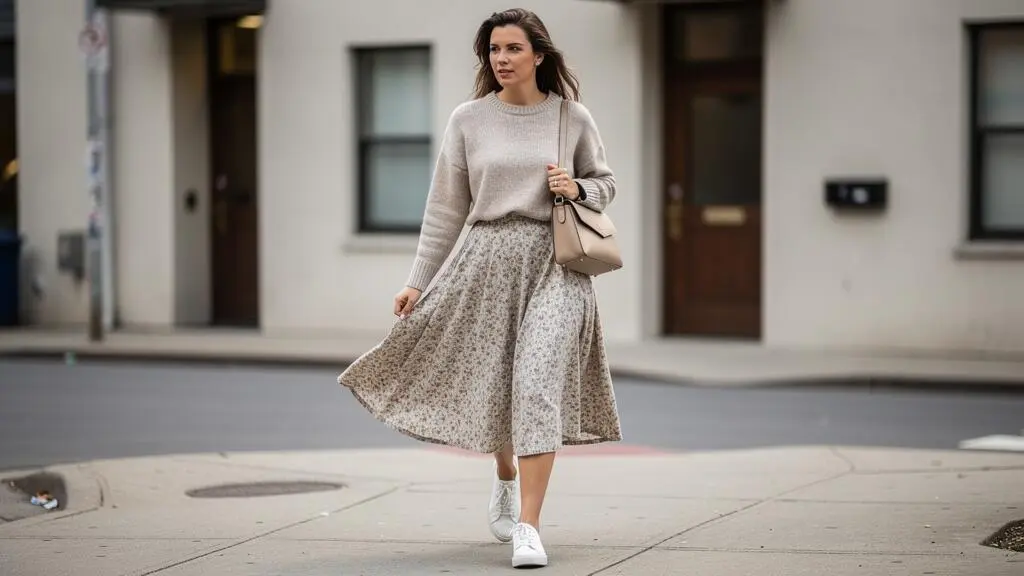
Vintage revival works best when the past influences an outfit without controlling every detail. A beautifully cut 1950s skirt, a 1970s leather jacket or a sharply tailored 1980s blazer can look entirely natural today. The difference between personal style and period costume usually comes down to proportion, context and restraint.
The most useful starting point is simple: choose one distinctive vintage piece, give it a contemporary anchor and keep the remaining elements relatively neutral. A modern shoe, an updated garment length or an unexpected knitwear shape can change how an entire silhouette reads.
Getting the look right also begins before dressing. True vintage, reproductions and vintage-inspired contemporary clothing involve different compromises in condition, sizing, maintenance and longevity. A garment may look exceptional on a rail but prove unsuitable for regular wear once its lining, seams or cleaning requirements are examined.
For UK vintage shoppers, the goal is not historical accuracy. It is a wardrobe that makes distinctive older designs useful in ordinary contemporary life, from commuting and weekend dressing to weddings and special occasions.
Vintage revival without the costume effect
- Let one vintage statement establish the aesthetic, then introduce a contemporary anchor through shape, footwear or outerwear.
- Assess vintage purchases by measurements, construction, fabric condition and cleaning requirements rather than their decade labels.
- Modernise proportions instead of chasing trends, and buy early enough to allow for alterations and garment care.
- Why Do Vintage Trends Come Back Stronger When People Say They Want “New”?
- How to Modernise a Vintage Silhouette With One Contemporary Anchor Piece?
- True Vintage or Reproduction: Which Is Better if You Want It to Last 5+ Years?
- The Vintage Buying Mistake That Shows Up Only After the First Dry Clean
- When Should You Shop Vintage So You’re Not Competing With Everyone Before Event Season?
- How to Modernise Classic Pieces Using One Proportion Change and Zero New Trends?
- Full-Grain or Top-Grain Leather: Which Ages Better With Daily Commuting?
- How Do You Build a Timeless Look That Still Feels Modern, Not Stuck in the Past?
Why Do Vintage Trends Come Back Stronger When People Say They Want “New”?
Vintage trends return because fashion novelty does not always require entirely new designs. Familiar silhouettes can feel fresh when their materials, styling or cultural context change. Vintage also offers recognisable design, individuality and a connection with the past. Its appeal extends beyond nostalgia, although there is no universal rule linking fashion revivals to economic uncertainty.
Fashion repeatedly revisits distinctive proportions: the defined waists of the 1950s, the elongated lines of the 1970s and the assertive shoulders associated with the 1980s. These shapes remain available for reinterpretation because a new context changes their meaning.
When contemporary fashion feels visually repetitive, established silhouettes offer a recognisable alternative. Economic pressures may also influence how consumers shop, but they do not establish a single explanation for why particular decades return.
Research presented in Columbia Business School‘s research on vintage consumption identifies moderate age, iconicity and scarcity as defining dimensions of vintage products. The research also associates vintage with perceived authenticity, heritage connection and distinctiveness. It examines multiple product categories rather than proving a specific mechanism for clothing-trend cycles.
Understanding the difference between three garment types helps explain why some revival outfits feel natural while others feel theatrical.
- True vintage: an authentic garment manufactured in an earlier period, carrying original construction details and signs of its history.
- Modern reproduction: a newly manufactured garment intentionally recreating an older style, sometimes with contemporary sizing or materials.
- Vintage-inspired contemporary clothing: a current design borrowing selected historical elements without attempting to reproduce a complete period garment.
These categories can coexist successfully. The difficulty arises when every piece competes to establish a different historical or theatrical identity.
Consider a 1950s-style circle skirt. Combined with victory rolls, period-style shoes, a fitted cardigan and coordinated retro accessories, it communicates deliberate historical styling. Replace the cardigan with a boxy contemporary jumper and the shoes with understated trainers, and the skirt becomes a distinctive everyday garment.
The issue is not that accurate period dressing is undesirable. It is that historical accuracy produces a different visual result from contemporary vintage revival.
There is another complication: a garment manufactured in the 1980s may itself imitate a 1940s design. Its silhouette therefore cannot establish its manufacturing date. Understanding whether a piece is original or a later interpretation helps prevent accidental layering of unrelated historical references.
The practical lesson is to treat vintage revival as an exercise in visual editing. Once the historical statement is clear, the next decision is how to place it convincingly in the present.
How to Modernise a Vintage Silhouette With One Contemporary Anchor Piece?
Modernise a vintage silhouette by pairing its most distinctive historical element with one clearly contemporary anchor, such as minimalist footwear, a relaxed jacket or a modern knit. Then adjust one proportion to balance the outfit. The anchor provides present-day context without obscuring the original design. This is a styling guideline, not a fixed numerical rule.
Start by identifying what makes the vintage garment recognisable. It might be the volume of a full skirt, the shoulder structure of a tailored jacket or the high waist of a pair of trousers.
That distinctive feature should remain visible. Modernising does not require removing the garment’s character.
For example, a full 1950s skirt traditionally invites a close-fitting upper half. A cropped, boxy knit changes the relationship between the waist and shoulders, giving the silhouette an unfamiliar contemporary balance.
Conversely, pairing that skirt with a tightly fitted cardigan, period shoes and matching accessories reinforces the original decade. This can work for a deliberately retro outfit, but it is less suitable when the aim is effortless modern dressing.
The contemporary anchor should carry an identifiable present-day styling signal. Its function matters more than its novelty: clean-lined boots, simple trainers or a relaxed outer layer can provide enough contrast without requiring a fashionable statement purchase.
Look at the outfit as a relationship between shapes rather than a collection of individual garments. Four variables are particularly useful: hem position, shoulder width, waist definition and the distribution of volume between the upper and lower body.
Changing just one of these often creates sufficient contrast. A structured vintage blazer may become easier to wear with straight contemporary trousers. High-waisted vintage trousers may look more relaxed beside a shorter, less fitted top.
Restyling should be the first experiment, not automatically the final solution. Sometimes an older garment has a hem, lining or shoulder construction that genuinely limits its versatility.
If the garment fits correctly and its defining shape works, change the surrounding pieces first. If the garment itself creates persistent imbalance, ask a tailor whether a reversible or restrained alteration is possible. Avoid removing historically significant construction simply to follow a passing fashion preference.
A useful final test is to photograph the outfit in black and white. Without colour competing for attention, examine its overall silhouette and identify the element that connects it to current everyday dressing.
If everything looks tied to one historical period, try changing one piece. If the vintage element becomes almost unnoticeable, restore some of its visual prominence. This is a subjective styling test rather than an objective method of dating clothing.
The strongest combinations preserve what makes the original garment interesting. Before deciding whether to invest further in vintage clothing, however, it is worth considering which purchases can withstand years of real use.
True Vintage or Reproduction: Which Is Better if You Want It to Last 5+ Years?
Neither true vintage nor reproduction automatically lasts longer. Original vintage can offer valuable construction details and durable materials, but some of its usable lifespan has already passed. Reproduction starts with new materials and may accommodate modern sizing, yet its quality varies considerably. For five years or more of use, condition, construction and maintenance matter more than authenticity.
The essential distinction is between historical value and remaining service life. A beautifully constructed vintage coat may have sound fabric and years of practical wear left. Another coat from the same decade may contain weakened lining, brittle stitching or deteriorated internal materials.
Likewise, a carefully manufactured reproduction can be a sensible long-term purchase, while a poorly constructed one may not survive repeated use.
Rather than treating one category as inherently superior, consider the garment’s intended workload.
| Garment | True vintage: main considerations | Reproduction: main considerations |
|---|---|---|
| Structured coat | Inspect canvas, lining, seams and previous repairs; potentially worthwhile if sound. | Useful for regular wear when construction and fabric quality are verifiable. |
| Everyday trousers | Check seat, crotch, knees, fabric recovery and alteration allowance. | May offer easier sizing and a new fabric lifespan, provided construction is good. |
| Leather jacket | Can be worthwhile when the leather remains supple and stitching and lining are sound. | Offers an alternative when vintage fit, finish or condition is unsuitable. |
| Occasional evening wear | Often worth considering when original detailing matters and the garment is structurally stable. | Potentially more practical for demanding wear, cleaning or fit requirements. |
| Frequently washed basics | Existing fabric wear and uncertain care history require particular attention. | Often easier to assess for routine care, though durability is not guaranteed. |
These are practical decision factors, not evidence that one manufacturing category consistently outperforms another over a five-year period.
For authentic vintage, examine the garment from the inside. Seam allowances indicate whether modest alterations might be possible. Lining condition matters because repairing internal damage can require substantial work. Zips, fasteners and stitching should function without putting unusual strain on surrounding fabric.
Fibre content is another useful clue, but natural fibres are not automatically more durable. Their condition, weave, previous wear and care history determine whether they remain suitable for use.
Brand recognition and decade labels tell relatively little about remaining fabric strength. A lesser-known garment in excellent condition may be more practical than a prestigious piece with extensive deterioration.
Sizing presents a separate risk. Historical labelled sizes cannot be reliably translated into today’s UK sizes, and reproduction manufacturers use different size charts.
Measure the actual garment laid flat, including chest, waist, hips, shoulders, sleeves and total length where appropriate. Compare those figures with a garment you already wear comfortably, allowing for ease and fabric behaviour.
A five-year purchase that never fits properly is unlikely to remain useful, whatever its original construction quality.
The sensible long-term investment is the piece you can wear comfortably, repair realistically and care for correctly. That makes condition checking especially important before any purchase is sent for its first clean.
The Vintage Buying Mistake That Shows Up Only After the First Dry Clean
The costly mistake is assuming that a vintage garment in excellent visible condition can safely undergo routine dry cleaning. Older textiles may conceal weakened fibres, compromised seams or unstable linings. Cleaning introduces mechanical and chemical stresses that fragile garments may not withstand. Inspect the construction and consult an experienced cleaner before authorising treatment.
A jacket can appear immaculate on a hanger while the fabric inside its sleeves has become fragile. The original surface may remain attractive even when the garment’s structural integrity has deteriorated.
Potential warning signs include discoloured underarms, splitting linings, brittle threads, deteriorated elastic components and distorted internal layers. These conditions have different causes and do not affect every vintage garment, but they deserve attention before cleaning.
The Canadian Conservation Institute‘s textile-care guidance explains why cleaning must be judged according to a textile’s condition. Commercial dry cleaning involves solvents, mechanical manipulation and elevated temperatures, and unsuitable treatment can cause irreversible damage.
This does not mean that all vintage garments should avoid professional cleaning. Robust, wearable pieces may be suitable, while fragile historical textiles require a more conservative assessment.
Before purchasing, ask permission to turn the garment inside out and examine areas that experience friction or carry structural stress. Look closely at the lining, armholes, underarms, waistband and seam junctions.
A portable light may help reveal thinning, small holes or irregular stitching. Persistent musty odours also warrant questions about storage history, although smell alone cannot establish the condition or cause of deterioration.
Do not pull or stretch a suspected fragile seam to test it. On delicate vintage textiles, even gentle manipulation may cause damage. Visual inspection and professional assessment are safer when fibre integrity is uncertain.
Ask what cleaning has already been performed, whether any repairs are known and whether the seller considers the item wearable or primarily collectible.
Five checks before buying a vintage garment
- Record the measurements: obtain a written set of flat measurements and compare it with a garment that fits.
- Inspect the reverse: examine the lining, seam allowances and stress areas, recording any visible defects in photographs.
- Identify the materials: photograph available fibre and care labels, noting missing or uncertain information.
- Confirm the cleaning history: ask the seller what treatments are known and keep the response with the purchase details.
- Document the transaction: save the listing, condition description, return terms and dated arrival photographs.
Authentication should form part of this process. A modern reproduction may resemble an original garment closely, so the silhouette alone is insufficient evidence of age.
The Vintage Fashion Guild‘s garment-dating reference describes how labels, zips, construction and textile characteristics can help narrow a manufacturing period. No single stitch, label or fastener provides a universally reliable date.
Purchase protection also depends on the seller and transaction. For UK buyers, business sellers, private sellers and different selling arrangements may involve different legal rights and contractual terms. A shop’s stated returns policy does not necessarily remove applicable statutory rights.
Documenting the condition immediately upon delivery helps establish what was received, although photographs alone do not determine whether a refund or remedy is legally available.
When condition is uncertain, the appropriate next step is a specialist assessment rather than experimental cleaning. Buying with sufficient time before an occasion makes that decision considerably easier.
When Should You Shop Vintage So You’re Not Competing With Everyone Before Event Season?
Shop vintage before the immediate rush for weddings, festivals, parties or other seasonal occasions, allowing extra time for fit checks, cleaning and alterations. Unlike standard retail stock, individual vintage garments may have no identical replacement available. Buying ahead reduces the pressure to compromise, although the best shopping window depends on the event and available stock.
Vintage supply behaves differently from mainstream clothing retail. A particular dress may appear because someone clears a wardrobe, an estate collection enters the market or a specialist dealer acquires new stock.
That means desirable garments can appear at any point in the year. Demand, however, may concentrate around occasions when particular styles become popular.
For example, shoppers seeking distinctive summer wedding outfits may gravitate towards occasionwear before the main wedding season. Winter party dressing can create similar interest in velvet, evening jackets and embellished garments.
These are useful planning considerations, not evidence of a fixed annual vintage-price cycle.
Work backwards from the date you need to wear the garment. Reserve time for shipping or collection, an initial fit assessment, possible tailoring, cleaning suitability checks and a final outfit trial.
Consider a hypothetical wedding outfit needed in June. If the dress requires a specialist clean and alteration, finding it only days before the event creates several dependencies that may be impossible to resolve in time.
Finding it earlier allows you to reject unsuitable pieces rather than accept flaws under pressure.
Online sourcing and physical shopping require different habits.
- Online marketplaces: check saved searches regularly, request measurements before committing and consider delivery and return arrangements.
- Specialist vintage shops: visit when practical, ask about upcoming stock and take advantage of the opportunity to inspect construction in person.
- Markets and fairs: establish your measurements and priorities beforehand, since browsing opportunities and stock availability vary by event.
- Estate and wardrobe sales: pay particular attention to condition, seller information and whether returns or inspections are available.
Frequent searching is useful only when guided by clear criteria. Without a preferred silhouette, suitable measurements and an acceptable condition threshold, an abundance of listings can encourage impulsive purchases.
A practical method is to maintain a shortlist of acceptable colours, measurements, materials and alteration possibilities. This helps you recognise a suitable garment when it appears rather than trying to force an attractive but impractical piece into an outfit.
The greatest cost of last-minute sourcing is not necessarily a higher purchase price. It can be the loss of time needed to discover fit problems or cleaning limitations.
Early sourcing creates the freedom to choose carefully. Once a suitable garment is found, the next challenge is to make its proportions feel current without rebuilding an entire wardrobe around it.
How to Modernise Classic Pieces Using One Proportion Change and Zero New Trends?
Modernise a classic garment by changing one visible proportion rather than adding a fashionable accessory or trend-specific item. Adjust the relationship between hem, waist, shoulder or garment volume while keeping the rest of the outfit restrained. This makes older pieces feel more relevant without depending on a particular season’s fashion cycle.
The most effective change is usually the one that alters how the eye reads the complete silhouette.
A traditional long blazer worn with similarly narrow trousers may feel closely associated with its original styling period. Combining it with a different trouser width changes the balance while leaving the blazer itself untouched.
Likewise, a vintage mid-length skirt can look very different with a shorter top that ends near the waist rather than a long cardigan extending across the hips.
Five proportion variables provide a useful starting vocabulary:
- Rise: where trousers sit in relation to the natural waist.
- Hem: where trousers, dresses or skirts end relative to the legs and footwear.
- Shoulders: how width, structure and sleeve attachment shape the upper body.
- Sleeve volume: whether fabric gathers, follows the arm or expands away from it.
- Garment length: how tops, jackets and outerwear divide the body visually.
Choose one variable and leave the others stable. For example, wearing a roomy vintage jacket with narrower trousers changes the distribution of volume without requiring any new fashion reference.
This approach has an advantage over styling with highly recognisable trends. A trend-led addition can identify an outfit with a particular moment, while a restrained change in proportion can remain useful across multiple styling cycles.
That does not mean proportions are timeless or immune to changing taste. They also evolve. The benefit is that they can often be adjusted through pieces already in the wardrobe.
For a practical visual exercise, compare contemporary street-style photographs with older fashion images. Ignore the labels and individual accessories. Instead, observe where jacket hems finish, how trousers fall over shoes and where volume concentrates.
Try recreating one relationship with clothing you already own. Take photographs of two alternatives and assess which allows the classic piece to remain recognisable without making the entire outfit feel historically fixed.
Some garments resist this treatment. Strongly constructed shoulder pads, historically specific drop waists and designs intended for particular foundation garments may not respond to ordinary restyling.
Alterations to such pieces can be expensive, structurally difficult or damaging to their character. A specialist tailor should assess feasibility before major changes are attempted.
A modern wardrobe can draw substantial value from existing garments when their proportions are reconsidered. Material quality adds another dimension, particularly for leather pieces expected to withstand everyday commuting.
Full-Grain or Top-Grain Leather: Which Ages Better With Daily Commuting?
Full-grain leather can develop an attractive worn character because its original grain surface remains intact. However, top-grain is a broader classification, not automatically a lower-quality or heavily corrected material. For daily commuting, the finish, thickness, construction and weather exposure are more useful predictors of performance than the grain label alone.
Leather terminology often creates confusion because retailers use overlapping descriptions without always explaining the manufacturing process.
Full-grain leather retains the original grain surface without corrective mechanical removal. Corrected-grain leather has undergone surface modification, often followed by finishing treatments to produce a more uniform appearance.
Importantly, top-grain does not necessarily mean corrected-grain. It generally refers to leather from the upper grain-containing part of the hide, and the surface may be left natural or modified depending on the product.
The Leather Working Group‘s leather terminology reference distinguishes full-grain, corrected-grain, aniline, semi-aniline, pigmented and coated leather. Those definitions establish manufacturing differences rather than universal durability rankings.
For someone commuting regularly in the UK, several everyday stresses matter: rain, rubbing against bags, contact with seating, repeated handling and prolonged wear.
An unfinished or lightly finished leather surface may show scratches, colour changes and natural variation. Some wearers value these changes as patina, particularly in vintage-inspired jackets and accessories.
Others may prefer a more uniform finish with surface protection. Pigmented or coated finishes can offer different practical characteristics, but resistance to water, abrasion and staining must be assessed for the specific product.
A heavily finished surface is not automatically unsuitable for commuting. Nor is full-grain leather guaranteed to become more attractive with use.
When comparing products, ask the seller for information that goes beyond broad quality claims.
- Is the leather full-grain, corrected-grain or otherwise specified?
- Does the surface use an aniline, semi-aniline, pigmented or coated finish?
- What care instructions apply to rain, staining and regular handling?
- Can the seller describe the leather thickness, lining and construction?
- Are repair, conditioning and appropriate cleaning options available?
In-store inspection helps identify obvious concerns. Look for a consistent, appropriate finish, sound seams and well-constructed edges. Examine how the leather bends and whether the surface already shows cracking or flaking.
Touch and edge inspection cannot definitively authenticate a leather grade. Product specifications and reliable supplier information are necessary when the classification matters.
For a daily vintage-revival wardrobe, a simple leather jacket or bag can act as a contemporary anchor because it works with garments from several decades. The purchase makes sense when the finish and care requirements match actual commuting conditions.
Leather illustrates a wider principle of timeless dressing: materials must remain functional under real conditions. A coherent vintage-inspired wardrobe depends as much on upkeep and compatibility as it does on visual design.
Key takeaways for a wearable vintage wardrobe
- Evaluate every statement garment as part of an existing wardrobe, not as an isolated historical object.
- Prioritise condition, fit and realistic care requirements before committing to long-term ownership.
- Use differences in proportion and historical era deliberately, without requiring every garment to share the same decade.
How Do You Build a Timeless Look That Still Feels Modern, Not Stuck in the Past?
Build a timeless but modern look around versatile foundations, one distinctive vintage statement and a contemporary anchor. Keep the outfit’s proportions intentional, mix historical references selectively and maintain each garment according to its materials. The result should reflect your personal style rather than reproduce a complete historical period or follow every new fashion cycle.
The foundation of this approach is an era-neutral wardrobe: garments whose primary role is to support an outfit rather than announce a particular decade.
Examples might include a straightforward knit, well-fitting trousers, an understated shirt or a relatively simple coat. These pieces create breathing room around a more distinctive vintage garment.
Then select the historical focal point. A sharply structured vintage blazer, a patterned 1970s dress or a full mid-century skirt can provide enough visual personality without requiring matching period accessories.
Add a contemporary anchor according to how the outfit will actually be worn. For commuting, practical footwear and weather-appropriate outerwear may be more valuable than decorative accessories. For a formal event, modern tailoring or restrained jewellery may achieve the same visual balance.
Mixing eras is another useful technique. Rather than combining several obvious references from one decade, try bringing together different design languages.
For instance, a 1970s patterned blouse could sit beneath a relatively minimal 1990s-style jacket, with straightforward modern trousers completing the look.
As a starting exercise, limit the outfit to two recognisable historical influences. This is a practical editing technique rather than an established rule about good taste. More complicated combinations can work when the silhouette remains coherent.
The key question is whether every garment has a clear role. Some define the aesthetic, others contribute shape or practicality, and the rest allow the statement pieces to stand out.
Timelessness also depends on maintenance. Store fragile vintage garments with appropriate support, avoid forcing delicate pieces onto unsuitable hangers, and review cleaning recommendations before treatment. Leather items may require care specific to their finish, while tailored clothing benefits from timely seam and lining repairs.
Preserving good garments is often more effective than repeatedly replacing them with newer interpretations of the same design.
Before purchasing another vintage piece, ask: Will this still work in my wardrobe once the current enthusiasm for its era has faded?
Answer by identifying at least two realistic outfit combinations, confirming the fit and considering how often the garment is likely to be worn. If the only possible use involves buying several matching pieces, it may be closer to a themed outfit than a versatile wardrobe addition.
For the next vintage purchase, choose the garment for its fit, condition and design character first. Try it with clothing already in your wardrobe, photograph the combination and make one proportion adjustment before deciding whether anything else is needed.
Can you wear vintage every day without looking overdressed?
Yes. Choose vintage garments that suit your everyday activities and combine them with practical contemporary basics. A vintage jacket over ordinary trousers or a period skirt with a simple knit can feel natural in casual settings. Fit, footwear and the formality of the surrounding pieces matter more than the garment’s age.
Does vintage clothing have to be at least 20 years old?
A minimum age of 20 years is a commonly used retail convention, but vintage does not have one universally binding age threshold across all contexts. Age is only part of the distinction. Recognisable historical design, scarcity and the garment’s relationship to a particular period also influence how it is understood and marketed.
How can you tell whether a vintage-inspired outfit looks too theatrical?
Look at how many elements reproduce the same historical period. When the hairstyle, shoes, clothing silhouette and accessories all reinforce one decade, the result may resemble period styling. Keep the strongest vintage element, then experiment with contemporary footwear, a different top or a change in proportion. The distinction is aesthetic and depends on your intended setting.
Should you alter an authentic vintage garment to make it more wearable?
Alterations can be appropriate when they improve fit without compromising important construction details. Start with styling changes and assess whether the garment genuinely requires modification. For fragile, unusual or historically significant pieces, consult a specialist before shortening, reshaping or removing original materials. Reversible changes may help preserve future options.
Is buying vintage always more sustainable than buying new clothing?
Buying an existing garment can extend its useful life and may reduce demand for new production, but the environmental outcome depends on factors including additional consumption, transport, cleaning and how long the item is actually worn. A carefully selected garment used repeatedly is generally a more meaningful wardrobe decision than buying multiple vintage pieces that remain unworn.