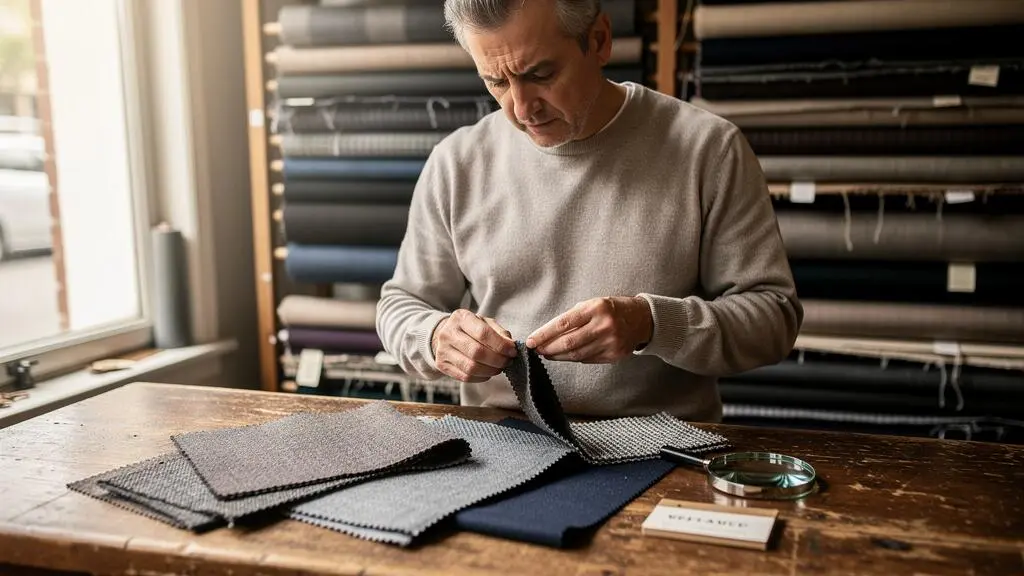
A premium textile is not necessarily a better textile. A high price can reflect a recognised designer, an expensive retail location, elaborate packaging or a carefully constructed luxury image without telling you much about how the fabric will behave after six months of commuting, repeated washing or everyday friction. The more useful question is whether its construction, performance and care requirements justify the money.
For UK shoppers investing in better coats, knitwear, trousers and leather accessories, quality is a combination of measurable characteristics and practical suitability. Fibre composition matters, but so do yarn construction, fabric density, finishing, garment assembly and the conditions in which a piece will be worn. A beautiful wool coat that pills rapidly or a heavily finished jacket that feels uncomfortable in a heated office may be a poor investment regardless of its label.
The most reliable approach is to separate the evidence from the sales language. Examine how the material is made, identify what its finish does, verify any certification and consider the maintenance required to preserve it. Premium should describe a convincing combination of performance and workmanship, not simply a price bracket.
Premium Textile Quality: The Essentials
- Judge fabric construction, fibre behaviour and resistance to everyday abrasion rather than relying on fibre prestige or retail price.
- Check composition, material specifications and independently verifiable certifications before buying online.
- Spend more where superior fabric changes comfort, drape, warmth and longevity; do not confuse expensive finishing or designer branding with proven quality.
- Why Can an Expensive Fabric Pill or Shine After Just 5 Wears?
- How to Evaluate a “Premium” Fabric Label in 3 Checks When You Can’t Touch It Online?
- Coat or Knitwear: Where Does Premium Fabric Make the Most Noticeable Difference?
- The “Luxury Finish” That Can Make Fabric Less Breathable in Warm Offices
- When Should You Buy Premium Fabric or Designer Pieces So You Don’t Overpay by 40%?
- How to Read Fibre Blends So You Don’t End Up Sweaty, Static, and Uncomfortable?
- Full-Grain or Top-Grain Leather: Which Ages Better With Daily Commuting?
- How Can You Spot Traditional Craftsmanship Before You Pay Premium Prices?
Why Can an Expensive Fabric Pill or Shine After Just 5 Wears?
An expensive fabric can pill or develop shiny patches after only a few wears because retail price does not determine resistance to abrasion. Pilling happens when loose fibres work free from the yarn, become tangled and form small surface balls. Shine can develop when repeated friction flattens or distorts the surface. Fibre length, yarn twist, fabric construction and finishing all influence these outcomes, sometimes more than the prestige of the raw material.
Consider wool knitwear. A garment made with shorter or loosely secured fibres can release more fibre ends during movement. When those fibres encounter friction around the underarms, elbows, sides or stomach, they can tangle into pills. The Woolmark Company identifies abrasion, fibre length, yarn twist and fabric cover factor as relevant variables. Its guidance favours longer fibres, higher yarn twist and greater fabric cover as design factors that can help reduce pilling.
That explains why a relatively affordable, tightly constructed wool fabric can outperform an expensive, loosely constructed alternative in everyday wear. It does not mean that all inexpensive fabrics are better, or that pilling can be eliminated. Even well-designed wool garments may pill under repeated friction.
Shine requires a separate diagnosis. On worsted wool trousers, repeated rubbing can flatten fibres and change how light reflects from the surface. The result is a glossy patch around the thighs, seat or knees. This is not automatically evidence of poor-quality wool: the fabric’s weave, finish, pressure and frequency of contact all matter. A surface that has been flattened by friction can look shiny without the underlying fibres having suffered the same type of damage as a torn or weakened yarn.
A quick in-store assessment can reveal warning signs, although it cannot reproduce months of wear. Rub a discreet area gently with clean fingers, then inspect it under angled light. Look for loose fibres, uneven fuzz, an immediate change in surface appearance or a finish that seems to sit on top of the weave. Compare the result with an untouched area. This is an indicative handling check, not a validated laboratory prediction of five-wear performance.
Also question exceptionally soft surfaces. Heavy softeners or other finishing treatments can change the initial hand-feel, but softness alone does not establish fibre quality or durability. A garment may feel impressive on the first day and behave differently after cleaning.
The practical lesson is to assess the yarn and construction rather than assuming a premium fibre name guarantees performance. Ask about fibre length, yarn construction and fabric structure where this information is available. Follow the care instructions carefully: Woolmark recommends turning wool garments inside out before washing, avoiding fabric softener and reducing unnecessary abrasion. Its guidance also makes clear that pilling cannot be guaranteed never to occur.
Good wool should be assessed by the way its fibres are secured and the way its surface responds to use. The next step is establishing whether a product description provides enough evidence to make that assessment remotely.
How to Evaluate a “Premium” Fabric Label in 3 Checks When You Can’t Touch It Online?
When buying premium fabric online, assess the label through three checks: fibre composition, construction specifications and traceability. A credible description identifies the actual fibres and their percentages, provides useful information about fabric weight or construction where available, and names verifiable manufacturers, mills or certifications. If the listing offers only luxury terminology and atmospheric photography, the evidence is incomplete.
Check 1: Fibre composition. Look for generic fibre names and percentages rather than expressions such as “exclusive luxury blend” or “signature natural fabric”. A garment described as a premium wool blend should disclose what the blend contains. The proportions help establish which fibre dominates, although they cannot independently predict comfort, longevity or resistance to pilling.
For regulatory context, the US Federal Trade Commission explains that covered textile products generally disclose fibre names and percentages by weight in descending order of predominance. Its guidance also recognises functional additions: nylon may be added to wool for durability, while spandex may provide elasticity. These are examples of possible functions, not guarantees that every such blend will perform better. Importantly, FTC requirements apply to the relevant US market and should not be presented as a universal statement of UK labelling law.
Check 2: Fabric specifications. Look for weight in GSM, weave or knit structure, yarn information and meaningful construction details. GSM describes mass per square metre, not quality by itself. A heavier fabric may provide useful substance for a winter coat but feel cumbersome in a lightweight summer garment. Thread count is also not a universal quality measure across different textile constructions. Compare like with like.
Check 3: Traceability. Look for the named mill, manufacturing location, production information and verifiable certification where relevant. A designer’s country is not necessarily the country where the fabric was woven or the garment assembled. Similarly, a country-of-origin declaration does not identify every supplier or establish the quality of every production stage.
More than 1,000
OEKO-TEX describes STANDARD 100 as testing certified textile products and their components against a list of more than 1,000 harmful substances. This indicates the scope of the standard, not the number of substances found in a particular garment or proof of superior durability.
OEKO-TEX, official STANDARD 100 certification information.
Certification needs equally careful interpretation. OEKO-TEX STANDARD 100 certification requirements describe testing for specified harmful substances. Product classes distinguish intended use and skin-contact exposure, and the organisation provides a Label Check facility for verifying certification details. A valid certificate is useful evidence about chemical testing; it does not certify that a fabric is luxurious, breathable, resistant to abrasion or exceptionally long-lasting.
Online imagery deserves scrutiny too. A front-facing product photograph rarely shows the reverse side, yarn structure or surface irregularities. Zoom into detailed photographs, inspect seam areas and request additional fabric images where possible. Read reviews that mention repeated wear and washing rather than relying exclusively on first-impression comments. Where a seller offers swatches, request one before committing to a significant purchase.
Your Five-Point Online Fabric Verification Checklist
- Record the exact fibre percentages. Deliverable: a composition breakdown showing every disclosed fibre.
- Find the fabric weight or construction details. Deliverable: a specification note identifying GSM, weave or knit structure where disclosed.
- Identify the mill and manufacturing locations. Deliverable: a traceability record distinguishing design, weaving and garment assembly.
- Verify any certification using the issuing organisation’s official system. Deliverable: a certificate reference and validity result, where available.
- Review long-term customer feedback and request a swatch if possible. Deliverable: a saved review or physical sample assessment documenting surface, handle and construction.
A transparent product page cannot replace physical inspection, but it can eliminate many weak purchases before checkout. Once the evidence is credible, the more important question becomes where superior fabric will make a noticeable difference in everyday clothing.
Coat or Knitwear: Where Does Premium Fabric Make the Most Noticeable Difference?
Premium fabric usually makes its most noticeable difference in coats and knitwear because these garments expose material performance directly. Coats depend on fabric structure for drape, insulation, weather suitability and shape retention. Knitwear brings the fibres into prolonged contact with the skin, making softness, itch, temperature regulation and surface wear immediately apparent. By comparison, heavily structured garments can conceal much of the fabric’s contribution beneath interfacing, lining and construction.
A well-made wool coat can demonstrate the value of better cloth through its drape and ability to maintain a convincing silhouette. Fabric weight, weave, yarn quality and finishing all influence how it hangs and responds to repeated use. A dense cloth may offer useful protection and substance in a cold, exposed environment, but density alone does not establish warmth or comfort. The lining, fit, layering system and construction also matter.
Knitwear offers a different test. A fine wool or cashmere jumper sits close to the body, so differences in fibre characteristics and yarn construction can affect comfort, appearance and care. However, a prestigious fibre is not automatically the best choice. A loosely knitted, delicate jumper may demand more maintenance than a practical everyday garment made with a more robust yarn.
There is a diminishing-returns curve. Moving from a poorly constructed fabric to a well-designed one can transform the way a garment feels and wears. Moving from an already competent cloth to an exceptionally expensive alternative may produce a difference that is difficult to notice during ordinary use.
For a UK wardrobe, climate and wearing frequency should guide the decision. A coat worn throughout a long winter commute has a different value equation from a decorative occasion jacket worn a handful of times. Likewise, a frequently worn jumper deserves closer examination of comfort, recovery and pilling behaviour than a seasonal piece stored for most of the year.
| Garment | Potential benefit of better fabric | What to prioritise |
|---|---|---|
| Winter coat | Drape, warmth-to-weight balance and surface ageing | Cloth structure, density, lining and resistance to abrasion |
| Everyday knitwear | Skin comfort, temperature management and appearance over time | Fibre length, yarn construction, knit density and care demands |
| Tailored trousers | Shape retention and resistance to shine at friction points | Weave, yarn construction, crease behaviour and reinforcement |
| Casual cotton basics | Potential improvements in handle and durability | Fabric weight, yarn quality and stitching rather than prestige alone |
| Structured jacket | More limited visible fabric difference when heavily supported | Interfacing, internal construction, fit and seam quality |
Consider the cost per wear rather than the initial ticket. A hypothetical £450 coat worn 150 times costs £3 per wear before maintenance. A hypothetical £180 coat worn 30 times costs £6 per wear. These figures are illustrative calculations, not market averages or predictions of lifespan. The expensive coat is better value only if it actually delivers the expected use and remains suitable throughout that period.
Maintenance can reverse the calculation. A garment that requires specialist cleaning, careful storage or frequent repairs may cost more to own than its retail price suggests. Before upgrading, check whether the material’s care requirements fit the time, facilities and budget available.
The best investment is rarely the most expensive fabric in every category. It is the material that improves the performance of the garment most frequently used, in the conditions it will actually encounter.
The “Luxury Finish” That Can Make Fabric Less Breathable in Warm Offices
A luxury-looking finish can reduce breathability when it creates a denser or less permeable surface. Calendering, resin treatments, water-repellent coatings and certain stretch laminates can alter how air and moisture move through a textile. These treatments are not inherently poor quality: they may improve appearance, water resistance, wrinkle performance or shape retention. The problem arises when a finish is chosen for its visual effect without considering the conditions in which the garment will be worn.
Calendering uses pressure, and sometimes heat, to modify the surface of a fabric and create a smoother or more lustrous appearance. Depending on the textile and process, the resulting surface may be less open to airflow. Resin finishes can alter stiffness, handle and crease behaviour, while water-repellent coatings are designed to change how moisture interacts with the surface. Some stretch constructions incorporate membranes or laminated layers that prioritise performance characteristics other than air permeability.
For someone moving between a cold outdoor commute and a heated office, these trade-offs matter. A jacket designed to resist wind and rain may feel comfortable outside but become unpleasant indoors when movement and rising body temperature increase moisture production. A highly polished finish can also disguise the difference between natural fibre quality and a surface modified to feel exceptionally smooth.
Hand-feel is particularly unreliable as a standalone indicator. Chemical softeners can create an appealing initial touch, but that sensation does not establish the inherent softness or performance of the underlying fibre. The finish may change after cleaning, while other functional coatings may remain. Always distinguish the fibre’s properties from the effects of its treatment.
There are practical ways to investigate the issue without pretending to perform a laboratory breathability test. First, ask the retailer whether the fabric has a water-repellent, resin, laminated or other functional finish. Then inspect the reverse side and compare the openness of the weave across different panels. A simple backlighting check may reveal differences in construction, but light transmission is only a rough visual proxy: it does not measure air permeability or moisture-vapour transmission.
Match the finish to the actual use:
- Heated offices: prioritise comfortable layering and avoid unnecessary coatings when indoor wear dominates.
- Outdoor commuting: water and wind resistance may justify a more protective finish, depending on exposure and ventilation.
- Formal everyday clothing: evaluate surface appearance alongside comfort, maintenance and the garment’s internal construction.
- Active use: investigate the complete fabric system rather than assuming a technical finish automatically means good ventilation.
Ask for a product’s technical description rather than accepting words such as “silky”, “smooth” or “performance luxury” as evidence. A retailer who can explain the finish, its purpose and its care requirements offers more useful information than one who relies on tactile adjectives.
Comfort is not an optional luxury feature. A fabric that looks impressive but consistently feels unpleasant in the conditions where it is worn is not delivering the performance its price implies.
When Should You Buy Premium Fabric or Designer Pieces So You Don’t Overpay by 40%?
There is no reliable universal buying window that guarantees a 40% saving on premium textiles or designer clothing. Discounts vary by retailer, category, season, colour and stock position. End-of-season reductions can make a genuine difference, but the original ticket price is not proof of the item’s normal selling value. The sensible approach is to track comparable prices, understand the garment’s seasonal demand and buy when the actual price fits its expected use.
End-of-season clearance can be attractive for winter coats, knitwear and seasonal outerwear, particularly when the remaining size and colour options match what you need. However, waiting carries a trade-off: the desired size may disappear, and the remaining stock may not suit your wardrobe. Buying a colour simply because it has been reduced is still overspending if it will rarely be worn.
Pre-order periods and archived colourways can provide alternative opportunities. Some products are offered at different prices depending on the sales period or availability, but there is no guarantee that a pre-order will be cheaper or that an archived colour is identical in every production detail. Compare the exact model, composition, construction and retailer rather than assuming two similarly named products are equivalent.
Category matters. A classic, practical coat may remain useful across multiple seasons, while a highly trend-dependent designer piece can lose its appeal quickly. This is a wardrobe-use distinction, not a guaranteed resale forecast. Resale value depends on brand demand, condition, rarity, size and market conditions.
Build a reference price before making a decision. Record the product’s current selling price, its previous observed prices, the price of genuinely comparable alternatives and any relevant delivery or alteration costs. A discount percentage is meaningful only when the comparison is honest.
A practical buy-or-wait rule combines three questions:
- Wardrobe gap: does the garment solve a real need, or is the discount creating the desire?
- Wear frequency: will it be used regularly enough to justify the total cost?
- Price history: is today’s price genuinely competitive with the product’s observed selling history and comparable alternatives?
Timing can improve value, but it cannot transform unsuitable fabric or poor construction into a good purchase. The strongest financial decision is to pay a fair price for a garment that fills a real wardrobe need and performs as expected.
What to Establish Before Judging a Premium Purchase
- Determine whether the material’s fibre composition and construction suit the comfort and wear demands of the garment.
- Separate genuine manufacturing and certification evidence from marketing claims about purity, luxury and exclusivity.
- Assess the full ownership proposition, including maintenance, expected frequency of wear and the construction quality that supports the material.
How to Read Fibre Blends So You Don’t End Up Sweaty, Static, and Uncomfortable?
Fibre blends should be judged by what each component contributes, not by whether the label says natural or synthetic. A high synthetic proportion can increase static or create an uncomfortable moisture-management experience in some constructions, but synthetic fibres are not automatically inferior. Small additions of nylon or elastane can serve useful functions, including durability and stretch recovery. Comfort depends on the combination of fibre, yarn structure, fabric density, finishing and garment design.
Start with the dominant fibre. If a garment contains 80% wool and 20% polyester, wool is the principal component by weight, but that does not tell the whole story. The yarn construction, weave or knit, fabric thickness and lining influence how the garment feels in use. A predominantly natural-fibre textile can still feel hot if it is densely constructed, heavily coated or worn in unsuitable layers.
Static electricity is influenced by friction, fibre characteristics and environmental conditions. Synthetic-rich fabrics can be more prone to noticeable static in certain combinations, especially in dry indoor environments. However, static is not determined by one percentage threshold. Fabric-to-fabric contact, humidity, garment construction and the other materials being worn also contribute.
Moisture management is equally nuanced. Fibre absorption, moisture transport, evaporation and air movement are different processes. A fabric may absorb moisture without drying quickly, while another may move moisture through its structure but feel less comfortable against the skin. A blend’s actual performance depends on the complete textile system rather than a simple natural-versus-synthetic ranking.
The FTC’s labelling guidance offers useful context for interpreting functional blends. It recognises examples such as 96% wool and 4% nylon, where nylon is added for durability, and 96% acetate and 4% spandex, where spandex supplies elasticity. These examples demonstrate why a small synthetic component is not necessarily a sign of inferior quality. They do not prove that every blend with those percentages will deliver the intended performance.
Use percentage bands as a first reading, not a scientific comfort threshold:
- Dominant natural fibre: investigate how the natural component contributes to handle, moisture behaviour and comfort, while checking the remaining fibres.
- Substantial synthetic share: ask what functional benefit the blend is designed to provide and whether the fabric is suitable for the expected temperature and activity.
- Small elastane or nylon addition: consider whether stretch, recovery or abrasion resistance is useful for the garment.
- Unclear or incomplete composition: treat missing percentages as an information gap rather than assuming the marketing description is sufficient.
Do not ignore the lining. A breathable outer fabric combined with a poorly matched lining can feel uncomfortable. The same applies to dense yarns, close-fitting cuts and multiple layers. For a workday outfit, the complete combination matters more than the fibre percentages printed on one label.
The FTC guidance on textile and wool labelling requirements is useful for understanding why fibre names and weight-based percentages matter, but its regulatory scope is US-specific. UK shoppers should use the information as a way to interpret composition disclosures, not as a substitute for checking the rules applicable to products sold in the UK.
A comfortable textile is the result of material choices working together. Once that principle is clear, the same sceptical approach can be applied to leather, where grain terminology is often treated as a complete quality ranking despite describing only part of the material.
Full-Grain or Top-Grain Leather: Which Ages Better With Daily Commuting?
Full-grain leather is not automatically the better commuting choice than top-grain leather. Full-grain describes leather whose grain surface has not been removed by corrective mechanical treatment. Top-grain is a broader commercial expression whose exact meaning can vary, so the product’s actual surface treatment should be verified. Daily ageing also depends on tanning, finishing, thickness, construction, exposure to rain and friction, and the owner’s willingness to maintain the leather.
The terminology matters because leather grades are frequently simplified in retail descriptions. The Leather Working Group distinguishes full-grain leather, which retains its complete grain, from corrected-grain leather, which has undergone surface buffing or similar mechanical treatment followed by finishing. These classifications describe processing and surface characteristics; they do not establish a universal hierarchy of daily performance.
Full-grain leather can develop a visible patina as it is handled and exposed to its environment. Scratches and changes in colour may become part of its appearance, particularly where the finish allows the natural grain to remain visible. For someone who appreciates signs of use, this ageing can be attractive. For a commuter who wants a consistently uniform appearance, the same marks may be undesirable.
Corrected-grain leather can offer a more uniform surface, depending on its finishing system. However, a heavily coated surface may show scratches differently from a lightly finished one. Neither category guarantees resistance to creasing, rain or repeated contact with clothing and transport surfaces.
Tanning adds another variable. Chrome tanning uses chromium salts, while semi-chrome leather involves an initial vegetable-tanning stage followed by retanning with chromium salts. Vegetable tanning is another distinct process. These descriptions identify manufacturing methods, not an automatic ranking of longevity, water resistance or suitability for daily commuting.
The Leather Working Group’s leather terminology reference is useful for distinguishing grain classifications, splitting and tanning terminology. It should not be mistaken for a controlled comparison proving that one leather type ages better than another.
For everyday commuting, evaluate the actual leather:
- Inspect the surface finish and ask whether it has been corrected, coated or otherwise treated.
- Check how the leather bends at likely flex points, particularly handles, straps and bag corners.
- Look for consistent construction around seams, edges and attachment points.
- Ask about the tanning process and the care products compatible with the finish.
- Consider whether the expected patina is desirable or whether a more uniform appearance better suits the intended use.
Rain exposure deserves particular attention. Leather is not automatically waterproof because it is full-grain or vegetable-tanned. Water behaviour depends on the hide, tanning, finishing and any protective treatment. Follow the manufacturer’s care guidance rather than applying an arbitrary conditioning product that could alter the surface.
For a commuter bag, construction can matter as much as the leather itself. A beautiful hide cannot compensate for weak handle attachments, poorly reinforced stress points or inadequate stitching. Conversely, a well-constructed bag made with a suitable corrected-grain leather may be more practical for someone who prioritises a consistent appearance and manageable maintenance.
The right leather is the one whose surface behaviour, care demands and construction suit the daily journey. The final test is whether the garment or accessory has been assembled well enough to let its material perform over time.
How Can You Spot Traditional Craftsmanship Before You Pay Premium Prices?
Traditional craftsmanship is best assessed through observable construction details, not labels such as handmade, artisanal or heritage. Look at stitch consistency, seam finishing, pattern matching, internal assembly and the way hardware is attached. These details can reveal whether a product has been made with care, although no single visual marker proves that an entire garment is handcrafted or guarantees a long service life.
Start with the seams. Examine whether stitch lines are reasonably even, whether seam allowances are controlled and whether stress points have appropriate reinforcement. On a tailored coat, inspect the inside where the lining meets the outer fabric. A well-finished interior should look deliberate rather than rushed, with no obvious loose threads, irregular stitching or poorly secured edges.
Pattern matching is another useful signal. On checked, striped or visibly directional fabrics, examine whether patterns align across adjoining panels where alignment would reasonably be expected. Matching can require additional material and careful cutting, but it is not always practical or necessary at every seam. Its absence should be judged in context rather than treated as automatic evidence of poor workmanship.
Look for the selvedge when the fabric construction makes it relevant. A genuine woven selvedge can reveal information about the cloth’s edge, but its presence alone does not prove exceptional quality, traditional manufacture or a particular mill. Similarly, decorative hand stitching may be a genuine finishing detail or simply an aesthetic feature added to a machine-made garment.
Hardware needs equally close inspection. On bags, coats and leather accessories, check whether fastenings sit securely, whether attachment points are reinforced and whether moving components operate without obvious looseness. A premium-looking metal finish does not establish the strength of the underlying attachment. The method of fixing the component to the material is what deserves attention.
Be sceptical of broad craftsmanship claims. Handmade can describe one operation rather than the entire product. A garment may be machine-stitched but include hand-finished details, or it may be made in a traditional workshop using modern equipment. Neither description is inherently deceptive, provided the manufacturer explains what was actually done.
Ask specific questions:
- Which production stages are completed by hand?
- Where is the garment assembled, and can the manufacturer identify the workshop?
- Which seams or stress points are reinforced?
- What construction method is used for the lining, fastening and finishing?
- Are repairs or alterations supported, and what maintenance does the manufacturer recommend?
Be cautious about claims that appear inconsistent with the price and production context. A complex garment described as entirely hand-stitched at a very low retail price deserves more scrutiny than an ordinary product with a clearly explained mixture of machine and hand finishing. The claim itself needs evidence, not an assumption based on the brand’s visual identity.
Most importantly, separate the quality of the material from the quality of the construction. Excellent cloth assembled carelessly can fail at the seams. Meticulous assembly cannot turn an unsuitable fabric into a durable one. A premium price is justified most convincingly when both elements are supported by visible evidence and transparent manufacturing information.
Before committing to a premium purchase, examine the fabric, the finish and the construction as three distinct parts of the same decision. Ask for evidence where claims are vague, and choose the piece whose quality can be explained, inspected and maintained over years of actual use.
Does 100% wool always mean better quality than a wool blend?
No. A 100% wool label identifies fibre composition, not guaranteed durability, comfort or workmanship. A carefully constructed wool blend may include nylon for durability or another functional fibre for a specific purpose. Assess yarn construction, fabric density, finish and care requirements alongside the percentages.
Can you tell whether a fabric will pill before buying it?
You can identify potential risk factors, but you cannot reliably predict the exact amount of pilling through a quick shop-floor test. Fibre length, yarn twist, fabric cover and expected abrasion all matter. Woolmark recommends longer fibres, higher twist and greater fabric cover as design factors that can help reduce pilling, while acknowledging that it cannot be guaranteed to disappear entirely.
Does OEKO-TEX certification prove that a garment is premium quality?
No. OEKO-TEX STANDARD 100 concerns testing for specified harmful substances in certified textile products and their components. It is useful evidence about the certification’s testing scope, but it does not establish luxury status, fabric lifespan, breathability, pilling resistance or superior craftsmanship. Verify the certificate through the official Label Check system.
Is a heavier fabric always more durable?
No. Weight is only one construction characteristic. Yarn strength, fibre length, weave or knit structure, finishing and garment design also affect durability. A heavier fabric may suit an outerwear application but could be uncomfortable or unnecessarily bulky in a lightweight garment. Compare weight within the same garment category and intended use.
Is full-grain leather worth paying more for?
It can be worthwhile if you appreciate its natural grain and the possibility of visible patina, but full-grain is not an automatic guarantee of better commuting performance. Surface finishing, tanning, thickness, construction, rain exposure and maintenance all affect ageing. Compare the actual leather and workmanship rather than relying on the grade name alone.