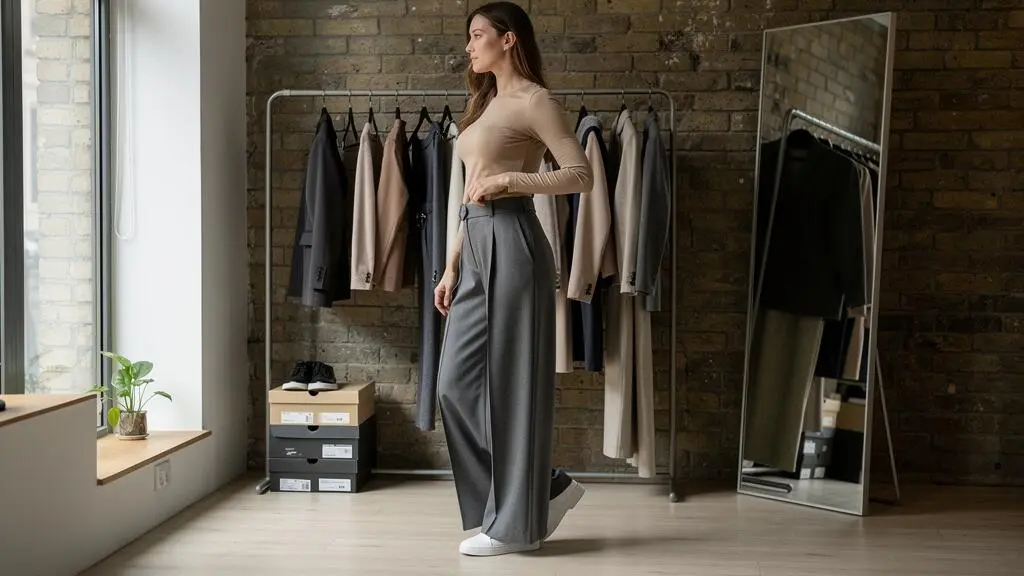
Wide-leg trousers can create a long, uninterrupted silhouette, but only when the waistband, fabric and hem work together. If they make you look shorter or feel overwhelmed by fabric, the problem is usually not your height. It is where the volume begins, how the trousers hang and what happens when the hem meets your shoes.
The most reliable starting point is to establish a clear waistline, choose a length for your everyday footwear and check how the fabric moves. A fitted top can sharpen a generous silhouette, while a structured jacket or a carefully judged hem can achieve the same effect without requiring everything else to be slim.
For everyday life in the UK, proportions must also survive damp pavements, train journeys, office chairs and walks between meetings. Trousers that look excellent in a stationary mirror but drag along the ground or bunch behind the knees are not properly resolved.
The goal is not to make wide-leg trousers appear narrow. It is to make their width look deliberate, comfortable and appropriate for the way you actually dress.
Wide-leg trousers: the essentials
- Define at least one point of the silhouette: the waist, shoulders or hem.
- Choose hem length with your flattest intended shoes, checking that the fabric clears the ground as you walk.
- Prioritise a secure waistband, sufficient room through the hips and fabric that retains an attractive drape after sitting.
- Why Do Wide-Leg Trousers Look Effortless on Some People and Chaotic on Others?
- How to Choose Rise and Hem Length So Wide-Leg Trousers Work With Trainers and Boots?
- Pleated or Flat-Front: Which Wide-Leg Trousers Look Sharper for the Office?
- The Wide-Leg Fabric Mistake That Turns “Flowy” Into “Frumpy” by Hour Two
- When Should You Hem Wide-Leg Trousers So You Don’t Regret It After One Week?
- How to Spot Mobility Features in Clothes Without Doing a Full Changing-Room Workout?
- How to Choose Trousers That Work With Trainers Without Looking Like You Forgot to Change?
- Which Smart Casual Trousers Work for Both Trainers and Loafers Without Looking Confused?
Why Do Wide-Leg Trousers Look Effortless on Some People and Chaotic on Others?
Wide-leg trousers look effortless when their volume has a clear visual structure. A defined waistband, recognisable shoulder line or controlled hem gives the eye a reference point. They look chaotic when excess fabric gathers in several places without an intentional shape. The solution is to identify whether the problem is width, length or fabric behaviour before changing the outfit.
This is the volume-to-frame principle: generous fabric works when the underlying proportions remain readable. A broad trouser leg does not need a narrow body or a particular height. It needs enough structure to distinguish deliberate volume from clothing that simply looks too large.
Three problems can produce the familiar feeling of being swamped:
- Excess width: fabric spreads outwards at the hips or hangs in unnecessary folds. Try a less exaggerated leg opening or a cut with better hip shaping.
- Excess length: fabric accumulates over the shoe, making the lower leg appear crowded. Adjust the footwear relationship before considering alterations.
- Excess fabric bulk: a heavy or unresponsive material creates thick folds that disrupt the intended vertical line. Look for a different drape rather than automatically sizing down.
The distinction matters because three people wearing equally wide trousers may need completely different adjustments.
Consider two deliberately contrasting outfits. In the first, high-rise wide-leg trousers are paired with a fitted knit and simple trainers. The waistband is visible, and the hem ends cleanly around the footwear. In the second, the same trousers are worn with a long, untucked sweatshirt that obscures the waist and covers much of the upper leg.
The second combination is not automatically wrong. It simply requires another anchor, perhaps a shorter outer layer, a clearly defined shoulder or more substantial footwear. Otherwise, the torso and trousers may merge into one continuous area of volume.
For shorter frames, a close-fitting or neatly tucked top is often the easier starting point. An oversized top can also work, but its length and shape become more important. A cropped boxy jacket, for example, can preserve a visible waist boundary even when both garments have generous cuts.
Menswear and womenswear follow the same underlying logic. The goal is not to force every wearer into an hourglass outline; it is to make the relationship between torso, waist and legs understandable at a glance.
Once you know which part of the silhouette is unresolved, the next decision becomes much simpler: identify where the trousers should sit on your body and where they should finish over your shoes.
How to Choose Rise and Hem Length So Wide-Leg Trousers Work With Trainers and Boots?
Choose the shoes first, then decide how long your wide-leg trousers should be. Flat trainers usually require a shorter practical hem than heeled boots, while a higher rise can create a longer-looking leg line. The waistband must sit securely at its intended position, and the hem should avoid being trapped beneath your footwear during ordinary movement.
Rise and length solve different problems. Rise determines where the trouser leg visually begins. Hem length determines where that line ends.
A higher rise can make the legs appear longer by establishing the waist higher on the torso. It works particularly well with a tucked shirt, short knit or jacket that finishes near the waistband.
But a high rise is only useful when the cut fits. A waistband that slides down, digs into the abdomen or leaves excessive fabric at the crotch can undo the intended effect.
In Threads magazine‘s trouser-fitting tutorial, trouser balance begins with correctly positioning and fitting the waistband. The guidance also explains how crotch depth and abdominal shaping influence the garment’s fit.
Use a simple mirror check:
- Position the waistband where the design intends it to sit.
- Stand naturally and inspect the front and back without pulling the fabric into place.
- Walk several steps, then sit and stand again.
- Check whether the waistband stays in position and whether the crotch feels restrictive, drops excessively or produces persistent pulling.
If the trousers repeatedly shift or need lifting, investigate the waist, hip and crotch fit before making a decision about the leg length.
Next, check the hem with real footwear.
With low-profile trainers, look for a hem that falls cleanly over the upper part of the shoe or finishes slightly above it. A modest break can be attractive, but the fabric should not repeatedly disappear beneath the sole.
With boots, the ideal length depends on heel height, toe shape and how much of the upper the trousers cover. A slight break at the front may look polished with a structured boot, while an excessively long hem can fold across the toe and collapse around the ankle.
In UK conditions, rain and damp pavements make this particularly important. A floor-skimming hem that looks dramatic indoors can become inconvenient outside. The practical test is whether the trousers clear the ground when standing and walking naturally, not whether they meet a universal measurement.
Tailoring specialists interviewed in The Guardian‘s advice on hemming long, wide trousers recommend checking the length against the flattest footwear you intend to wear and bringing your shoes to an alteration appointment.
The important limitation is that one hem cannot always accommodate every shoe. Trousers fitted to sit close to the ground with heeled boots may be too long with flat trainers, and cutting them for boots can leave insufficient length later.
Once the waistband and hem are balanced, you can consider how the front construction affects the trousers’ appearance, particularly when dressing for an office or a smart-casual workplace.
Pleated or Flat-Front: Which Wide-Leg Trousers Look Sharper for the Office?
Pleated wide-leg trousers often create a more traditionally tailored office silhouette because their folds give extra fabric room to fall from the waist. Flat-front trousers offer a cleaner surface and can make the front of the leg appear uninterrupted. Neither is universally sharper: the better option is the one that sits smoothly across your waist, stomach and hips without pulling.
Pleats are not merely decorative. They introduce additional fabric near the top of the trousers, which can open as the wearer sits or moves. A well-designed pleat helps the leg fall from the waistband instead of gripping the front of the hip.
Flat-front trousers have no such folded allowance. This can create a particularly clean visual line, but it requires the cut to provide enough space through the hips and abdomen.
When the front is too tight, diagonal pulling or curved tension creases may appear around the crotch. These are sometimes described as smiling creases. Sizing up may help in some cases, but an unsuitable rise, crotch shape or hip cut can also be responsible.
The comparison is best made through fit and how you intend to use the trousers.
| Fit consideration | Pleated trousers | Flat-front trousers |
|---|---|---|
| Fuller hips or rounded abdomen | Can provide additional room through the front when properly cut | Need sufficient shaping to avoid pulling across the stomach or hips |
| Visual line | Creates structured folds flowing into the leg | Offers a smooth, uninterrupted front |
| Long periods sitting | Pleats may open to accommodate movement | Comfort depends on the available ease and fabric |
| Office styling | Works naturally with tucked shirts, knitwear and blazers | Looks sharp with a defined waistband and neat upper half |
| Main fitting risk | Pleats pulling open while standing | Tension lines or fabric clinging across the front |
The number of pleats also matters. A single pleat introduces a relatively restrained amount of volume. Double pleats generally create more folding capacity, although the actual effect depends on their depth, direction and the overall cut.
Additional pleats do not automatically make trousers more comfortable. Poor hip shaping or an incorrectly positioned waistband can still cause restriction. Conversely, a well-cut flat-front design can accommodate a full working day without discomfort.
To assess either style, check the front while standing naturally, then sit in a chair. Pleats should not remain strained open under ordinary conditions, and flat fronts should not pull so tightly that the pockets flare or the fabric draws across the crotch.
Styling determines the final level of formality. A tucked fine-gauge jumper, restrained belt and structured blazer can make pleated trousers feel more formal. Flat-front trousers gain definition from a crisp shirt, clean waistband and carefully selected shoes.
If the trousers have a generous leg, avoid using an unnecessarily long top to conceal a poorly fitting front. That can hide the waistband while leaving the underlying fit problem unresolved.
Even correctly fitted trousers can lose their sharpness during a working day if the fabric creases heavily or collapses around the knees. The next consideration is therefore material behaviour rather than cut alone.
The Wide-Leg Fabric Mistake That Turns “Flowy” Into “Frumpy” by Hour Two
The biggest fabric mistake is confusing softness with good drape. Wide-leg trousers need material that falls cleanly from the hips while maintaining enough structure to avoid becoming shapeless. Very limp fabric may cling or collapse, while overly stiff fabric can produce bulky folds. Fibre composition, weave, weight and crease recovery all influence how the silhouette looks after several hours.
Drape describes how fabric hangs under its own weight. Softness describes how it feels. These characteristics overlap, but they are not interchangeable.
A soft material might feel luxurious against the skin yet gather around the knees or cling to the thighs. A slightly firmer material can create a more stable leg outline, particularly when the cut is generous.
However, greater fabric weight does not automatically mean greater elegance. Thick, rigid material can stand away from the body and exaggerate volume. The right choice depends on how much shape the trousers are supposed to maintain.
Think about three useful fabric behaviours:
- Fluid movement: the material falls back into relatively smooth folds after walking.
- Shape retention: the trouser leg keeps its intended outline rather than collapsing into irregular bunching.
- Crease recovery: pressure marks from sitting are reduced when the material is released, although some creasing is normal.
These properties become particularly important during a commute involving stairs, train seats, cycling or prolonged sitting.
A quick shop-floor experiment can reveal useful differences. With the retailer’s permission, gently compress a small section of fabric in your hand, release it and observe the creases. Then let a portion of the leg hang vertically to see whether it forms smooth folds or an irregular, bulky shape.
This is an informal comparison, not a validated prediction of how the garment will perform after two hours. Sitting pressure, humidity, fabric finishing and garment construction can all change the result.
The University of Georgia Cooperative Extension‘s textile fibre reference explains that synthetic fibres in blends can improve wrinkle recovery and crease retention, while cotton and linen generally have lower resistance to wrinkling. Wool has useful elasticity and wrinkle-resistant characteristics, and manufactured cellulosic fibres such as rayon are recognised for their drape.
These are general material properties, not guarantees about individual trousers.
Pure linen, for example, may develop obvious creases during a desk day but still look attractive if the relaxed texture suits the outfit. A wool-blend fabric can look more structured, yet an excessively heavy construction may feel bulky. Cotton with some synthetic content can offer a useful compromise, depending on its weave and finish.
Touch can provide clues, but it should never replace checking the finished garment. Slippery fabric may fall smoothly without having good recovery. Clingy material may follow the leg too closely. Springier fabric may resist compression, but the outcome still depends on its structure.
Also inspect the lining and opacity. Lightweight trousers can look opaque on a hanger yet become revealing under strong daylight or cling around the thigh. A lining may improve coverage, but it can also change movement, warmth and weight.
For UK workwear, assess the garment in natural light where possible, especially if it will move between indoor heating and cool outdoor conditions.
A suitable fabric makes the intended hem easier to maintain, but it may still change slightly through wear or laundering. That is why permanent alterations deserve more consideration than a quick fitting-room pin.
When Should You Hem Wide-Leg Trousers So You Don’t Regret It After One Week?
Hem wide-leg trousers after confirming the waistband fit, testing the length with your normal shoes and checking the garment’s care instructions. When the fabric may relax or shrink, laundering or wearing it according to those instructions before alteration can reduce surprises. A permanent hem should solve genuine excess length, not compensate for trousers that slip at the waist.
The most common mistake is judging length while standing motionless. A trouser leg can appear perfectly balanced in the mirror yet slide beneath the shoe when walking, bunch at the front when sitting or catch at the back during stairs.
A short home wear-test provides a better basis for deciding.
Wear the trousers indoors, at their original length, with the flat shoes you expect to use most often. Walk, sit and climb a few steps. If the fabric catches, mark the approximate adjustment without cutting it.
Then repeat the test with any other footwear you genuinely intend to wear. Some trousers can move between trainers and boots without difficulty; others need a dedicated hem length.
Before booking an alteration, check whether the waistband remains secure. If the trousers settle lower after a few minutes, the apparent excess length may partly come from the garment slipping rather than an overlong leg.
In that situation, reducing the hem can conceal the symptom without correcting the fit. Altering the waist or choosing a different rise may be more appropriate.
Fabric behaviour also matters. Some linen, denim and loosely woven cotton garments may relax during wear, while laundering may cause shrinkage depending on construction and care. There is no universal settling period, and not every fabric becomes longer. Follow the care label and check the garment again before removing fabric.
A tailor can explain which finishing method suits the design:
- Plain machine hem: generally practical and durable, although stitching and the folded edge can affect how lightweight fabric hangs.
- Blind or hand-finished hem: can minimise visible stitching and preserve a neat tailored appearance; reversibility depends on the remaining fabric and construction.
- Raw or cropped edge: appropriate for selected casual designs, particularly where the material and intended finish permit it.
When preserving versatility matters, ask whether the alteration can retain enough material for possible future adjustment.
Your five-step wide-leg trouser hemming checklist
- Secure the waistband. Walk and sit in the trousers, then confirm that they remain at their intended height. Record whether the waistband slips or stays in place.
- Choose your reference shoes. Place your flattest regularly worn pair beside the trousers and identify any second pair worth accommodating. Record the footwear choices.
- Test the full length indoors. Walk, sit and use stairs, then mark where fabric catches or reaches the floor. Record the problem areas.
- Check fabric behaviour. Review the care instructions, complete any appropriate pre-alteration care and reassess the length. Record whether the position has changed.
- Agree the final finish. Confirm the pinned length while wearing your reference shoes and choose a suitable hem method with the tailor. Leave with an agreed hem position and finish.
Correct length is only part of a successful fit. The trousers must also allow normal movement without constant adjustment, particularly through the waist, hips and crotch.
How to Spot Mobility Features in Clothes Without Doing a Full Changing-Room Workout?
Inspect the waistband, fibre composition, seam construction and crotch shape to assess whether wide-leg trousers are likely to move comfortably. A flexible waistband, adequate hip room and suitably designed seams can improve everyday wearability. However, labels and construction details only provide clues: a brief walk, sit and stand test remains the most dependable practical check.
Wide legs can create an impression of freedom, but generous width below the thigh does not guarantee comfort around the waist, hips or crotch.
A trouser leg may look spacious while its upper section restricts sitting or climbing stairs. When this happens, the wearer often compensates by repeatedly pulling up the waistband or adjusting the fabric.
Those adjustments can disturb the silhouette even when the trousers look balanced while standing.
A useful inspection takes approximately a minute and focuses on four areas.
- Seam construction and allowances: look inside the trousers for smooth stitching, appropriate seam finishing and any available alteration allowance. Extra seam allowance may help with future adjustments but does not itself guarantee mobility.
- Composition label: identify the fibres and any elastane content. A small amount of elastane, including around 2–3%, may provide noticeable give, but actual stretch depends on the fabric’s construction and cannot be calculated from the percentage alone.
- Pleats and gussets: inspect whether additional fabric or shaped panels provide room where the body bends. Pleats can create ease at the hip, while a gusset may support movement in designs that use one.
- Waistband behaviour: look for elastic sections, adjusters or a sufficiently shaped fixed waistband. A rigid waistband is not inherently uncomfortable if it fits correctly.
Composition deserves particular attention. Cotton without elastane is not necessarily uncomfortable: a suitable weave and enough ease can allow movement even without mechanical stretch.
Viscose and lyocell fabrics, including those marketed under the TENCEL brand, can offer fluid drape, but fibre identity alone cannot establish how a finished trouser will stretch or recover.
Similarly, an elastane blend does not automatically solve a crotch that is cut too short.
Another detail worth checking is the crotch depth and back rise. Excessive pulling when sitting, fabric cutting into the crotch or persistent folds below it can indicate a fit issue.
You can inspect the garment on a flat surface by aligning the legs and examining the front and back rise curves. This may reveal obvious construction differences between styles, but folding the trousers at the crotch seam is not a validated way to determine whether they will fit your particular body.
The final judgement still requires checking how the garment behaves when worn.
To keep the process discreet in a changing room, perform three ordinary movements: sit on a chair or bench, stand again and take several steps. Watch for the waistband shifting, fabric gripping the upper thigh or the back hem lifting awkwardly.
If a garment needs constant correction during these simple actions, a different cut may offer a better solution than relying on stretch.
Once the fit supports comfortable movement, footwear can complete the silhouette rather than being used to conceal bunching or awkward proportions.
How to Choose Trousers That Work With Trainers Without Looking Like You Forgot to Change?
Wide-leg trousers work with trainers when the hem and footwear form a deliberate relationship. A clean hem above the shoe creates a sharper appearance, while a controlled break can produce a relaxed look. Problems arise when fabric accidentally pools over the trainers and hides their shape. Matching trouser texture, shoe bulk and colour makes the combination more cohesive.
The main decision is whether you want the trainers to remain clearly visible or to sit partly beneath the trouser leg.
For a neater smart-casual outfit, choose a hem that reveals enough of the shoe to establish a finishing point. The fabric may lightly touch the upper, but it should not repeatedly collapse onto the toe or drag beneath the sole.
For a more relaxed outfit, a fuller break can look intentional, particularly with substantial denim, heavier cotton or other structured fabrics. The difference is control: the folds should form a recognisable part of the style rather than accumulating unpredictably while walking.
There is no fixed measurement separating a good break from a bad one. Shoe shape, leg opening and material all influence the outcome.
Footwear bulk should also relate to the trousers.
| Trouser style | Trainer approach | Styling effect |
|---|---|---|
| Fluid tailored wide-leg trousers | Slim leather or similarly low-profile trainers | Preserves a relatively refined leg line |
| Structured cotton wide-leg trousers | Low-profile or moderately substantial trainers | Balances a defined trouser shape with everyday footwear |
| Heavy denim or deliberately oversized trousers | Chunkier trainers with a visible sole | Supports a more substantial, relaxed silhouette |
These are useful starting points rather than rules. A contrasting combination can work when the rest of the outfit makes the choice feel deliberate.
Colour is another practical tool. Trainers close in tone to the trousers can create a more continuous visual line, which may help someone seeking an elongated appearance.
Bright white trainers with dark trousers introduce an obvious horizontal contrast at the foot. This does not make the outfit wrong, but it creates a stronger visual stopping point. If you want that contrast, keeping the hem clean can help it appear purposeful.
For example, charcoal wide-leg trousers with dark trainers and a tucked knit can create a restrained, continuous silhouette. The same trousers with white trainers and a coordinating light top create a different but equally coherent look because the footwear colour is repeated above the waist.
The aim is not to eliminate contrast. It is to avoid an outfit in which the trainers seem disconnected from everything else.
For UK commutes, also consider grip, weather resistance and the ease of keeping the hem away from wet surfaces. A combination that requires lifting the trousers whenever you encounter a puddle may be poorly suited to everyday travel.
A well-chosen pair of trainers can make tailored trousers more wearable outside the office. With the right trouser construction, the same outfit can also accommodate loafers without requiring a complete change of wardrobe.
Key takeaways before choosing versatile trousers
- Choose a hem that works with the lowest-profile footwear you intend to wear, rather than relying on shoes of different heights to compensate for the length.
- Look for a defined waistband, controlled width and fabric that maintains an attractive shape through ordinary movement.
- Make changes in formality deliberate: footwear, top, belt and outer layer should share at least one visual connection.
Which Smart Casual Trousers Work for Both Trainers and Loafers Without Looking Confused?
Moderately wide, well-tailored trousers in a mid-weight, softly draping fabric are often the easiest to wear with both trainers and loafers. Look for a secure waistband, controlled leg opening and hem that accommodates both shoes. Matte wool blends, suitable cotton fabrics and some lyocell blends can bridge casual and smart styling without looking overly formal.
The most versatile wide-leg trousers tend to sit between two extremes: they are neither so exaggerated that they dominate every outfit nor so formal that casual footwear looks entirely disconnected.
A moderate single-pleat design is one useful option. The pleat introduces a tailored detail without necessarily creating substantial additional bulk.
A clean flat-front pair can be equally flexible, particularly when it has enough hip room to retain a smooth surface while sitting.
Two fabric approaches are especially worth comparing:
- Mid-weight wool-blend trousers: useful when a softly structured, tailored appearance is the priority. The exact fibre mix, weave and finish determine how the material moves.
- Matte cotton or lyocell-blend trousers: potentially suitable for a slightly more relaxed interpretation of smart casual, provided the fabric is not too clingy, rigid or prone to losing its shape.
Texture and finish matter as much as composition. A subtly textured matte fabric may feel appropriate with both simple trainers and loafers, while highly lustrous formal suiting can create a stronger mismatch with athletic-looking shoes.
It is still possible to combine formal trousers with sporty trainers. The result simply requires more deliberate styling.
Consider the same charcoal wide-leg trousers worn in two ways.
For an office day, pair them with loafers, a tucked shirt and a structured jacket. The waistband stays visible, the shoe appears neatly beneath the hem and the upper half reinforces the tailored character.
For a more casual day, change to low-profile trainers and a fine-gauge jumper or simple T-shirt. A relaxed jacket can soften the outfit without hiding the entire waistband. Visible socks can either coordinate with the trousers for continuity or repeat a colour elsewhere in the outfit.
The trousers have not changed. Their context has.
The main risk is combining unrelated levels of formality without any element connecting them. Extremely sporty trainers under sharply tailored trousers can look accidental if the rest of the outfit is strictly formal. Similarly, very relaxed trousers and highly polished loafers may appear disconnected when neither the top nor the accessories provide a bridge.
Use a simple confusion test: identify the most formal and least formal items in the outfit. Then ask whether a colour, material, shape or garment on the upper half connects them.
If not, adjust one element rather than changing everything. A neat knit can help connect trainers with tailored trousers. A softer shirt or relaxed blazer can make loafers feel more natural with a casual wide-leg cut.
Hem length remains the practical constraint. Loafers and flat trainers may have different sole heights and upper shapes, so test both before buying. A hem that lands neatly over one shoe can look crowded over another.
When choosing between two similarly good pairs of trousers, favour the one that moves comfortably, maintains a defined waist and works with the footwear you already own. A theoretically versatile garment offers little value if it requires constant adjustments to look right.
Start with one pair of trousers, your most frequently worn trainers and your preferred loafers. Test both combinations in a full-length mirror, then walk and sit in each. Keep the version that preserves the fit, makes the footwear relationship intentional and feels comfortable enough for an ordinary day.
Can short people wear very wide-leg trousers?
Yes. Height does not determine whether wide-leg trousers will suit someone. A secure waist, appropriate rise and controlled hem help create a coherent silhouette. If an exaggerated leg opening feels overwhelming, compare a moderately wide cut before abandoning the style. A tucked top or shorter jacket can help define proportions without requiring uncomfortable footwear.
Should wide-leg trousers cover the whole shoe?
Not necessarily. The amount of shoe coverage depends on the intended silhouette, fabric and footwear. A clean hem above the shoe creates a sharper look, while a controlled break can feel more relaxed. For everyday UK wear, the important practical consideration is that fabric should not repeatedly become trapped beneath the sole or drag along wet ground.
Can wide-leg trousers be worn without tucking in a top?
Yes. An untucked top can work when its length, shoulder shape or structure gives the outfit definition. A shorter boxy jumper, structured overshirt or jacket may provide enough visual balance without exposing the waistband. If both the top and trousers are very long and oversized, check whether the overall silhouette still has a clear finishing point.
How can you tell if wide-leg trousers are too big rather than intentionally oversized?
Check how the garment fits above the thigh. Intentionally wide trousers can still have a secure waistband, suitable crotch depth and well-positioned side seams. If the waistband slides down, the crotch hangs awkwardly or the trousers twist during walking, the issue may be fit rather than intentional leg volume. Check the waist and hip construction before shortening the hem.
Is it better to buy wide-leg trousers slightly long and have them altered?
Buying slightly longer trousers can provide flexibility when the waist, hips and rise already fit well. Excess length can often be removed, while restoring material after shortening may be difficult or impossible. Before altering, check the care instructions, test the trousers with intended footwear and confirm the pinned hem while wearing them. Do not use hemming to compensate for a waistband that slips.