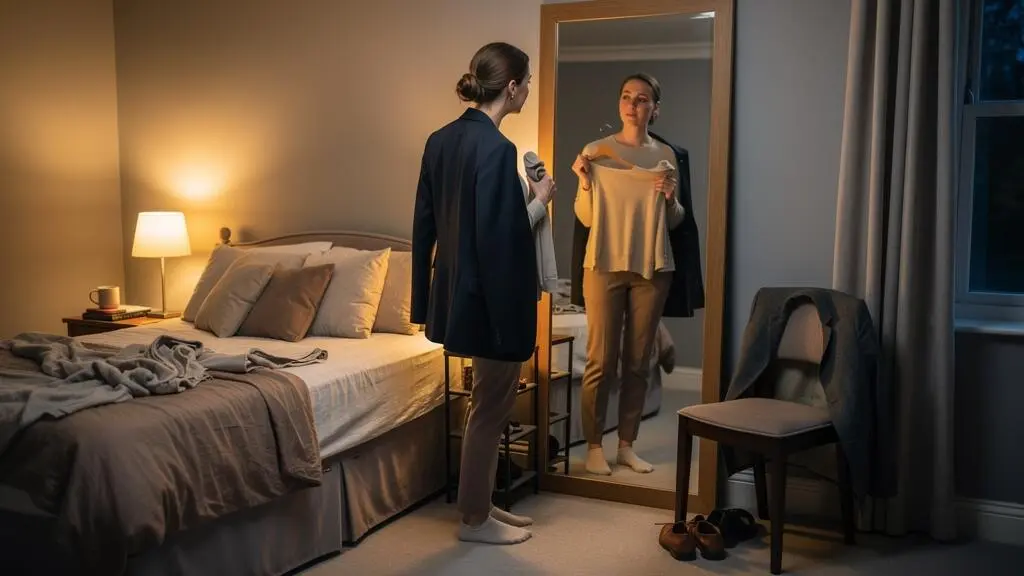
An invitation arrives for Saturday evening. It mentions dinner, perhaps a few drinks beforehand, but says nothing about what to wear. A suit feels excessive. Jeans might be too relaxed. The restaurant’s website offers little guidance, and asking everyone else seems unnecessarily complicated.
For most informal-to-smart evening gatherings in the UK, the safest starting point is smart, comfortable clothing with one deliberate upgrade. Think tailored trousers with a refined knit, a simple dress with polished shoes, or dark trousers and a collared shirt beneath a well-fitting jacket. The precise combination depends on the venue, occasion and people involved.
The aim is not to look as though you’re attending the most formal event imaginable. It’s to demonstrate that you’ve understood the occasion without appearing uncomfortable or overprepared.
A reliable approach starts with four clues, moves through a practical outfit decision and finishes with a short test before leaving. Once you know what to assess, even a vague invitation becomes manageable.
Evening dress codes: the essentials
- Read the venue, invitation, timing and host’s expectations together rather than relying on the word “dressy”.
- Start with an appropriate outfit and elevate one element instead of making everything more formal.
- Check fit, footwear and indoor-lighting appearance before the event, with a dependable alternative ready.
- Why Does Everyone Feel Uncertain About Evening Dress Codes Now?
- How to Calibrate an Evening Outfit in 4 Clues When You Only Have 30 Minutes to Get Ready?
- Statement Piece or Elevated Basics: Which Works Better for 3 Evening Plans a Month?
- The Evening Outfit Mistake That Shows Up in Photos Under Warm Restaurant Lighting
- When Should You Do a 10-Minute Outfit Test So You Don’t Panic an Hour Before Leaving?
- Subtle Detail or Full-Body Print: Which Looks More Expensive In Real Life?
- How to Choose Men’s Accessories Based on What You Carry Every Day, Not Hype?
- Which Men’s Designer Accessories Add Refinement Without Looking Flashy?
Why Does Everyone Feel Uncertain About Evening Dress Codes Now?
Evening dress codes feel uncertain because social occasions have become more flexible while expectations often remain unspoken. A restaurant dinner, birthday celebration or theatre outing might accommodate several clothing styles, but guests still want to respect the host and setting. The challenge is interpreting context rather than following one universal rule.
Traditional British etiquette distinguishes clearly between white tie, black tie and less formal clothing. Contemporary gatherings frequently operate outside those precise categories. A private birthday dinner might encourage smart casual, while a celebration at the same restaurant could call for something noticeably smarter.
As explained in Debrett’s article on dress codes and social etiquette, the formality of an invitation, its setting and its timing all help indicate appropriate clothing. The guidance acknowledges increasing informality without suggesting that traditional dress codes have disappeared.
Three expectations are particularly important:
- The stated dress code: what the invitation explicitly requests, if anything.
- The venue’s dress culture: what guests typically wear there and whether specific clothing restrictions apply.
- The host’s expectations: whether the gathering is a relaxed catch-up, a significant celebration or a deliberately elegant occasion.
These expectations can differ. A restaurant may welcome clean trainers, for example, while a host celebrating a milestone birthday hopes everyone will dress more formally. Meeting the venue’s minimum standard does not necessarily mean matching the social occasion.
There is also a perceived imbalance between dressing slightly too smartly and dressing too casually. In many British social settings, a modest extra effort can appear considerate, whereas clothing that seems careless may suggest insufficient attention to the invitation. This is a practical etiquette judgement, not a guaranteed reaction from every group.
The distinction matters because being slightly smarter is different from being dramatically overdressed. A blazer at a casual dinner is adaptable; a dinner jacket at a gathering where everyone wears knitwear may feel conspicuous.
Even experienced guests can misjudge an unfamiliar venue. A regular at one neighbourhood restaurant may have no reliable reference point for another, particularly when a private function changes the atmosphere.
Rather than treating that uncertainty as a personal failure of style, treat it as a question of gathering better clues. A few observations usually reveal a sensible starting point.
How to Calibrate an Evening Outfit in 4 Clues When You Only Have 30 Minutes to Get Ready?
When you have 30 minutes to get ready, assess four clues: the venue, the day and time, the invitation’s wording, and photographs showing how people actually dress there. Choose the simplest outfit that fits those clues, then make one deliberate upgrade. Prioritise shoes and outerwear before refining smaller details.
This method avoids two common extremes: relying entirely on a generic smart-casual outfit or attempting to dress for every possible interpretation of the invitation.
The four clues can be assessed quickly.
| Clue | What to examine | Practical starting point |
|---|---|---|
| Venue | Restaurant, pub, theatre, private home or dedicated event space | A neighbourhood pub may suit smart jeans and a knit; a formal restaurant may favour tailoring. |
| Day and time | Weeknight catch-up, Saturday dinner or late-evening celebration | A weekday drink may be relaxed; a planned Saturday celebration may justify a smarter finish. |
| Invitation | Casual message, formal invitation or language such as “dress up” | A carefully presented invitation suggests greater formality than an informal group message, other factors being equal. |
| Venue photographs | Recent images of ordinary guests, not just promotional styling | Look for recurring footwear, jackets, dresses and overall levels of polish. |
Photographs are clues rather than definitive evidence. A venue’s gallery might feature weddings or promotional events that do not resemble your particular evening. And if the invitation specifies black tie, a casual photograph does not override that instruction.
Once you’ve identified the likely level of formality, apply the one-notch-up rule. This is a practical styling heuristic: picture the most casual outfit you would still consider appropriate, then improve exactly one prominent element.
For a hypothetical pub-to-restaurant evening, dark, clean jeans and a neat knit might form the base. Replace everyday trainers with polished loafers or ankle boots. Alternatively, keep the shoes and add a structured jacket. There is no need to do both automatically.
For a birthday dinner, a straightforward midi dress might become evening-ready with elegant footwear, while tailored trousers and a simple top could gain refinement through a textured jacket.
With only half an hour available, allocate attention in this order:
- Footwear and outerwear: ensure both suit the venue, weather and outfit.
- Fabric and fit: assess whether garments look intentional, clean and appropriate for the setting.
- Accessories: select one or two finishing details without complicating the overall appearance.
This order is useful because shoes and jackets can substantially change an outfit’s overall impression. It is not an experimentally established ranking of what every observer notices first.
Your five-step, 30-minute evening outfit checklist
- Read the invitation and identify the occasion. Write down one working dress level: relaxed smart, smart evening or formal.
- Check the venue’s latest relevant photographs or stated policy. Identify one outfit detail that appears appropriate.
- Choose a comfortable base outfit. Lay out the complete combination, including trousers or dress, top and necessary layers.
- Upgrade one element through footwear, fabric or outerwear. Confirm that the resulting outfit still looks coherent.
- Put everything on, check the full-length reflection and take one indoor photograph. Keep one alternative layer or pair of shoes ready.
What if you arrive and realise the room is more casual than expected? Remove a tie, open the jacket or reduce prominent jewellery. These are reversible adjustments that can soften an outfit without requiring a complete change.
If the room is smarter than expected, buttoning or arranging a jacket neatly, adjusting a collar and keeping accessories restrained may improve the presentation. Such changes cannot transform genuinely casual clothing into formalwear, but they can help at the margins.
Once the right baseline becomes familiar, choosing what to wear takes less thought. The next question is whether building that baseline around distinctive statement pieces or versatile wardrobe essentials makes more sense for your social calendar.
Statement Piece or Elevated Basics: Which Works Better for 3 Evening Plans a Month?
For three evening plans a month, elevated basics generally offer greater flexibility when the occasions vary, while a statement piece can work well when your venues and social settings are similar. The strongest approach often combines both: a dependable, well-fitting base with one distinctive item that can be changed for each occasion.
Consider two hypothetical social calendars. In the first, all three outings involve dinner with the same friends at similarly smart restaurants. In the second, the plans include a birthday at a pub, a theatre visit and an anniversary dinner.
The first calendar offers repeated opportunities to wear a bold jacket, patterned dress or distinctive pair of shoes. The second benefits from clothes that can move between levels of formality.
| Decision factor | Statement piece | Elevated basics |
|---|---|---|
| Best occasion mix | Similar venues and consistent dress expectations | Different venues and changing levels of formality |
| Visual impact | Creates a recognisable focal point | Produces understated, adaptable combinations |
| Repeat-wear flexibility | Depends on whether the item works across several outfits | Usually easier to combine with existing clothing |
| Main risk | May feel too distinctive for certain invitations | May feel unremarkable without thoughtful finishing |
The financial question is not simply whether a garment feels special. It is how often you genuinely expect to wear it.
Cost per wear can be assessed by dividing an item’s purchase cost by the number of times it is worn, with cleaning, alteration or maintenance costs included when relevant. A striking outfit worn once may be harder to justify financially than a versatile jacket worn regularly, even if both were originally appealing.
The Ellen MacArthur Foundation‘s research on fashion business models places emphasis on keeping clothing in use for longer. Its 2021 report describes a historical decline in average clothing utilisation between 2000 and 2015, although it does not specifically compare evening statement pieces with wardrobe basics.
A useful personal purchasing test is whether a new statement item could work for at least two of your typical evening plans. This is a decision aid, not a universal threshold for value.
Before buying a bold printed jacket, for example, imagine it with both your usual tailored trousers and your more relaxed dark denim. If it works convincingly with only one very specific outfit, its actual usefulness may be limited.
A hybrid wardrobe is often easier to manage. Start with neutral trousers, a comfortable dress or skirt, polished shoes, and a top with a refined cut or texture. Then select one interchangeable focal point:
- A patterned or textured jacket for a celebration.
- Distinctive but comfortable shoes for a restaurant dinner.
- Jewellery that changes the mood of a simple outfit.
This approach makes dressing feel varied without requiring a new complete outfit for each occasion.
Whatever balance suits your wardrobe, consider the environment in which the outfit will be seen. An apparently perfect combination in daylight may produce a different impression under restaurant lighting.
The Evening Outfit Mistake That Shows Up in Photos Under Warm Restaurant Lighting
One easy-to-miss eveningwear mistake is relying entirely on subtle contrasts between dark colours. Under warm, dim restaurant lighting, those distinctions may become harder to see in photographs. A navy jacket, burgundy top and black trousers can appear less differentiated than expected, especially when the camera struggles with exposure or colour balance.
The problem is not that dark colours are unsuitable for eveningwear. They often look elegant. The problem arises when the whole outfit depends on small differences in shade that may not remain visible under unfamiliar lighting.
Incandescent lighting can introduce yellow or orange casts into photographs, while a phone’s automatic white balance may compensate to varying degrees. As Adobe‘s explanation of photographic white balance describes, the recorded appearance of colours depends on both the illumination and the camera’s processing.
In a dim restaurant, exposure and shadows can also make subtle fabric distinctions difficult to recognise. This is particularly noticeable in photographs where dark garments occupy relatively unlit areas of the frame.
A practical styling option is to introduce one visible point of contrast near the face. A pale shirt collar beneath a navy jacket, a softly coloured scarf over a dark top or understated metallic earrings can give the eye a clearer point of reference.
That contrast need not be bright white or visually dramatic. Cool blue, soft grey, muted ivory or a lighter textured fabric might work, depending on the wearer’s colouring and the rest of the outfit.
Neither Adobe’s technical guidance nor the available sources establish that a particular accessory will improve everyone’s complexion under warm light. The value of the approach is that it offers a styling option to test rather than a guaranteed photographic correction.
Try photographing the complete outfit indoors under the sort of warm lighting available at home. Compare it with the mirror image, paying attention to whether the garments remain visually distinct. Avoid judging entirely from a daylight photograph.
A household lamp cannot reproduce every restaurant’s lighting, and modern phones may process identical colours differently. Nevertheless, the comparison may reveal contrast issues worth correcting before leaving.
The point is not to design every outfit around a camera. It is to ensure that clothing chosen for its carefully balanced colours still communicates the intended impression in the environment where it will actually be worn.
When Should You Do a 10-Minute Outfit Test So You Don’t Panic an Hour Before Leaving?
Do a ten-minute outfit test the night before an unfamiliar event or whenever you’re wearing new clothes. For a routine gathering with familiar garments, earlier on the same day may be sufficient. The essential requirement is leaving enough time to replace an uncomfortable shoe, correct an awkward fit or choose a dependable alternative.
Last-minute dressing problems often come from details that cannot be assessed while garments remain on hangers. A jacket may look perfectly proportioned until you sit down. Shoes may feel comfortable for a moment but become awkward after walking around the house. A top may wrinkle more than expected.
The test should involve wearing the complete outfit, including the shoes, outerwear and accessories you actually intend to use.
Start by standing naturally in front of a full-length mirror. Check whether the hems, sleeves and layers sit as intended. Then sit in an ordinary chair, particularly if the evening involves a restaurant or theatre, where you’ll spend substantial time seated.
Walk around for a few minutes. Pay attention to footwear, waistbands, restrictive sleeves and anything that needs frequent adjustment. An outfit that demands constant attention can become tiring, however polished it appears when stationary.
Finally, check the combination under indoor lighting and take one photograph. The photograph offers a different view of proportions and colour relationships, although it should not replace the comfort and fit checks.
The fallback is as important as the test. Keep a familiar outfit available rather than waiting until the last moment to invent an entirely new combination.
For example, a new pair of leather shoes might feel less comfortable than expected. A known pair of polished alternatives could preserve the intended level of formality without requiring changes to the rest of the outfit.
The same principle applies to accessories. A heavy bag, unstable earrings or awkwardly fastening belt may seem unimportant at home but become distracting during an extended evening.
There is no need to turn the test into an elaborate rehearsal. Its purpose is to identify practical problems early and eliminate avoidable decisions during the final hour.
With the outfit tested and a fallback identified, attention can move away from basic suitability and towards the quieter details that influence how refined the overall appearance feels.
Subtle Detail or Full-Body Print: Which Looks More Expensive In Real Life?
Subtle detail often creates a more understated, refined impression than a full-body print, particularly when the garment has good proportions, a pleasing fabric and a comfortable fit. A bold print can still look sophisticated, but it draws more immediate attention. Neither approach proves actual quality or price; the effect depends on execution and context.
Clothing that looks expensive is not necessarily expensive. A well-cut, unbranded jacket may appear more considered than a costly printed garment with awkward proportions. Likewise, a beautifully constructed printed dress can be more impressive than a poorly finished plain one.
The distinction comes down to how an outfit holds attention.
Full-body prints communicate from a distance. A large floral pattern, striking geometric design or dramatic colour arrangement may establish the outfit’s character before anyone notices its fabric or construction.
Subtle details emerge more gradually. A textured weave, carefully positioned seam, restrained fastening or change in proportion may only become apparent at conversational distance.
At an evening gathering, both impressions can be useful. A statement print may suit a celebratory birthday where expressive clothing feels welcome. A quietly textured outfit may work particularly well for an intimate dinner or a setting where the conversation matters more than visual impact.
When evaluating refined details, look at four practical qualities:
- Fabric: does the material drape naturally, or does it pull and bunch?
- Construction: do seams, hems and fastenings appear neat and intentional?
- Hardware: do buttons, buckles and zips complement the design rather than distract?
- Proportion: does the garment sit comfortably within the overall silhouette?
These qualities may influence perceived refinement, but they are not reliable indicators of manufacturing cost, luxury status or ethical production.
A useful selection exercise is the second-look test. Examine the outfit briefly, look away and then return to it. Does the print still feel engaging, or was its initial impact the main attraction? Does a quieter garment reveal an interesting detail you missed the first time?
The answer is personal. The goal is not to eliminate bold clothing but to decide whether its visual character suits the evening and feels consistent with your own style.
Once you’ve established the impression you want, accessories should reinforce it. For men in particular, some of the most useful evening accessories may already be part of their everyday routine.
How to Choose Men’s Accessories Based on What You Carry Every Day, Not Hype?
Choose men’s evening accessories by examining the items you already use: watch, belt, glasses, wallet and bag. Improving their condition, fit and consistency often produces a more natural result than adding unfamiliar decorative pieces. Accessories should support your existing style and remain comfortable to wear or carry throughout the evening.
For a dinner or birthday celebration, think first about what will actually accompany you. Your watch may be visible when greeting someone or reaching across a table. Your glasses frame your face throughout the evening. Your bag or wallet may appear when you arrive or pay.
These are functional items, yet they also contribute to the outfit’s appearance.
Start with a simple inventory. Notice the metal tones, leather colours and proportions you already prefer. Someone who regularly wears understated silver-toned accessories and dark leather may find it easier to incorporate a restrained evening watch than a large, highly polished gold-toned statement piece.
This is a coherence principle, not a rule that every metal or leather item must match exactly. Mixed finishes can work when the overall combination feels deliberate.
The carry test offers another useful filter: will the accessory behave naturally during the evening?
A bag that needs constant adjustment, an unfamiliar fastening or an object with no obvious purpose may create avoidable inconvenience. If you must repeatedly check, reposition or carry it differently, consider whether it genuinely improves the outfit.
For example, a compact crossbody bag could be practical for a theatre-to-restaurant evening if it holds essential belongings and suits the clothing. A decorative pouch carried solely for its appearance may be less useful if it becomes awkward during drinks or dinner.
Trends are not inherently unsuitable, but purchasing something only because it is fashionable can be difficult to justify if it does not work with your established wardrobe.
Before buying, consider whether the accessory would complement your usual daytime clothing as well as the planned evening outfit. Versatility gives you more opportunities to use and enjoy it.
Clean, maintained everyday accessories may also offer a more believable impression of polish than adding several new pieces simultaneously.
This approach naturally leads to a more specific question: when is a designer accessory worth incorporating, and how can it add refinement without becoming the dominant feature of an evening outfit?
What to remember before choosing designer accessories
- Choose accessories that complement the outfit’s level of formality rather than trying to make them establish it.
- Look for suitable proportions, comfortable use and finishes that work with the clothes you already own.
- Assess the actual design and usefulness of an item separately from its branding or designer label.
Which Men’s Designer Accessories Add Refinement Without Looking Flashy?
Men’s designer accessories can add understated refinement when they are proportionate, practical and visually restrained. A well-finished watch, suitable belt or discreet leather bag can complement an evening outfit without dominating it. Prioritise the quality and suitability of the individual item rather than assuming that a luxury label automatically makes an outfit more elegant.
For most smart-casual evenings, a useful distinction is between accessories that complete an outfit and accessories that compete with it.
Highly visible logos, oversized hardware and strongly reflective finishes can become focal points. That may be intentional for a more expressive occasion, but it is not always the effect someone wants at a dinner or theatre visit.
Restrained designs can communicate a different kind of attention: thoughtful materials, controlled proportions and finishing details that complement the clothing without demanding recognition.
Three categories are worth examining first.
1. A well-proportioned watch. Choose a case size and finish that sit comfortably with your wrist and jacket sleeve. A restrained watch can suit both tailored evening clothing and more relaxed combinations, provided it feels natural to wear.
2. A suitable belt and shoes. Rather than insisting on perfectly matching colours, aim for a compatible level of formality and coherent finishes. A discreet belt and polished leather shoes may complement tailored trousers more naturally than an oversized statement buckle.
3. A practical cardholder or bag. Consider compactness, construction, condition and ease of use. A refined-looking cardholder may be useful if you already carry one, while a quality bag matters more if the evening requires carrying belongings.
These categories are practical priorities, not a scientifically established ranking of what guests notice or admire.
The subtlety of a designer accessory comes partly from letting its construction speak without relying on prominent branding. Leather texture, stitching, hardware and shape can all contribute to an impression of care, although none guarantees that an item is expensive or well made.
A discreet designer piece can still be unsuitable. An immaculate formal watch may look out of place alongside a deliberately rugged outfit. An elegant bag may be impractical for a crowded standing reception.
More importantly, expensive accessories cannot solve an incorrectly judged dress code. Designer shoes do not make a very casual outfit appropriate for a black-tie event, just as a luxury belt cannot compensate for uncomfortable or badly fitting trousers.
Establish the correct clothing baseline first. Confirm the fit and comfort, then decide whether a particular accessory adds anything useful.
For your next evening gathering, identify the venue’s expected tone, choose a familiar outfit and improve just one detail. Check the complete combination before leaving. The most convincing result is usually one that lets you enjoy the occasion without thinking about your clothes throughout it.
Can you wear jeans to a smart-casual evening event in the UK?
Yes, in some settings. Clean, dark jeans without obvious distressing may be appropriate for informal smart-casual gatherings, especially when combined with a neat shirt, knit or jacket and suitable shoes. More formal smart-casual occasions may call for tailored trousers instead. Check the invitation, host’s expectations and any venue restrictions before deciding.
Is it acceptable to ask the host what to wear?
Yes. A short, practical question is entirely reasonable when an invitation is ambiguous. Asking whether the occasion is more relaxed or closer to smart eveningwear helps establish expectations without requiring the host to specify every garment. You can also ask what other guests are planning to wear.
What should you wear when drinks at a pub turn into dinner at a restaurant?
Choose an adaptable outfit that suits the smarter destination without feeling excessively formal at the first. Tailored or dark trousers, a refined top or collared shirt, and polished footwear provide a useful starting point. An optional jacket or removable layer can make the transition easier. Check whether the restaurant has specific requirements.
Do you need different clothes for the theatre and a restaurant dinner?
Not necessarily. Many contemporary theatre outings and restaurant dinners can be accommodated by the same well-considered smart-casual outfit. However, opening nights, special celebrations, formal invitations and particularly sophisticated venues may involve different expectations. Comfort while seated is important for both occasions.
What if everyone else is dressed more casually than you?
Keep the adjustment small. Removing a tie, opening a jacket, taking off a structured layer or reducing prominent jewellery may soften the impression. There is usually no need to apologise for looking slightly smarter. Concentrate on participating comfortably in the gathering rather than continually adjusting your clothes.