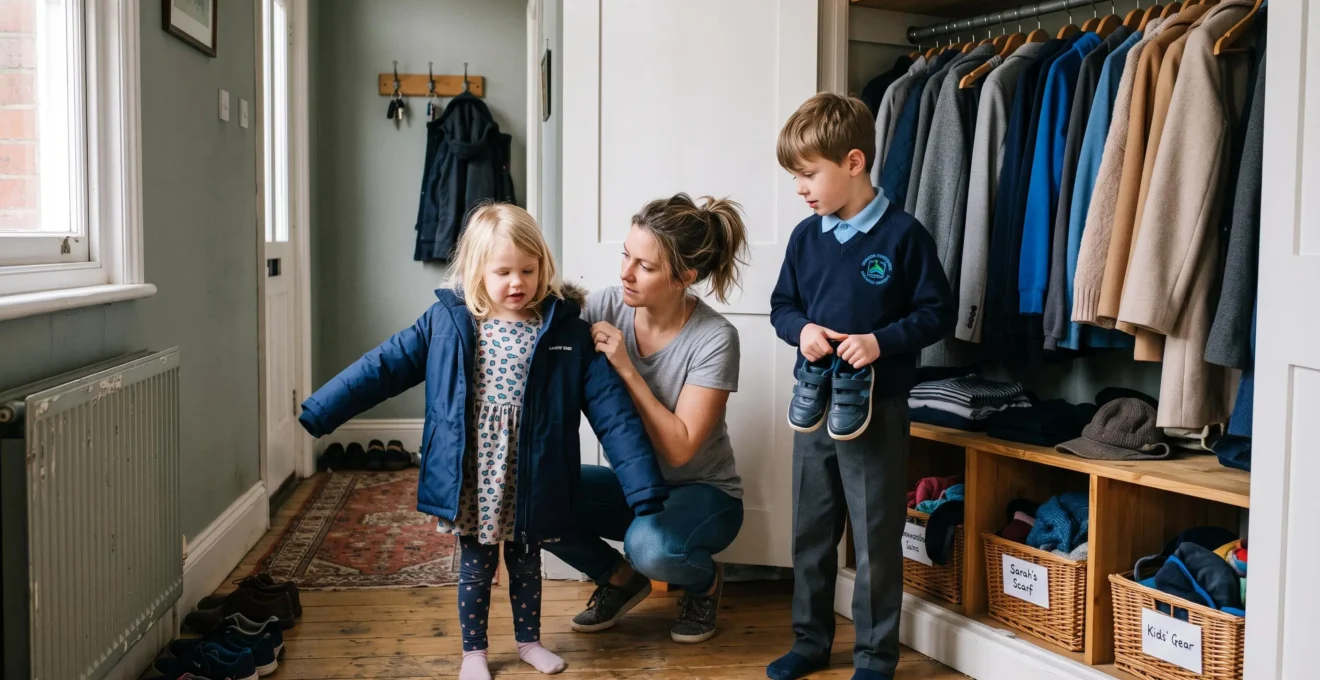
A family wardrobe saves time when everyone can find something clean, comfortable, weather-appropriate and ready to wear without starting a negotiation before breakfast. The solution is not necessarily fewer clothes. It is a repeatable system that connects outfit choices, children’s changing sizes, laundry schedules and purchasing decisions.
For UK parents managing school runs, work commitments and weekend plans, that means creating a small number of reliable outfit combinations, keeping practical backups available and making sure clothes return to their proper places after washing.
A family wardrobe system should also prevent unnecessary spending. Clothes that no longer fit need a clear route towards younger siblings, storage, resale or donation, while new purchases should solve identifiable gaps rather than introduce more choices.
Start with what your household actually wears. Then build around its existing routines, rather than expecting everyone to adopt an immaculate minimalist wardrobe overnight.
The family wardrobe system in three decisions
- Reduce morning choices: establish compatible colours and dependable outfit combinations, with school-uniform backups where needed.
- Size the wardrobe around laundry: calculate how many wearable changes each person needs between washes, including sensible reserves.
- Keep clothes moving: use weekly resets, fit checks, small repairs and a controlled purchasing list to prevent clutter returning.
- Why Do Families Feel Overwhelmed by Clothes Even When Storage Is Full ?
- How to Build a Family Colour Palette That Cuts Outfit Fails in Half ?
- School-Run Uniform or Capsule Wardrobe: Which Works Better With 10-Minute Mornings ?
- The Purchase Pattern That Creates 6 Unworn “Occasion Outfits” in One Household
- When Should You Do the Family Wardrobe Swap So You Don’t Miss the First Cold Week ?
- 12 Pieces or 20 Pieces: Which Capsule Size Works Better if You Wash Once a Week ?
- How to Build a Circular Wardrobe System Using 4 Habits You Can Do Weekly ?
- How Do You Build a Minimalist Capsule Wardrobe That Works in Unpredictable UK Weather ?
Why Do Families Feel Overwhelmed by Clothes Even When Storage Is Full ?
Families feel overwhelmed by clothing because wardrobe capacity and outfit availability are different problems. A full drawer offers little help when the suitable trousers are in the wash, the matching top no longer fits or a child cannot decide what to wear. The real burden comes from repeated decisions, not simply the number of garments owned.
Three recurring problems typically create this friction.
- Uncoordinated purchases: individual items look appealing in shops but do not combine easily with existing clothes.
- Unnoticed growth: children’s clothes remain in drawers after becoming uncomfortable or too short, reducing the number of genuinely wearable options.
- Disconnected laundry routines: washing happens without considering which outfits must be ready for school, work or weekend activities.
Adding another chest of drawers may organise the surplus, but it does not necessarily improve access to the clothes everyone needs.
There is evidence that unused clothing represents a substantial part of UK wardrobes.
Around 30%
WRAP research presented by Zero Waste Scotland reported that approximately 30% of clothing in the average UK wardrobe had not been worn for at least a year. Fit was the most frequently reported reason. This figure describes wardrobe use, not measured family morning delays.
Zero Waste Scotland’s presentation of the Valuing our clothes report
When usable clothes disappear beneath ill-fitting or rarely worn garments, parents may overlook what they already own and buy replacements unnecessarily.
The best starting point is a simple seven-day wear log.
For one ordinary week, record what each family member actually wears, what gets rejected and why. Include school days, workdays and any weekend activities.
Use four labels for rejected outfits: choice, fit, cleanliness and coordination.
At the end of the week, review the patterns. If clean clothes regularly remain unfolded, the laundry turnaround is the bottleneck. If children reject combinations despite having plenty of clean items, the problem may be outfit compatibility or personal preference.
Avoid buying anything during this observation period unless an essential item is genuinely missing.
Once the actual problem is visible, coordinating existing clothes becomes more useful than buying additional storage or starting an entirely new wardrobe.
How to Build a Family Colour Palette That Cuts Outfit Fails in Half ?
A family colour palette makes mornings easier by limiting the number of combinations that require thought. Choose two or three dependable neutrals for each person, introduce a shared accent colour where practical and check that existing garments work together. The goal is not identical outfits or a proven 50% reduction in mistakes, but fewer frustrating mismatches.
Think of colour as a compatibility rule rather than a fashion restriction.
A practical starting palette might include navy, grey and cream, with rust as a shared accent. One family member could favour navy and grey, while another prefers cream and denim blue. Their clothes do not need to match exactly.
The important point is that each person’s everyday pieces combine reliably.
Build the palette in this order:
- Lay out the clothes each family member actually wears, excluding items that no longer fit.
- Identify two or three neutral colours already represented in their favourite pieces.
- Choose one accent that works with those neutrals and suits the family’s preferences.
- Put difficult-to-combine garments aside temporarily rather than automatically discarding them.
- Only add a replacement to the shopping list when an essential combination remains impossible.
Now perform the grab test. Choose three suitable garments from the clean laundry pile without deliberately creating an outfit. Check whether any two that could reasonably be worn together make an acceptable combination.
Repeat with different items. If one colour repeatedly clashes, identify the troublesome colour family before deciding whether that garment belongs in the everyday rotation.
A compatible palette can also make hand-me-downs more practical. A navy sweatshirt or neutral cardigan may move between siblings without requiring an entirely different collection of coordinating clothes.
Colour compatibility never replaces checks for fit, comfort, condition or individual taste. Children should still have meaningful choices within the system.
With reliable combinations established, the next decision is how much morning choice each family member actually needs.
School-Run Uniform or Capsule Wardrobe: Which Works Better With 10-Minute Mornings ?
A school uniform usually removes more clothing decisions from a rushed morning, while a capsule wardrobe offers greater flexibility for non-uniform days. Neither automatically solves preparation delays. Uniforms depend on clean, correctly sized backups; capsules depend on compatible combinations. For many families, a hybrid system is more practical than choosing one approach exclusively.
A strict school uniform policy decides what children wear, leaving parents to manage garment availability and weather-appropriate layers.
A capsule wardrobe narrows the choice to a manageable collection of coordinated pieces. Children retain some independence, but the system works only when those choices remain compatible.
The two approaches involve different trade-offs.
| Decision factor | School uniform | Capsule wardrobe |
|---|---|---|
| Morning choices | Very limited when the required outfit is ready | Several combinations, ideally prepared in advance |
| Laundry pressure | Concentrated on required uniform pieces | Spread across interchangeable everyday clothes |
| Child independence | Simple selection from known items | Choice within clear boundaries |
| Common failure | Missing clean uniform or correctly sized backup | Incompatible or unsuitable self-selected outfits |
| Practical correction | Maintain enough duplicates for the wash cycle | Prepare approved combinations and use a shared palette |
For a household with several children attending schools with different uniform requirements, start by separating each child’s compulsory items. Keep their clean uniforms together, with enough spare pieces to accommodate the family’s actual washing schedule.
For younger children choosing their own non-uniform clothes, offer a small selection of ready-to-wear combinations. Older children may prefer broader capsule choices, particularly when they already dress independently.
A hybrid wardrobe combines both methods: a uniform core for school days and a coordinated capsule for evenings, weekends, holidays and non-uniform events.
The laundry system should serve both collections.
In England, the Department for Education‘s statutory guidance on school uniform costs addresses affordability, durability and access to second-hand uniforms.
From September 2026, the guidance reflects limits on compulsory branded uniform and PE items for schools within its scope: generally three or fewer, with an allowance of up to four for relevant secondary and middle schools where one item is a tie. These provisions should not be assumed to apply throughout the UK or other English-speaking countries.
Schools covered by the guidance must also make opportunities to acquire second-hand uniforms accessible to parents.
That makes it worth checking school-approved suppliers and second-hand arrangements before buying every item new.
Once school clothing is organised, the next spending risk often comes from items bought for special events rather than ordinary family life.
The Purchase Pattern That Creates 6 Unworn “Occasion Outfits” in One Household
Occasion outfits accumulate when clothing is purchased for one event without considering whether it will be worn again. A wedding outfit, birthday-party dress or family-photo ensemble may suit the immediate occasion but never enter normal rotation. Across several household members, repeated single-use purchases can leave drawers full while everyday clothing needs remain unresolved.
Consider an explicitly hypothetical household that buys separate outfits for two celebrations and a family photograph.
If two family members each receive an outfit for all three events, the household could accumulate six occasion-specific outfits. That is an illustration of the purchasing pattern, not a measured average or prediction.
The problem is not dressing up. It is buying items with no realistic second use.
A formal garment may be perfectly worthwhile when it is repeatedly worn or suitable for several occasions. But an expensive-looking item that cannot coordinate with anything else often becomes isolated from the everyday wardrobe.
That isolation causes two practical problems.
First, seldom-used occasion clothes occupy accessible drawer and hanging space. Second, they contribute to the impression that everyone owns plenty of clothing, even when essential everyday pieces are missing.
Introduce a three-context purchase test before buying a special-event item.
Ask whether the garment could realistically be worn in three different contexts over the next three months.
For example, a smart cardigan might work for a birthday party, a family meal and an ordinary school-free day. A highly specific outfit may have no realistic use beyond the original event.
The test is a household purchasing rule, not a research-validated threshold. When a genuinely one-off occasion requires special clothing, borrowing, hiring or buying second-hand may be preferable to forcing an unsuitable everyday purchase.
Existing occasion clothes deserve a separate audit.
Sort them into three groups:
- Return to rotation: comfortable pieces that fit and work with regular outfits.
- Keep for a known event: items with a specific, realistic future use and sufficient remaining fit.
- Pass onwards: pieces suitable for resale, donation or hand-me-downs that no longer meet household needs.
Avoid leaving every formal outfit in the children’s most accessible drawers. Store genuinely occasional pieces together so everyday choices remain visible.
This separation also makes seasonal reviews easier: the family can see which everyday clothes genuinely need replacing when sizes and temperatures change.
When Should You Do the Family Wardrobe Swap So You Don’t Miss the First Cold Week ?
The best time for a family wardrobe swap is before seasonal clothing becomes urgently necessary, but the final rotation should follow actual weather conditions rather than a fixed calendar date. Check children’s sizes early, keep transitional layers accessible and complete the swap when local forecasts indicate a sustained change. This avoids both last-minute shortages and premature packing.
A child’s growth and the arrival of colder weather do not happen on the same schedule.
A winter coat that fitted last year may now be too short in the sleeves. Equally, a mild autumn may suddenly give way to a colder spell before the family has unpacked heavier clothing.
Treat the process as two separate decisions: fit readiness and weather readiness.
Start with an early audit during a quiet weekend. Bring out stored coats, knitwear, trousers and weatherproof items. Ask each child to try on the essentials, checking sleeve length, trouser length, movement and comfort.
Do not rely exclusively on the size printed inside the garment.
Make a short list of missing essentials and check whether suitable hand-me-downs are already available.
Next, create a small transitional collection that remains accessible regardless of the season.
This might include a light waterproof jacket, a warm mid-layer, comfortable long trousers and tops that can be layered.
Finally, use your local forecast to decide when to move the main seasonal collection into everyday reach.
The Met Office describes the UK as having a temperate maritime climate with changeable conditions. Its explanation of the UK’s temperate maritime climate provides useful background for understanding why rigid seasonal boundaries are often inconvenient.
It does not establish a specific temperature or forecast period for switching wardrobes.
A practical household rule is to watch for several consecutive days of conditions requiring different clothing, rather than reacting to one unusually cold or warm afternoon.
Keep a small weather-flexible selection available after the swap. Otherwise, an unexpected return to milder conditions can leave perfectly suitable clothes inaccessible and encourage unnecessary emergency purchases.
Your five-step seasonal wardrobe readiness checklist
- Try on each child’s essential seasonal clothes and produce a short list of items that no longer fit.
- Check stored hand-me-downs before shopping and identify which missing sizes can already be supplied.
- Prepare a readily accessible transitional outfit for each person, including a suitable outer layer.
- Review the local forecast and record whether the expected conditions justify moving the main seasonal collection.
- Complete the rotation, label stored clothes by person and size, and leave a visible list of genuine replacement needs.
Once the right seasonal garments are accessible, the remaining question is how many of them each person actually needs between laundry days.
12 Pieces or 20 Pieces: Which Capsule Size Works Better if You Wash Once a Week ?
For a household washing once a week, a 20-piece capsule may offer more flexibility than a 12-piece capsule, particularly for children who need frequent changes. However, neither number is universally correct. The right size depends on how often each garment becomes dirty, the interval between washes, drying time and the backups required when laundry is delayed.
A capsule wardrobe should be treated as an availability calculation, not a minimalist competition.
Start by defining what counts as one piece. For a useful comparison, the following example counts everyday tops, bottoms and additional interchangeable layers, but excludes underwear, socks, footwear and essential specialist clothing.
Now consider a hypothetical child who needs a fresh top every school day and sometimes an additional change after play.
If the family washes and fully dries clothing only once a week, the child may need considerably more tops than a parent who regularly rewears suitable garments between washes.
A practical calculation is:
Required items = items used between completed laundry cycles + a reserve for unexpected changes or delays.
Count each clothing category separately.
For an illustrative adult, suppose seven days of wear require five distinct tops, three bottoms and two interchangeable layers. Add two backup tops and one spare bottom to accommodate a delayed wash or unexpected change.
That produces thirteen counted pieces for this hypothetical arrangement. It does not establish a universal minimum, and different activities or hygiene requirements may change the result.
For children, allow additional reserves based on actual staining, sports participation and changing needs.
The size comparison becomes more meaningful when translated into everyday trade-offs.
| Consideration | 12-piece capsule | 20-piece capsule |
|---|---|---|
| Daily selection | Fewer combinations to consider | More combinations and potential flexibility |
| Weekly laundry | Less room for missed cycles or delayed drying | Greater potential reserve if pieces are appropriately distributed |
| Children’s clothing | May be restrictive when frequent changes are needed | May better accommodate spare everyday items |
| Storage | Requires less space | Requires more organisation |
| Wear per garment | Individual pieces may be used and washed more frequently | Wear can be distributed across more pieces |
A smaller capsule can simplify decisions, but it can also make laundry more urgent. Frequent use may increase wear on individual garments, depending on fabric, care and activity.
A larger capsule creates breathing room, provided the extra pieces are useful rather than duplicates of unsuitable clothing.
The decision should therefore be made per person, not across the entire family.
If one child’s clean clothes repeatedly run out before laundry day, increasing that child’s practical reserves may be more effective than increasing everyone else’s wardrobe.
Even a correctly sized wardrobe loses its usefulness if clean clothes remain in baskets, repairs accumulate or outgrown pieces are never removed.
How to Build a Circular Wardrobe System Using 4 Habits You Can Do Weekly ?
A circular family wardrobe keeps clothing moving through wear, washing, repair, reuse and eventual exit rather than allowing garments to accumulate unnoticed. Four weekly habits make this manageable: resetting the wardrobe, returning clean laundry promptly, checking minor damage and reviewing children’s fit. These routines help identify genuine clothing needs without requiring repeated decluttering projects.
Circularity is useful when it describes actual household behaviour, not simply a preference for second-hand shopping.
A functioning system gives each garment a next destination.
Clean items return to rotation. Damaged but repairable items receive attention. Outgrown clothes move towards storage, hand-me-downs or another suitable owner. Items that cannot reasonably be used again are handled through an appropriate textile disposal route.
The four habits can fit into an ordinary weekly routine.
- Run a 15-minute wardrobe reset. Return stray garments from bedrooms, hallways and laundry baskets to their proper places. Set aside obvious non-fitting pieces instead of hiding them under usable clothes.
- Complete the laundry-to-drawer turnaround. Treat washing as unfinished until clean, dry garments are returned to accessible storage. This prevents clothes that are technically clean from becoming unavailable.
- Check minor repairs. Look for loose buttons, small tears and failing seams when folding or putting clothes away. Move repairable items to a clearly limited repair area and assign a realistic time to fix them.
- Review size and fit. Notice sleeves getting short, uncomfortable waistbands or shoes and clothing that children are refusing because of fit. Route outgrown items to a labelled hand-me-down collection or suitable exit channel.
The fit review should generate the family’s real needs list.
Rather than writing “new autumn clothes”, record specific requirements such as “one pair of school trousers in the next suitable size” or “replace the waterproof jacket that no longer fits”.
Before purchasing, check what the household already owns, including stored hand-me-downs and repairable alternatives.
This changes shopping from a response to sales or special events into a response to documented needs.
When the system starts to deteriorate, avoid immediately reorganising every wardrobe.
Look for the first broken loop instead.
A growing clean laundry pile suggests the turnaround habit is failing. An overflowing repair basket means the household needs a smaller repair queue or more realistic repair decisions. Unlabelled outgrown clothing points towards a stalled hand-me-down process.
Each problem has a targeted correction.
For busy families, consistency matters more than an elaborate tracking app or perfectly labelled storage system. A few accessible baskets and a shared list may be sufficient.
With these routines established, a family can build a genuinely weather-resilient capsule rather than repeatedly rebuilding its wardrobe each season.
Key takeaways before building your weather-ready capsule
- Choose the number of everyday pieces from real wear and laundry needs, not a fixed minimalist target.
- Keep transitional layers accessible so an unexpected weather change does not automatically create a shopping trip.
- Use fit checks and weekly maintenance to identify missing essentials before replacing otherwise useful clothing.
How Do You Build a Minimalist Capsule Wardrobe That Works in Unpredictable UK Weather ?
A minimalist capsule wardrobe for unpredictable UK weather works best when it is built around layers rather than rigid summer and winter collections. Combine comfortable base garments, adaptable mid-layers and suitable weatherproof outerwear. Choose pieces that work across different conditions, then test the complete collection against cold, warm and wet scenarios before relying on it.
The central principle is adaptability per garment.
A top that works alone during a mild afternoon but also layers comfortably beneath a jumper has more everyday flexibility than a highly seasonal item with only one practical use.
Similarly, a suitable waterproof outer layer can protect an otherwise versatile outfit without requiring a completely separate rainy-day wardrobe.
A useful family layering system has three components.
- Base layers: comfortable tops and everyday garments suitable for indoor activities and adjustable warmth.
- Mid-layers: jumpers, cardigans or fleeces that can be added or removed as temperatures change.
- Outer layers: weather-appropriate coats and waterproof pieces selected for the actual conditions and each person’s needs.
Build these layers around the family’s established colour palette so that adding warmth does not introduce difficult combinations.
Select fabrics according to comfort, durability and actual laundry capacity. Easy-care pieces that dry reliably between washes may be particularly useful when a household has limited drying space or normally washes once a week.
Quick-drying fabrics are a practical consideration, not a mandatory feature of every UK capsule wardrobe.
Aim for garments that work across at least two seasons when layered, while retaining genuinely specialised clothing for conditions that require it.
For children, prioritise freedom of movement, acceptable fit and the ability to dress independently.
Before making purchases, test the proposed capsule against three hypothetical weather challenges.
| Scenario | What the wardrobe must provide | Potential gap to investigate |
|---|---|---|
| Cold snap | Comfortable base clothing, sufficient insulating layers and appropriate outerwear | No suitable warm layer or correctly fitting coat |
| Warm spell | Breathable, comfortable outfits without unnecessary heavy layers | Too many garments that only work in cold conditions |
| Wet week | Suitable waterproof protection and enough clean, dry everyday clothing between laundry cycles | Inadequate rain protection or insufficient drying time |
Run each scenario using only the garments already assigned to the capsule.
If a cold snap exposes a missing essential, check stored clothes and possible hand-me-downs first. If a wet week requires more clean tops than the capsule contains, adjust the reserve or laundry routine rather than assuming the entire wardrobe needs expanding.
These exercises are practical resilience checks, not meteorological predictions or scientifically validated capsule formulas.
Keep the final collection accessible by grouping compatible outfits, maintaining a clear place for outer layers and ensuring clean clothing returns to rotation after washing.
Review it when genuine conditions change: a child grows, laundry frequency shifts, a garment wears out or the family’s routine becomes different.
Start with one ordinary week: track what gets worn, organise a few reliable outfits and correct the clearest bottleneck. Build the rest of the system gradually around what your family actually needs, rather than replacing a workable wardrobe with another complicated project.
How long does it take to set up a practical family wardrobe system?
Begin with a seven-day wear log, then use a convenient weekend to review fit, coordinate existing outfits and identify laundry gaps. There is no universal setup time: the work depends on household size, the condition of existing clothing and how much needs sorting. The aim is to establish a workable routine before refining storage or shopping rules.
Should siblings share clothes if they have different styles?
Sharing clothes can work when garments fit, remain in suitable condition and are acceptable to the person receiving them. A compatible family palette makes hand-me-downs easier to coordinate, but individual preferences still matter. Keep shared or stored clothing labelled by size and type so that useful pieces are easy to find.
What should parents do when children refuse preselected outfits?
First check whether the objection concerns comfort, fit, fabric or personal preference. Offer a limited choice of suitable combinations instead of insisting on a single outfit. Preparing acceptable options in advance preserves some independence without reopening the entire wardrobe decision every morning.
Is buying second-hand clothing always the most economical option?
Not necessarily. A second-hand item is useful when it fits, meets a genuine need, is in appropriate condition and is likely to be worn. Compare its suitability and total cost with existing clothes, available hand-me-downs and other options. For school uniforms in England, parents can also check the second-hand opportunities schools are required to make accessible under the applicable guidance.
How can a family tell whether its wardrobe system is actually saving time?
Compare similar school mornings before and after introducing the system. Record how often outfits need changing, essential pieces cannot be found or clean laundry is unavailable. Families can also note unplanned replacement purchases. Fewer interruptions and more reliable outfit availability provide practical evidence of improvement, without assuming a particular percentage of time saved.