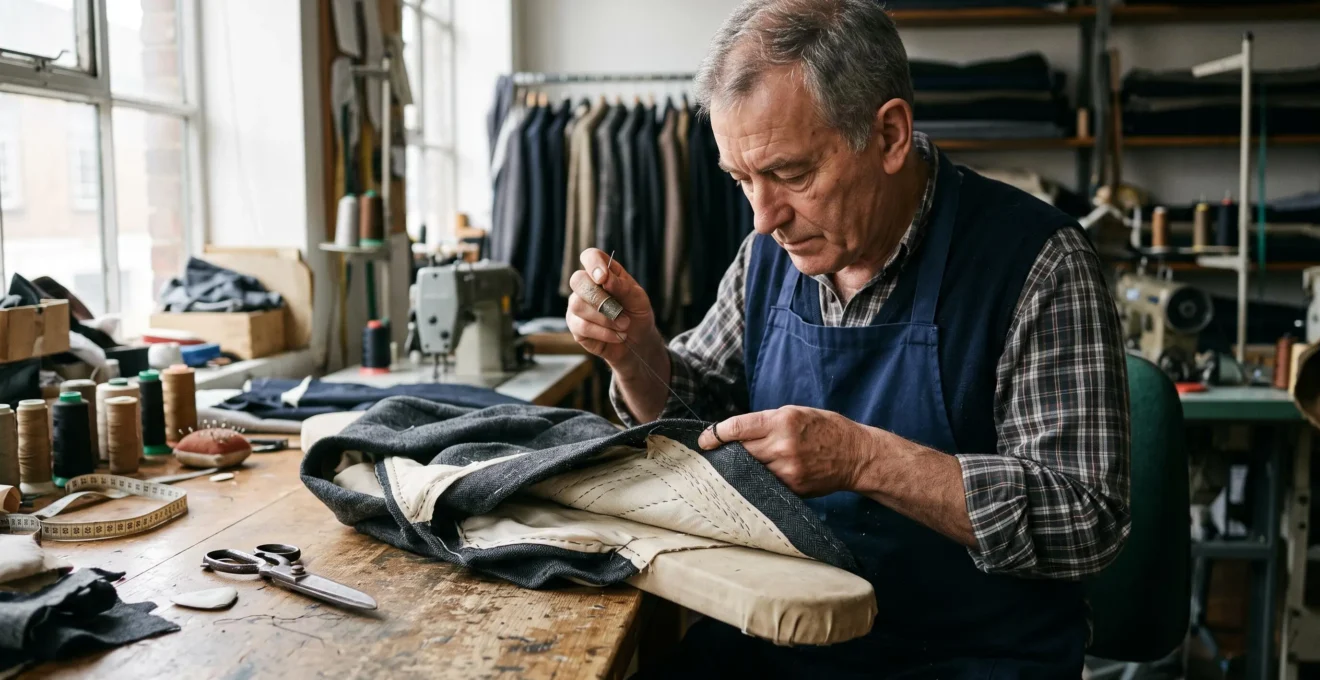
A beautifully rolled lapel, carefully matched checks and a discreetly finished lining can reveal more about a garment than its label. But these details only justify a premium when the underlying construction supports comfort, repairability and long-term wear.
Traditional craftsmanship is not simply the presence of hand-stitching. It is the appropriate combination of fabric, pattern cutting, shaping, stitching, interfacing and finishing. A precisely sewn machine seam may perform better than a decorative hand-worked one. Equally, expensive wool and handsome buttons cannot rescue a jacket with badly balanced sleeves or a collapsing front.
For UK shoppers trying to buy fewer, better garments, the useful question is not whether something looks luxurious on the hanger. It is whether its construction will still work after repeated sitting, walking, cleaning and alterations.
The difference becomes easier to recognise when you inspect the places a brand has less incentive to display: the seam allowances, the underside of the lapel, the lining, the crotch curve and the zip.
How to recognise workmanship worth paying for
- Judge stitching by its tension, placement and suitability for the fabric, not simply by whether it was sewn by hand.
- Inspect hidden construction: seam allowances, lining ease, canvas, reinforcement and functional hardware.
- Prioritise fit, comfort and future repairs over decorative heritage details or a prestigious label.
- Why Do Hand-Finished Seams Feel Better After 30 Wears Than Fast-Stitched Ones?
- How to Check Stitch Density, Lining, and Seam Allowances in 90 Seconds at the Rail
- Tailoring or Knitwear: Where Does Craftsmanship Make the Biggest Difference for £200?
- The « Heritage » Detail That Often Hides the Cheapest Zip in the Garment
- When Should You Alter a Jacket Instead of Replacing It If the Fit Is 80% Right?
- Why Do Some « Simple » Trousers Feel Comfortable for 10 Hours While Others Don’t?
- How to Read Fibre Blends So You Don’t End Up Sweaty, Static, and Uncomfortable?
- How Does Precision Stitching Change How a Garment Moves and Lasts Over Time?
Why Do Hand-Finished Seams Feel Better After 30 Wears Than Fast-Stitched Ones?
Hand-finished seams can remain comfortable through repeated wear because a skilled maker can control stitch tension, ease and fabric shaping individually. However, hand-sewing does not automatically outperform machine stitching, and no fixed improvement after 30 wears is guaranteed. What matters is whether the seam accommodates movement without pulling, puckering or distorting the garment.
A conventional machine lockstitch interlocks two threads within the fabric. When properly balanced, it forms an efficient, secure seam. Its flexibility depends on stitch length, thread, fabric and seam construction. A hand-running stitch has a different thread path and can be worked with deliberately controlled slack, allowing a tailor to accommodate subtle changes in shape.
This distinction matters particularly on a tailored jacket. The chest, collar and lapel are not flat surfaces once worn. They curve around the body, shift during movement and respond to posture.
Hand padding stitches can help shape a lapel over its supporting canvas. Hand-set details can also allow controlled ease around curved areas. The advantage is not that a garment magically reshapes itself over several months, but that its construction can preserve an intended three-dimensional form.
Look for controlled irregularity rather than obvious unevenness. On a genuinely hand-worked buttonhole, stitch intervals may vary slightly while the overall tension and edge remain consistent. Machine-made decorative stitching can imitate the appearance of handwork, so visible variation alone is not proof.
Run your fingers along the inside of a lapel and feel whether the layers move naturally. Inspect the buttonhole edges for firm, tidy stitching without loose loops. Ask which operations were completed by hand rather than accepting the broad phrase « hand-finished ».
There is an important counterexample: structural areas such as armholes and trouser crotches often benefit from carefully engineered machine seams. In these places, strength and consistent reinforcement matter more than the romance of handwork.
Good hand-finishing is a functional technique, not a universal quality certificate. To decide whether it is worth the premium, inspect the less glamorous construction beneath it.
How to Check Stitch Density, Lining, and Seam Allowances in 90 Seconds at the Rail
A 90-second garment inspection should concentrate on three things: consistent stitching, lining that allows movement, and seam allowances that leave room for future alterations. These checks reveal practical construction choices, although they cannot establish everything about internal canvas or long-term durability. Use them to identify obvious weaknesses before deciding whether a garment deserves closer attention.
Start with an accessible straight seam. Look at the stitch length, whether the line remains straight and whether the fabric sits flat. If useful, count stitches across a centimetre, but compare only garments made from similar fabrics with comparable seam purposes.
There is no universal ideal stitch count. Fine fabric may be weakened by excessive perforations, while heavier cloth may need a different stitch length. The better indicators are balanced tension, appropriate spacing and no skipped or broken stitches.
Utah State University Extension‘s guidance on knit fabrics identifies evenly spaced stitches, secure seam ends and suitable stitch types as important construction criteria. Its recommendations concern knitted fabrics rather than providing a universal standard for tailoring.
Next, turn back a cuff or inspect an accessible section of hem. Check whether the lining hangs freely rather than pulling tightly against the outer fabric. A little ease is desirable because the lining and shell move differently.
Look for a movement pleat in the back lining of a jacket, and check whether the sleeve lining permits comfortable bending at the elbow. Hand-felled attachment may indicate careful finishing, but a neatly machine-attached lining can also function well.
Finally, locate an accessible side-seam allowance. Feel or inspect the spare fabric beyond the seam, without forcing open a finished edge. Generous allowances may permit a garment to be let out later; narrow ones can make alterations impossible even when the outer fabric remains sound.
Pay particular attention to friction points such as sleeve cuffs and trouser seats. Linings should sit securely, without obvious strain or damaged attachment stitching. Reinforcement can be helpful, but its precise form varies by garment.
Your five-point fitting-room quality record
- Inspect one straight seam for consistent stitch length and tension; record whether you see puckering, skips or loose thread.
- Turn back an accessible cuff or hem; note whether the lining attachment is tidy and secure.
- Move your arm or bend your elbow while wearing the garment; record any lining restriction.
- Check an accessible seam allowance without damaging the finish; note whether there appears to be fabric available for alteration.
- Ask whether the jacket front uses fused or sewn-in interfacing; record the retailer’s specific answer rather than guessing from appearance.
Store lighting, closed linings and fused internal layers can conceal weaknesses. The 90-second check is a screening method, not a full construction audit, and a gentle pinch at the chest cannot reliably prove that a jacket contains a floating canvas.
A premium is easier to justify when the hidden construction supports future wear and alterations. The next question is where your clothing budget buys the most useful improvement.
Tailoring or Knitwear: Where Does Craftsmanship Make the Biggest Difference for £200?
At £200, craftsmanship offers different benefits in tailoring and knitwear. A jacket may reward better shaping, interfacing and lining construction, while knitwear may offer improved yarn, panel shaping and repairability. Neither category automatically gives better value. The strongest purchase is the garment whose construction addresses your most frequent problems with fit, comfort or wear.
A tailored jacket is structurally complex. Its outer cloth, chest support, sleeve setting and lining all influence how it hangs. A knitted jumper depends more directly on yarn characteristics, stitch structure, panel shaping and seam attachment.
The first distinction to understand in tailoring is between fusible and sewn-in interfacing. Sewing & Craft Alliance‘s Interfacing 101 explains that fusible interfacing bonds to fabric using heat-activated adhesive, whereas sewn-in interfacing remains separate and is secured during construction.
A floating canvas can contribute to a shaped chest, but a well-selected fusible is not automatically defective. Incorrect materials, preparation or bonding can cause problems, including rippling. The correct construction depends on cloth characteristics and the required silhouette.
At this budget, do not assume a jacket advertised as premium contains half-canvas construction. Ask for the actual specification and look for credible construction details.
With knitwear, check whether panels have been shaped during knitting or cut from knitted fabric. Fully-fashioned construction is worth understanding, but it is not an automatic guarantee of longevity. A well-made cut-and-sewn knit can perform well when its edges and seams are properly secured.
The comparison becomes clearer when the same spending limit is applied to both categories.
| Quality question | Tailored jacket | Knitted garment |
|---|---|---|
| Most important construction | Pattern balance, chest support, sleeve setting and lining | Yarn quality, stitch structure, panel shaping and joins |
| Useful visible evidence | Clean lapel roll, tidy lining, appropriate seams | Even knitting, stable edges, secure joined seams |
| Potential repair route | Alterations, lining repair, button or zip replacement | Darning, seam repair and, where feasible, reknitting |
| Main purchase risk | Paying for appearance without good internal construction | Paying for fibre prestige without suitable yarn or knitting quality |
A useful hypothetical comparison is a jacket worn occasionally versus a jumper worn repeatedly throughout winter. The jumper may deliver more day-to-day benefit from better materials and construction. But if your existing jackets consistently pull across the chest, correctly engineered tailoring might solve a more significant problem.
Labels and country-of-origin claims do not replace inspection. If two garments cost the same, compare the construction you can verify rather than assuming the better-known maker has invested more in workmanship.
Spend where craftsmanship changes how the garment performs. Then inspect the functional components, because some of the most frustrating failures arise in the smallest parts.
The « Heritage » Detail That Often Hides the Cheapest Zip in the Garment
A heritage-style garment can feature handsome buttons, decorative stitching and elaborate labels while using an ordinary zip that receives far less attention. Such decoration does not prove deliberate cost-cutting, but it can distract from components that face repeated mechanical stress. Test the zip, fasteners and attachment stitching before treating visible heritage details as evidence of overall quality.
Engraved buttons and hand-look stitching are easy to admire on a hanger. Zip teeth, sliders and tapes are less glamorous, yet they must work repeatedly under movement and tension.
Start by examining the slider and the surrounding fabric. Open and close the zip over its full accessible travel without forcing it. It should run smoothly, engage securely and leave the surrounding fabric flat rather than twisted.
Recognisable zip manufacturers include YKK, Riri and Lampo, while YKK Excella denotes a particular premium product range. Branding can help identify a component, but it does not establish independent durability or guarantee that the zip was installed correctly.
Now check the installation. The stitching attaching the tape should be even and secure, with no loose sections or obvious adhesive residue. Make sure the zip does not catch the lining or outer cloth during operation.
A failing zip does not always require complete replacement. According to Patagonia‘s zipper repair instructions, some problems can be resolved by replacing the slider. Damaged teeth or more extensive faults may require professional repair.
That distinction matters financially. Slider replacement can be relatively straightforward, whereas replacing a complete zip can involve substantial garment disassembly, particularly if its attachment is concealed beneath a lining. Actual repair cost depends on construction and the repairer.
Extend the inspection to buttons, press studs and drawcord ends:
- Check buttons for secure attachment and adequate thread support, especially on heavy cloth.
- Test press studs gently for reliable engagement without excessive force.
- Inspect drawcord tips and eyelets for rough edges or insecure attachment.
- Distinguish material claims such as horn, corozo or shell from the actual quality of finishing and fastening.
Natural button materials may be desirable aesthetically, but well-made synthetic alternatives can also be functional. The relevant question is how each component performs in its intended location.
If the moving parts feel flimsy or difficult to operate before purchase, decorative craftsmanship elsewhere offers little reassurance. The same practical approach applies when deciding whether an imperfectly fitting jacket deserves alteration.
When Should You Alter a Jacket Instead of Replacing It If the Fit Is 80% Right?
Alter a jacket that fits reasonably well when its main faults are technically adjustable, the underlying construction is sound and a tailor can achieve the result at a sensible cost. Sleeve length and waist shaping are often manageable; substantial shoulder, chest and overall proportion problems are much harder. An « 80% right » fit is worth improving only if the missing 20% is realistically repairable.
Start with the shoulders and chest, not the sleeve cuffs. A jacket should sit naturally across the shoulders, without major collapse or excessive extension. Its chest should allow comfortable movement without pronounced pulling or surplus fabric.
Shoulders establish the frame of the garment. If the width is substantially wrong, correcting it may require reconstructing the sleeve head and surrounding structure. That is far more involved than shortening a conventional sleeve or taking in the waist.
Likewise, jacket length cannot usually be changed dramatically without disturbing pockets, button positions and overall proportions.
The following grid offers a starting point, not a substitute for a tailor’s inspection.
| Fit problem | Typical feasibility | What to check |
|---|---|---|
| Sleeves too long | Often manageable | Working cuff details, lining and button placement |
| Waist too loose | Often manageable | Seam construction, available shaping and pattern alignment |
| Jacket slightly too long | Sometimes manageable | Pocket positions, hem shape and proportions |
| Waist or chest too tight | Depends on spare fabric | Seam allowances and available ease |
| Shoulders substantially too wide | Major reconstruction | Sleeve heads, padding and overall balance |
| Jacket much too short | Usually impractical | Fabric availability and original design |
Consider a hypothetical £200 jacket with excellent fabric and construction but sleeves that are too long. A specialist’s quotation might make alteration sensible. If the same jacket also needs extensive shoulder reconstruction, the total cost and risk may outweigh the benefit.
Use a simple comparison: purchase price plus alteration quotation versus the cost of a suitable replacement. If you already own the jacket, focus on the alteration cost against realistic replacement options rather than money already spent.
Construction matters here. A heavily fused front may respond poorly to extensive reshaping, while narrow seam allowances can prevent letting the body out. Checks or stripes create another complication because alterations can interrupt carefully matched patterns.
Ask the tailor which faults can be corrected, what visual compromises may remain and whether the garment can be returned to its original shape if the alteration fails.
A well-made jacket improved from an approximate 80% fit to a convincing 95% can offer better practical value than an apparently perfect but poorly constructed off-the-rail alternative. Those percentages describe a hypothetical judgment, not measurable tailoring standards.
Fit is the deciding factor only when the garment’s structure allows improvement. Trousers demonstrate this especially clearly because small differences in pattern cutting can become uncomfortable over a full working day.
Why Do Some « Simple » Trousers Feel Comfortable for 10 Hours While Others Don’t?
Trousers that remain comfortable throughout a long day usually combine a balanced rise, sufficient seat and thigh room, appropriate crotch shaping, stable waistband construction and fabric that moves with the body. Two pairs can look nearly identical on a hanger yet behave differently when sitting or walking. Comfort depends on pattern geometry and construction as much as softness or fibre content.
Begin with the rise, the relationship between the crotch and waistband. A rise that looks attractive while standing may become restrictive when seated if the pattern does not provide enough length and room through the seat.
Watch what happens when you sit. If the back waistband is pulled down, the rise or seat shaping may be inadequate. If the front crotch forms strong tension lines, the cut may not accommodate your posture or body proportions.
Crotch construction is particularly important. The curve and balance of the front and back crotch seams influence how the garment accommodates stride length and sitting.
A gusset can add mobility in suitable designs, but it is not essential to well-made conventional trousers. Properly shaped seams and sufficient ease can produce comfortable movement without one. A straight, poorly balanced crotch construction, by contrast, can restrict movement even when the fabric itself feels pleasant.
Next, inspect the waistband. A traditionally tailored curtained waistband may contain internal supporting materials that help it retain shape. Petersham or other stabilising components can improve structural control, depending on their placement and construction.
But a curtained waistband is not automatically comfortable. It must be cut and fitted correctly. An excessively stiff waistband may create pressure instead of preventing it.
Fabric recovery matters as well. Some wool cloths exhibit useful natural resilience; suitable stretch blends can accommodate movement and recover afterwards. Rigid cotton can work in a generously cut trouser, whereas even stretchy fabric may feel uncomfortable in an overly restrictive pattern.
Use two fitting-room tests:
- Sit down and stand up several times, then walk at your usual pace. Check for crotch pulling, seat tension, waistband movement and uncomfortable pressure.
- Inspect or gently feel the inside waistband for stabilising construction, then assess whether it supports the trousers without digging into your body.
Do not mistake an initially snug fit for superior tailoring. The true test is whether the trousers return to a comfortable position after movement without continual adjustment.
A technically sophisticated waistband cannot compensate for unsuitable cloth. The fibre label provides the next layer of evidence, but it must be interpreted alongside the garment’s structure.
How to Read Fibre Blends So You Don’t End Up Sweaty, Static, and Uncomfortable?
Read a fibre blend by considering where the garment touches your body, how its fabric is constructed and what the fibres contribute to moisture management, stretch and recovery. Natural fibres can absorb moisture, while many common synthetics absorb relatively little into the fibre itself. However, breathability, static and comfort cannot be predicted reliably from percentages alone.
Wool, cotton and linen interact with moisture differently from polyester and acrylic. Wool is particularly interesting because its fibre structure can absorb moisture vapour and later release it into the surrounding environment.
The Woolmark Company‘s wool breathability factsheet describes this hygroscopic behaviour and its role in thermal comfort. As wool is promoted by the publishing organisation, its comparative claims should be understood in that commercial context.
Absorbing moisture vapour does not automatically make a garment cooler. Fabric thickness, knit openness, air permeability, fit and the intensity of physical activity all influence how comfortable it feels.
Up to 35%
The Woolmark Company states that wool can absorb moisture equivalent to up to 35% of its own weight before feeling wet. This describes a fibre characteristic, not a guarantee that every wool garment will stay comfortable during heavy perspiration.
The Woolmark Company’s wool breathability factsheet.
Synthetics require equally careful interpretation. Polyester absorbs relatively little moisture within the fibre, but an engineered polyester textile can move liquid perspiration through its structure. It is therefore inaccurate to conclude that all polyester garments necessarily trap sweat.
Acrylic and polyester can contribute to static accumulation under suitable friction and humidity conditions. Yet static also depends on fabric construction, surface finishes, neighbouring garments and environmental dryness.
For next-to-skin clothing, consider softness, moisture behaviour and the way the fabric feels during movement. Outer garments can tolerate different combinations because warmth, resilience and weather resistance may matter more than direct skin contact.
Small additions of elastane can improve stretch and fit retention, provided the fabric and pattern are designed appropriately. Some synthetic fibres can also improve strength or particular performance characteristics in a blend. Conversely, a cotton-rich fabric may still feel uncomfortable if it is tightly constructed, heavily finished or poorly ventilated.
At the rail, use a practical sequence:
- Read the complete fibre percentages, including the lining where labelled.
- Feel the fabric against the skin to check texture and immediate irritation.
- Hold an accessible single layer towards the light to observe its openness and density, without treating transparency as a definitive breathability test.
- Gently stretch a suitable section and observe whether it recovers without permanent distortion.
- Read the care instructions to judge maintenance requirements, not to infer fibre composition from ironing temperature alone.
Rubbing cloth is not a reliable standalone test for static behaviour, and a high permitted ironing temperature does not prove natural-fibre content. The composition label and fabric behaviour together offer more useful information.
Comfort is a system involving fibre, textile construction and fit. Those same elements also determine how stitching should be engineered to withstand movement.
Key takeaways before the final stitch inspection
- Evaluate each seam against the movement and stress it must tolerate, rather than imposing one stitch-count standard on every garment.
- Give high-wear areas such as pocket corners, belt loops and crotch seams more attention than decorative stitching.
- Look for consistency across both the visible exterior and the concealed construction.
How Does Precision Stitching Change How a Garment Moves and Lasts Over Time?
Precision stitching helps a garment move and last by distributing stress through seams that are appropriately designed and consistently sewn. Even stitch formation, balanced tension and reinforcement at vulnerable points reduce avoidable construction weaknesses. The benefit does not come from maximum stitch density, but from matching stitch type, thread, seam allowance and reinforcement to the fabric and its intended movement.
Look first at stitch regularity. On a straight seam, stitches should generally remain consistent, with no unintended gaps, thread loops or sudden changes in tension.
Incorrect tension can pull fabric into puckers, while missed stitches interrupt the seam’s continuity. These faults are particularly revealing on fine cloth because the surface makes them easier to see.
Precision also involves preparing and feeding fabric correctly. If two layers move unevenly while sewing, the finished seam can twist, bunch or pull despite an otherwise neat-looking stitch line.
Inspect intersections where separate components meet: collar points, pocket corners, sleeve seams and waistband junctions. Accurate construction should leave these areas tidy and properly aligned, without unnecessary bulk.
Reinforcement is equally important. Bar tacks commonly protect vulnerable points such as pocket openings and belt loops. Trouser crotch seams may use suitable reinforced constructions to manage repeated strain. A strong seam is not merely one that looks dense; it must resist the forces expected in use.
On knitwear and stretch garments, the stitch must accommodate elasticity. A rigid stitch construction on a highly extensible fabric may break when stretched even if it looks perfectly regular while lying flat.
That is why stitch density alone is misleading. An excessively short stitch length can perforate delicate woven cloth, creating a line of weakness. Conversely, stitches spaced too far apart may leave a seam insecure or prone to opening.
Thread selection, needle suitability and the way the seam has been finished are all part of construction discipline. The best choice depends on material weight, flexibility and garment function.
Use a final inside-and-out inspection. Examine at least one long seam, a major junction and a high-stress point. Compare both sides where accessible. Check for untidy thread ends, inconsistent stitching, poorly controlled bulk and unsecured reinforcement.
No single observation proves how a garment will age. Washing, cleaning, abrasion, fit and frequency of wear also matter. Nevertheless, multiple well-executed details provide stronger evidence than an isolated luxury feature.
Before making your next premium purchase, inspect the garment on the rail, test it in movement and ask for clear information about any hidden construction you cannot verify. Buy the workmanship that performs a useful job, not simply the workmanship that advertises itself.
Does a higher clothing price always mean better craftsmanship?
No. A higher price may reflect materials, production costs, design, brand positioning or distribution rather than superior construction. Assess the garment’s fit, stitching, interfacing, lining, hardware and repairability independently of its price.
Can a machine-made garment be better than a handmade one?
Yes. Well-executed machine seams can provide consistent strength and reliability, particularly in structural or high-stress areas. Hand-finishing is most valuable where its specific technique contributes to shaping, flexibility or controlled attachment.
How can you tell whether a jacket is fully canvassed without opening it?
You generally cannot establish the entire internal construction with certainty from an exterior inspection. Feeling for separate layers may offer clues, but a pinch test is not definitive. Request the maker’s construction specification or ask a knowledgeable tailor to assess the jacket.
Is a lined garment automatically higher quality than an unlined one?
No. A lining can improve ease of dressing, conceal internal construction and protect certain fabrics, but it can also restrict movement if incorrectly cut. An intentionally unlined garment with neatly finished seams may be equally well made and more appropriate for warm-weather wear.
What should you ask a retailer when construction details are not visible?
Ask whether the jacket uses sewn-in or fusible interfacing, whether sufficient seam allowance remains for alterations, how the lining is attached and which repair options are available. Specific answers are more useful than broad terms such as « heritage craftsmanship », « artisan-made » or « premium finish ».