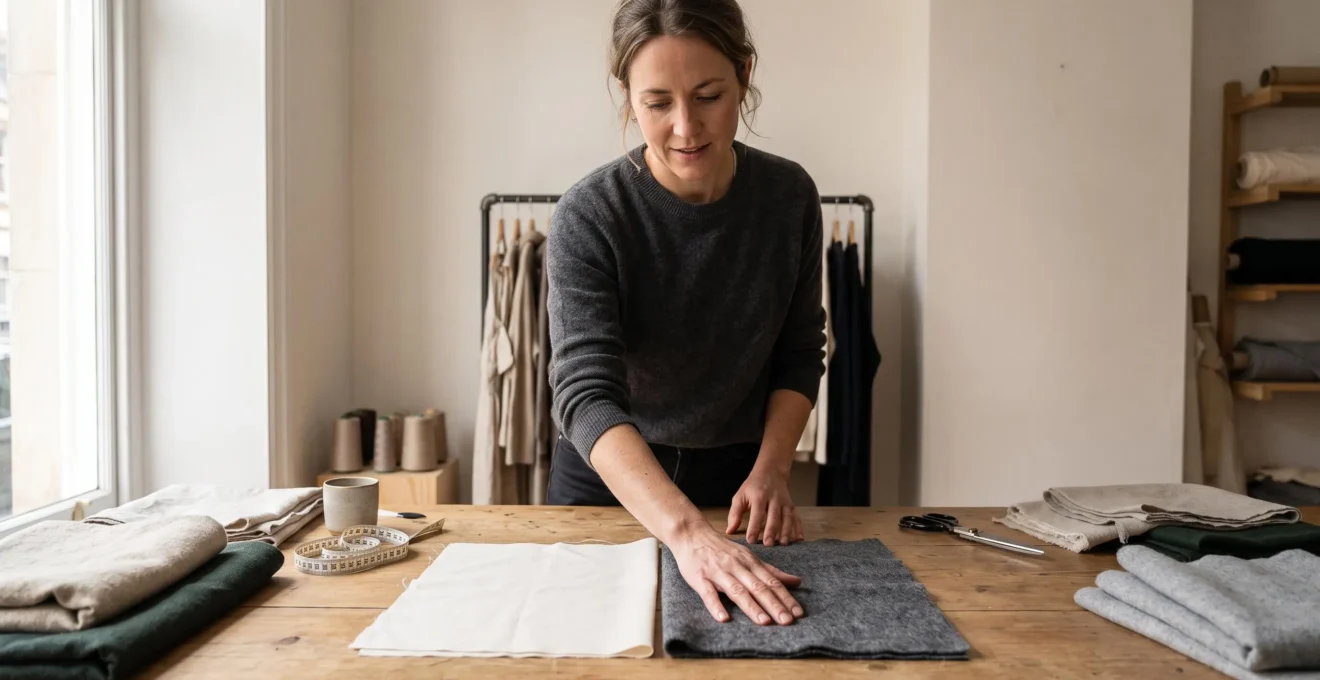
Personal style does not have to announce itself through prominent logos, dramatic prints or a wardrobe that changes with every season. Sometimes the most distinctive thing about an outfit is the fabric: a crisp cotton shirt against softened denim, a fluid wool trouser beneath a structured jacket, or a subtle sheen that catches the light only when you move.
Fabric choice communicates style through texture, drape, surface finish and colour. These details influence how clothing sits on your body, responds to light and feels throughout the day. They can make familiar silhouettes appear more deliberate without making an outfit feel overly constructed.
The trick is not to buy the most expensive material or restrict yourself to natural fibres. It is to understand which fabrics suit your skin, routine, proportions and existing clothes. A distinctive wardrobe becomes easier to build when each purchase has a practical purpose as well as an aesthetic one.
That means examining fabrics beyond their labels, testing how they behave in motion and recognising when an interesting material deserves a place in your everyday rotation.
Fabric-first personal style: the essentials
- Use controlled texture contrasts and restrained finishes to make simple outfits feel individual without prominent branding.
- Choose materials according to comfort, recovery, drape and maintenance rather than fibre names or price alone.
- Before buying, test how a garment moves, check whether it works with your existing wardrobe and consider how often you will genuinely wear it.
- Why Does Fabric Texture Change How « Put-Together » You Look in 5 Seconds?
- How to Build a Fabric Palette If You Hate Itching, Overheating, and Ironing?
- Matte or Sheen: Which Fabric Finish Looks More Expensive Under Office Lighting?
- The Fabric Choice That Makes a Great Outfit Look 2 Sizes Wrong After 10 Minutes
- When Should You Buy a « Statement Fabric » So It Doesn’t Sit Unworn for 9 Months?
- How to Evaluate a « Premium » Fabric Label in 3 Checks When You Can’t Touch It Online?
- Modern Blend or 100% Natural: Which Works Better for Crease-Free Travel Days?
- How Do You Judge Premium Textiles Without Falling for Price-Tag Theatre?
Why Does Fabric Texture Change How « Put-Together » You Look in 5 Seconds?
Fabric texture can make an outfit look more deliberate because its surface changes how light falls across the garment. Smooth, even materials often create a cleaner visual impression, while brushed, irregular or visibly pilled surfaces introduce softness or visual complexity. Neither is automatically better: the effect depends on the garment, its condition and the textures surrounding it.
Think of two otherwise similar navy jumpers. One has a fine, compact knit with an even surface. The other has a loose, fluffy structure. The first may communicate restraint and precision; the second may suggest warmth and ease. Both can look stylish, but they express different personalities before any logo or decorative detail enters the picture.
Texture also helps distinguish intentional softness from wear-related deterioration. A deliberately brushed wool surface is not the same as unwanted pilling, which can disturb an otherwise even finish. CottonWorks‘ technical resource on garment durability explains how abrasion resistance, fabric strength and pilling contribute to garment performance over repeated wear and washing.
These technical characteristics do not establish a universal rule about what looks expensive. They do explain why the surface of a garment can change noticeably during its useful life.
Start with one dominant texture and one contrasting texture. A crisp poplin shirt alongside brushed denim creates a clear difference between smooth and soft. Fine wool trousers with a chunky cardigan work for a similar reason: each material has a distinct visual role.
By comparison, combining several similarly weighted, slightly textured fabrics can leave an outfit without a clear focal point. It is not necessarily wrong, but it requires more attention to proportion and colour.
Texture is also an understated alternative to conspicuous prints. A charcoal bouclé jacket or softly ribbed jumper introduces character while remaining easy to combine with plain pieces. The effect can feel personal without demanding attention.
To identify your own preferences, compare five garments you wear regularly with five you rarely choose. Run your hand over each one, looking for patterns in surface softness, stiffness, weight and pilling. Perhaps you repeatedly favour compact knits and avoid scratchy, loosely woven materials. That observation is more useful than copying another person’s fabric preferences.
Once you know which surfaces appeal to you, the next question is whether they remain comfortable enough for real life.
How to Build a Fabric Palette If You Hate Itching, Overheating, and Ironing?
Build your fabric palette around the sensations and maintenance demands you cannot tolerate. If itching, overheating and ironing regularly stop you wearing otherwise attractive clothes, those constraints should determine which materials enter your wardrobe. Choose a small selection of fabrics that satisfy your comfort requirements, then refine their colours, textures and structure to express your style.
Start by ranking your three biggest frustrations. Someone who spends long days on trains and in heated offices may prioritise temperature comfort and crease recovery. Someone with easily irritated skin may care more about surface smoothness and seams.
Then compare potential materials according to what you actually need:
- For a smoother feel: lyocell and modal fabrics can have a soft, fluid surface, although finishing, seams and individual skin sensitivity still matter.
- For managing warmth: lightweight wool fabrics and some linen-cotton mixtures are worth trying, with garment weight, openness and layering influencing the result.
- For fewer visible creases: resilient knit constructions, including certain ponte fabrics, may be more forgiving than crisp lightweight woven materials.
There is an important distinction between fibre and structure. Cotton describes a fibre; jersey, poplin and twill describe different fabric constructions. A cotton jersey T-shirt can stretch and follow the body, while a cotton poplin shirt usually holds a more defined outline.
The same reasoning applies to wool. Woolmark‘s explanation of wool fibre properties describes how natural crimp contributes to elasticity, shape recovery and moisture management. Finer Merino fibres may feel less prickly than coarser fibres, but that does not mean every wool garment is comfortable for every wearer.
Someone who dislikes a coarse wool jumper may still enjoy fine-gauge Merino in a different construction. Test the finished garment rather than rejecting or accepting every fabric bearing the same fibre name.
Comfort can also compromise the appearance you want. An exceptionally soft, fluid jersey might be ideal at home but feel too relaxed for a structured workplace outfit.
A practical solution is a two-tier fabric palette. Keep relaxed materials, such as soft jersey and brushed cotton, for casual clothing. Use compact knits, well-balanced twills and more structured fabrics for occasions requiring sharper lines. Repeat the same navy, stone, charcoal or other preferred colours across both tiers.
With those practical boundaries in place, surface finish becomes a more reliable styling choice rather than another source of regret.
Matte or Sheen: Which Fabric Finish Looks More Expensive Under Office Lighting?
Matte fabrics are often easier to style discreetly under office lighting, while subtle lustre can add refinement when used selectively. High-shine finishes reflect more concentrated light and may become visually dominant beneath overhead LEDs. The most effective choice depends on the lighting, garment proportions and workplace expectations, not on a universal relationship between shine and quality.
Office lighting can be unforgiving because strong overhead illumination produces highlights in places you might not notice at home. A lustrous blouse can look restrained near a daylight window yet appear much brighter under cool-toned artificial lighting.
It helps to think of finish as a spectrum rather than a simple matte-versus-shiny choice.
| Finish | Typical visual effect | Practical styling approach |
|---|---|---|
| Full matte | Soft, diffuse reflection; understated appearance | Use for large garments such as trousers, jackets and coats |
| Subtle lustre | Gentle highlights that change with movement | Try fine gabardine or a softly lustrous blouse with matte separates |
| High shine | Stronger reflections and greater visual emphasis | Introduce selectively through smaller garments or accessories |
Fabric names alone do not guarantee a particular sheen. Raw silk can vary in surface character, while satin describes a weave that may be produced from different fibres with different degrees of shine. Finishing treatments can also alter reflectivity.
For an understated outfit, try a matte jacket over a gently lustrous blouse. The jacket establishes the visual structure, while the blouse introduces movement and contrast without dominating the entire silhouette.
The scale of the shiny surface matters as much as the intensity. A full-length satin skirt creates a very different impression from a narrow lustrous trim. As a starting experiment, keep most of an outfit matte and limit stronger shine to one smaller area. This is a styling guideline, not a measured proportion that works for everyone.
To make the decision more objective, photograph the garment under lighting similar to your workplace. Compare it with how it looks in daylight and under warmer evening illumination. Check whether reflections obscure its colour, emphasise folds or distract from the shape you want.
Even a beautifully balanced finish will be undermined if the underlying fabric cannot maintain the garment’s shape throughout the day.
The Fabric Choice That Makes a Great Outfit Look 2 Sizes Wrong After 10 Minutes
A garment can appear to fit perfectly in the changing room and look noticeably different after sitting, walking or bending if its fabric has poor shape recovery. Loose constructions, unstable knits and materials that stretch without returning can create bagging or distortion. The problem is not necessarily the labelled size: it may be the interaction between fibre, construction, cut and movement.
Imagine a pair of trousers that sits neatly at the knee when you stand still. After a period of sitting, the fabric remains stretched and forms a visible pouch. The trousers may now look larger or less tailored, even though the waistband and original measurements have not changed.
Elastane content alone does not solve this. Recovery depends on the complete fabric construction, the behaviour of the constituent fibres and the stresses placed on the garment. Some fabrics without elastane recover well; others containing a small amount may still lose shape.
Drape is the other hidden variable. Stiff cloth may project away from the body, creating volume even in the correct size. Fluid material may fall closer to the body and reveal underlying lines. The appropriate choice depends on the intended silhouette.
A boxy jacket may benefit from fabric that holds structure. The same stiffness in a garment designed to flow around the body could make it appear awkwardly oversized. Conversely, very fluid cloth can undermine the architectural lines of a tailored piece.
When trying on clothes, spend several minutes testing the movements they will encounter in daily use. Sit down, reach overhead, bend your knees and walk a short distance. If possible, use a few stairs. Then inspect the garment again rather than relying on the first mirror impression.
Look for knees that remain baggy, a waistband that shifts, a back that gaps or a hem that rides up and fails to settle. A short fitting-room test cannot establish long-term durability, but it can reveal immediate problems that standing still conceals.
Care matters as well. Some garments may change dimensions or shape during laundering, depending on their fabric, construction and finishing. Read the garment-specific instructions before purchasing, especially when the intended care routine conflicts with your available time or budget.
The words « dry clean only » describe a maintenance restriction, not an automatic indication of superior quality. A garment that requires care you cannot realistically provide is unlikely to remain a dependable wardrobe favourite.
A garment that keeps its intended shape is easier to wear repeatedly, which also makes more adventurous fabric choices less risky.
When Should You Buy a « Statement Fabric » So It Doesn’t Sit Unworn for 9 Months?
Buy a statement fabric when you can already identify several ways to wear it using clothes you own, and when a realistic occasion falls within the next couple of months. Distinctive fabrics are more useful when they extend an established wardrobe rather than demand an entirely new one. Texture-led statements are often easier to integrate than highly saturated colours or bold prints.
A statement fabric does not have to be dramatic. Bouclé, brushed mohair, metallic thread, pronounced ribbing or richly textured velvet can provide interest even in otherwise restrained colours.
Consider a neutral bouclé jacket. It might work with dark denim, tailored black trousers and a plain cotton skirt. A highly reflective coloured jacket could be equally compelling, but its combinations may require more thought.
Use the three-pairing rule: before purchasing, identify three solid, predominantly matte pieces already in your wardrobe that genuinely work with the proposed statement fabric. Try to name complete outfits rather than assuming combinations will appear later.
Timing matters. An interesting winter fabric purchased at the end of the season may remain unused for months. If you already know the kind of event or daily setting in which you would wear it, buying earlier in the relevant season gives the piece more opportunities to justify its place.
A useful personal rule is to name a plausible first wear within two months. If no occasion comes to mind, delay the purchase. This is a purchasing discipline, not a prediction of how often any particular garment will be worn.
Statement fabrics already sitting unworn can often be rescued by changing the surrounding outfit. A sequin skirt may feel excessive with a matching shiny top but more relaxed with a plain cotton T-shirt. A metallic blouse can become less conspicuous beneath a structured matte blazer.
In both cases, quieter fabrics reduce the visual competition. Instead of asking every garment to make a statement, give the most interesting material room to speak.
Once a fabric earns its place in your wardrobe, the next challenge is assessing its quality when you cannot inspect it in person.
How to Evaluate a « Premium » Fabric Label in 3 Checks When You Can’t Touch It Online?
Evaluate a premium textile listing through three checks: fibre composition, fabric construction and independent-looking evidence of real use. A persuasive label is not enough. Percentages help establish what the material contains, weave and weight indicate how it may behave, and customer photographs and repeated complaints can reveal issues that polished product photography does not show.
Check 1: read the actual composition. Look for specific fibre names and percentages rather than vague descriptions such as « premium blend ». A garment advertised as containing Merino wool or extra-long-staple cotton should provide enough information to understand the relevant composition.
For reference, the FTC‘s textile and wool labelling guidance explains that covered US textile products generally identify constituent fibres by weight in descending order of predominance. Those are US requirements, not a universal statement of UK law.
For UK shoppers, the practical lesson is to inspect the disclosed fibre composition rather than treat promotional adjectives as objective fabric grades. Even a high proportion of an attractive fibre cannot establish the quality of weaving, finishing or garment construction.
Check 2: investigate weave, knit and weight. GSM means grams per square metre and describes fabric mass relative to area. Higher GSM usually indicates greater mass per unit area, but not necessarily better quality, softness or durability.
A lightweight poplin may be desirable for a sharp summer shirt, while a substantially heavier material may better support a structured overshirt. Neither should be judged against the other’s intended purpose.
Named constructions also help. Twill often shows a diagonal pattern, jersey is a knitted structure and poplin is typically a relatively fine plain-weave fabric. Compare the listing with garments you already enjoy wearing. Where a retailer publishes GSM, use it alongside construction and fibre information, not as a standalone quality score.
Check 3: look beyond the studio photographs. Examine customer images, especially where they show the fabric in natural light or after wear. Read critical reviews for repeated references to unexpected transparency, pilling, uncomfortable texture, shrinkage or distortion.
Check whether the seller identifies a fabric mill, manufacturing origin or relevant technical characteristics. Those details may support transparency, although none automatically proves superior quality. A named manufacturer can still produce fabrics for different performance requirements and price points.
On arrival, inspect the garment promptly in natural light. Check its surface, stitching, recovery and care instructions, then try it on with the pieces you intend to wear alongside it. Do not wash or alter it before checking the retailer’s return conditions: doing so may affect your ability to return it.
A genuine wear-and-wash evaluation is useful for deciding whether to buy the same material again, but it should not be confused with a risk-free return-window test.
Your five-step online fabric buying checklist
- Record the complete fibre composition and percentages, creating a comparable specification for the garment.
- Note the stated weave or knit, GSM if supplied, and intended structure, producing a short description of expected drape.
- Save two relevant customer photographs and summarise recurring complaints about fabric behaviour.
- Read the care instructions and return conditions, recording any maintenance or return restrictions before ordering.
- On delivery, inspect the garment, try it with three existing pieces and write a keep-or-return decision before removing labels or washing it.
These habits also make shopping for travel clothing easier, where the wrong material can reveal its weaknesses within a single journey.
Modern Blend or 100% Natural: Which Works Better for Crease-Free Travel Days?
Neither modern blends nor entirely natural fabrics are automatically better for crease-free travel. Wrinkle resistance depends on elasticity, yarn structure, fabric construction and finishing. A resilient polyester-blend ponte may perform well after hours of sitting, while a knitted Merino garment can also recover effectively. A loosely woven pure linen item may crease more visibly, regardless of its quality.
The important question is not simply whether a fabric is natural. It is whether the finished garment can recover from compression, remain comfortable and look appropriate when you reach your destination.
Consider two common travel situations.
| Travel situation | Useful fabric characteristics | Potential trade-offs |
|---|---|---|
| Long flight followed by a meeting | Good recovery, stable structure, limited visible creasing | Dense or poorly ventilated fabrics may feel warm |
| Several days with laundry access | Comfortable, washable materials suited to the climate | Some fabrics need drying time or pressing |
| Mixed business and leisure travel | Versatile fabrics that layer well and retain their shape | One material may not suit every temperature or activity |
Some polyester-rich blends offer useful crease resistance, particularly when their construction is engineered to maintain shape. However, fibre composition alone does not establish breathability or odour performance. The weave, thickness, moisture management and garment design matter too.
Natural fibres have their own advantages and compromises. Wool’s elastic structure can support wrinkle recovery, whereas linen is often chosen partly for its characteristic creased appearance. Viscose fabrics vary substantially according to construction and finishing.
Steaming is not a guaranteed solution. Heat and moisture requirements differ, and certain materials or finishes may be damaged by inappropriate treatment. Check care instructions before attempting to remove travel creases.
A useful strategy is to separate travel-day clothing from destination clothing. Choose garments with reliable recovery for prolonged sitting, then pack more relaxed or crease-prone fabrics for occasions when you can change, wash or press them.
Before a trip, try a simple home comparison: roll two suitable garments and leave them overnight, then inspect how each recovers after being unrolled. This informal experiment cannot reproduce an aircraft journey or laboratory wrinkle testing, but it can reveal a meaningful difference between items you already own.
Pay attention to the location of creases as well as their depth. Wrinkles around knees, seat and elbows may be more noticeable in tailored garments than in relaxed shapes with deliberate texture.
The same performance-based thinking helps separate genuinely valuable textiles from expensive garments that rely on branding more than substance.
What matters before paying more
- Choose materials for the way they perform in the garments you actually wear, not for their prestige alone.
- Evaluate construction, surface stability and maintenance requirements as well as fibre content.
- Estimate realistic use before deciding whether a higher purchase price represents better value.
How Do You Judge Premium Textiles Without Falling for Price-Tag Theatre?
Judge premium textiles by their construction, intended performance, comfort and likely usefulness rather than the price tag or brand presentation. Expensive fibres and skilled finishing can justify additional cost, but logos, exclusivity messaging and elaborate packaging do not independently prove fabric quality. A less expensive garment may deliver better value when it maintains its shape and is worn frequently.
Price can be an appealing shortcut. A garment displayed in a beautifully designed boutique, described as limited edition and presented in elaborate packaging may feel more exceptional before anyone has examined the textile itself.
That impression is not necessarily deceptive. It simply combines several different forms of value: design, identity, presentation, distribution and the physical garment. A careful buyer separates them.
Some costs have a genuine material basis. Fibre selection, yarn preparation, specialised finishing processes, manufacturing complexity and quality-control practices can all influence production requirements.
Other price influences, including marketing campaigns, prominent branding and celebrity associations, may contribute to perceived desirability without revealing how the fabric will withstand regular wear.
When shopping in person, conduct a brief quality audit. Hold an appropriate section of fabric towards the light and inspect the consistency of its construction. Uneven areas may deserve closer attention, although visible openness is intentional in some lightweight and decorative textiles. A good fabric is not necessarily an opaque fabric.
Gently examine the surface for loose fibres or existing pilling. Stretch a small suitable area only where doing so will not damage the garment, and observe whether it returns to shape. Inspect seams, edges and the way the garment hangs.
These checks are useful for identifying obvious problems, but they are not substitutes for standardised testing. A quick rub cannot reliably predict long-term pilling, and tightly packed fibres do not automatically guarantee superior durability.
Care labels add another layer of information. The US Federal Trade Commission’s guidance on clothing care labels explains that covered manufacturers must have a reasonable basis for their care instructions, including restrictions involving dry cleaning. The guidance is specific to US regulation, but the consumer principle is broader: maintenance requirements should influence a purchase decision rather than being mistaken for proof of luxury.
Cost per wear provides a useful final comparison. Divide the purchase price by the number of times you realistically expect to wear the garment over a defined period.
Illustrative example: comparing cost per wear
Consider two hypothetical garments. A £120 pair of trousers worn 40 times over a year costs £3 per wear. A £240 statement skirt worn four times over the same period costs £60 per wear.
These figures are hypothetical, not market averages or measured garment lifespans. They demonstrate how wearing frequency can matter more than the initial price. Cost per wear also changes as ownership continues and does not capture every benefit, including enjoyment or personal significance.
To estimate realistic frequency, look at similar garments already in your wardrobe. If you wear tailored trousers every week but rarely choose occasion skirts, that habit provides a better starting point than an optimistic forecast made during a sale.
Price can still be worth paying for excellent design, distinctive craftsmanship or a material you genuinely love. The point is to know what you are purchasing rather than assuming that cost alone establishes superior quality.
For your next purchase, choose one garment you already wear frequently, identify what makes its fabric successful, and use those characteristics as your benchmark. Building personal style this way replaces trend-chasing with more considered choices.
Can inexpensive fabrics still make an outfit look sophisticated?
Yes. An inexpensive garment can look refined when its fabric suits the cut, holds its intended shape and works with the surrounding textures. Good fit, appropriate care and deliberate combinations matter more to the overall effect than price alone. However, appearance at purchase does not guarantee long-term fabric durability.
Should every fabric in a capsule wardrobe have the same texture?
No. A capsule wardrobe benefits from controlled variety. Smooth cotton, fine knits, textured wool and denim can all work together when they share compatible colours and silhouettes. Keeping a few dominant textures makes mixing easier without making every outfit look identical.
Does a higher percentage of natural fibres guarantee better quality?
No. Fibre percentages identify composition, not the quality of spinning, weaving, knitting or finishing. A carefully constructed blend may perform better for a particular purpose than a poorly constructed fabric made entirely from natural fibres. Compare the finished material against your requirements for comfort, drape, recovery and care.
How can you keep a minimalist wardrobe from looking plain?
Introduce contrast through fabric surfaces rather than adding more colours or decorative elements. Try fine wool with brushed denim, crisp cotton with a softly textured knit, or a subtle lustre beneath a matte jacket. These combinations create depth while preserving a restrained overall appearance.
What should you do when a favourite garment starts pilling?
Check the care instructions before removing pills with a suitable fabric comb or debobbler, using gentle pressure and testing an inconspicuous area first. Avoid pulling pills by hand if doing so could damage the fabric. Pilling can result from friction and fibre behaviour; it does not automatically mean a garment was cheap or poorly made.